Showing posts with label RSV-2CE. Show all posts

Monday, April 23, 2018

Guest Post: One Approved Translation per Territory (w/ Fr. Neil)


Given some confusion in the discussion about the possibility of using the RNJB as the basis of a new Lectionary, I thought it might be helpful to explain a little the current rationale of having only one Biblical translation per language per bishops’ conference.  So that, for example, the Bishops’ Conference of Canada is welcome to have one Bible translation for their French Lectionary and another for their English, but is not allowed to use both the NRSV and the NAB and have two English language Lectionaries.

Immediately after Vatican II, the Congregation for Divine Worship (CDW) in Rome approved multiple lectionaries for the same region. So that in the United States three lectionaries were approved: The Jerusalem Bible, The New American Bible and the Revised Standard Version. In Ireland, England & Wales and Scotland, the Jerusalem Bible and the Revised Standard Version were both approved.  I am not sure which translations were approved in other regions. When the current US Lectionary that uses an adaptation of a revision (of a revision) of the New American Bible was approved in 1998 and 2001 the United States Conference of Catholic Bishops themselves withdrew permission to use the three older Lectionaries (JB, RSV and NAB 1st ed.).

In 2001 the CDW published Liturgiam Authenticam the Fifth Instruction “for the Right Implementation of the Constitution on the Sacred Liturgy of the Second Vatican Council.”

This instruction radically transformed the translation philosophy of the Catholic Church. In number 36 this document says:

36. In order that the faithful may be able to commit to memory at least the more important texts of the Sacred Scriptures and be formed by them even in their private prayer, it is of the greatest importance that the translation of the Sacred Scriptures intended for liturgical use be characterized by a certain uniformity and stability, such that in every territory there should exist only one approved translation, which will be employed in all parts of the various liturgical books. This stability is especially to be desired in the translation of the Sacred Books of more frequent use, such as the Psalter, which is the fundamental prayer book of the Christian people. The Conferences of Bishops are strongly encouraged to provide for the commissioning and publication in their territories of an integral translation of the Sacred Scriptures intended for the private study and reading of the faithful, which corresponds in every part to the text that is used in the Sacred Liturgy.

This desire for a single translation was not retroactive.  But when any new liturgical book was approved in a region, permission to use any older translations was automatically withdrawn. However, in Ireland while the JB Lectionary is basically the only Lectionary used at the parish level, the current JB Lectionary pre-dates 2001, so the 1970 RSV Lectionary is still approved for use. However if a new Lectionary was approved for use in Ireland, the JB and the RSV would automatically be withdrawn.   

So from a technical point of view, the fact that the CDW has approved a Lectionary for one region, that permission does not carry to other countries. So if a RNJB Lectionary was approved in Ireland, technically it could not be used in a celebration in the U.S. This can be seen, for example, in the case of the RSV. Ignatius Press prepared a Lectionary based on their own edition of the RSV (The Second Catholic Edition). This was approved as the Lectionary in the Antilles. However many US parishes considered adopting it.  In the April 2006 edition of the Newsletter of the Committee on the Liturgy of the USCCB carried this clarification:

Approved Editions of the Lectioanry for Mass
The Secretariat has recently received many inquiries concerning the use of an edition of the Lectionary for Mass based on the Revised Standard Version of the Scriptures and available from Ignatius Press. This Lectionary has not been approved for use in the Dioceses of the United States of America. Only the New American Bible edition of the Lectionary for Mass, published in 1998 and 2001 may be used at celebration of the Liturgy in this country.

However, as I noted in my original post, Pope Francis has officially said that the translation principals of Liturgiam Authenticam are to be revised. So it is possible that a bishops’ conference could ask for more than one Lectionary to be used at the same time. There is no way to know what the guidelines that replace Liturgiam Authenticam will say in this regard. I personally hope that they will allow the bishops to make a pastoral decision that best suits their region. Although it is also worth noting that the market forces of printing Lectionaries, hand missals, devotional books, worship aids, etc. make it impractical to have too many editions in use in a given area.

At the end of the day, if the bishops ask for a particular liturgical bool to be recognized, the CDW may well grant their request. This is the case in English-speaking Africa. They use a 2012 edition of the RSV Lectionary (which form their website looks very like the Ignatius Press Lectionary and a 2009 edition of the Liturgy of the Hours, that uses the New American Bible. Surely Liturgiam Autheticam 36 mandated that they use one translation for these liturgical books that are boith almost entirely composed of scripture passages and published within 3 years of each other, and which must have been in preparation at the same time. This shows that even before Pope Francis said that Liturgiam Authenticam was no longer fit for purpose, during the time-period when many liturgists thought that the CDW was being very inflexible in their supervision of liturgical translation, that it was still possible to have more than one Scripture in use in a given region.


Neil Xavier O'Donoghue is a priest of the Archdiocese of Newark, New Jersey. He currently ministers in the Archdiocese of Armagh, Ireland, where he serves as vice rector at Redemptoris Mater Seminary. He has studied at Seton Hall University, the University of Notre Dame, and St Vladimir’s Orthodox Theological Seminary. He holds a Doctorate in Theology from St Patrick’s College, Maynooth.

Thursday, December 21, 2017

Guest Review: Augustine Institute's Bible in a Year

Thanks to Jason for providing this guest review!

When the Augustine Institute announced earlier this year that they were producing a new Bible in a Year with daily commentary and in a leather-bound edition, I pre-ordered it immediately. I’m a big fan of editions of the complete Bible arranged in daily readings. They are prevalent in Protestant editions, but Catholic ones are harder to come by. The One-Year Bible, which was first published with the NLT text and later with other translations, is the gold standard, arranging the readings with a little OT, NT, and Psalms/Wisdom literature read each day. 


To my knowledge, the only Catholic contender until now has been My Daily Catholic Bible from Our Sunday Visitor, which has been published in RSV-CE and NAB editions. It has some nice features, such as a quote from either the saint of the day or another saint speaking about the day’s feast or about the Scriptures. It also gives you readings from the OT and NT each day, although the wisdom literature is included in the OT, as opposed to being a third reading on its own. I felt at times that the readings were quite uneven in length from day to day, though I haven’t done a close study to confirm that. Also, the only binding available is paperback.


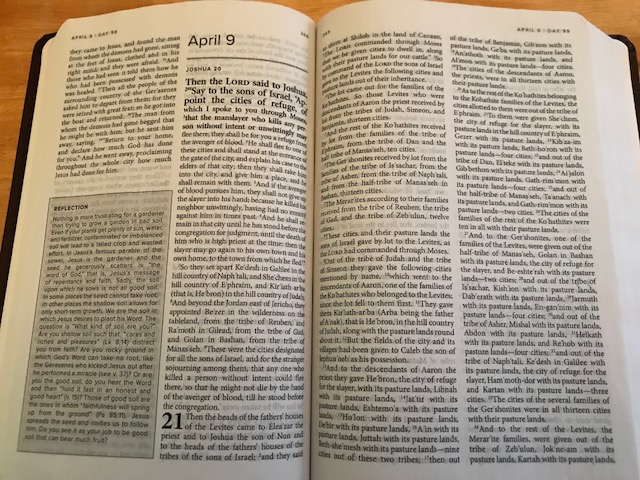
The Augustine Institute’s Bible in a Year (RSV-2CE) is also available in paperback, but for a bit higher price a leather edition is also available. This latter edition you can see in the photos. Though I’m not an expert with leather, it is almost certainly bonded, so far from premium (despite the publisher’s description), but it has a great size and weight. It’s glued instead of sewn, which is easily the biggest knock against it at a $50 price point. The paper is white with clear dark text. There is some ghosting but it appears to be line-matched, and it is very comfortable to read. I’m not sure about the type size, but it appears to be the same as the standard Ignatius RSV-2CE. With the bright white paper and darker text, though, I think it’s easier to read than the Ignatius edition. There is one yellow ribbon, which is perfect for this type of Bible.


As for the content, this is every bit the equal of The One-Year Bible. Each day has a manageable reading from the OT, a short reading from the Psalms or Wisdom lit, an NT reading, and a closing reflection. This really is an ideal way to read the Bible in a year. Flipping through the volume, it appears that each OT reading is a bit over two full pages, and seems more or less consistent. Each of the three sections reads through in (RSV-CE) canonical order (Genesis-2 Maccabees, Psalms-Song, Matthew-Revelation). This is perhaps my one disappointment in the layout. Why not spread the Gospels out over the course of the year, reading the epistles in between? But this is a minor quibble. The daily reflections are, as you can see from the photos, the length of a long paragraph and provide a bit of background and give you something, in the form of a closing question, to think about in light of the day’s readings.  All in all, I think this is an excellent resource.

One closing note: I ordered this in October and just received it in on December 20. They sent out an email saying they had printing issues which delayed the first pre-orders being shipped until now. If you notice on the order page now, it warns that new orders won’t ship until late January. So, be aware that getting one before January 1 is likely impossible.


Thursday, October 19, 2017

Bible in a Year: Your Daily Encounter with God

Description:
It’s a mountaintop experience if you can open up the Word of God. It’s majestic, it’s beautiful, it’s breathtaking. It gets us out of our day-to-day and into God.


The simple format of this premium, leather-bound version of Bible in a Year will keep you engaged as you make your way through all 73 books of the Bible.


Commentaries are written by renowned Catholic biblical scholars and theologians, including Dr. Tim Gray, Dr. Mark Giszczak, Dr. John Sehorn, Dr. Scott Powell, Dr. Michael Morris, Dr. Elizabeth Klein, and Deborah Holiday. 


• Each day features three readings, one each from the Old Testament, Wisdom Literature, and the New Testament 
• Insightful daily reflections are written by leading theologians to facilitate deeper meditation and encounter with God through his Word 
• Revised Standard Version of the Bible – Second Catholic Edition


This beautiful, leather-bound book is a perfect gift for any occasion!  (It is also available in a paperback edition.)  


Thanks to John and Chris for alerting me to this new edition, which will be released at the beginning of Advent.  More info can be found here.  The also have a sample which you can see here.  This is a product of the Augustine Institute.

Monday, June 19, 2017

The Slow Trickle Continues........

Thanks to Emilia for spotting this!  Due to be published October 10th.

Description:
Ignatius Catholic Study Bible: 1&2 Kings
This volume in the popular Ignatius Catholic Study Bible series leads readers through a penetrating study of the First and Second Books of Kings using the biblical text itself and the Church's own guidelines for understanding the Bible.

Ample notes accompany each page, providing fresh insights by renowned Bible teachers Scott Hahn and Curtis Mitch as well as time-tested interpretations from the Fathers of the Church. These helpful study notes provide rich historical, cultural, geographical, and theological information pertinent to the Old Testament book information that bridges the distance between the biblical world and our own.

The Ignatius Catholic Study Bible also includes Topical Essays, Word Studies, and Charts. The Topical Essays explore the major themes of 1 & 2 Kings, often relating them to the teachings of the Church. The Word Studies explain the background of important biblical terms, while the Charts summarize crucial biblical information "at a glance".

Tuesday, May 30, 2017

Guest Review: Ignatius New Testament and Psalms RSV-2CE

Thank you to Chris for this guest review.


Because I travel a lot for work, I often rely on the Catholic Study Bible app from Ignatius Press and the Augustine Institute. Phone batteries, however, drain fast. So when the Holy Father recommended in March that Catholics should put down their phones, talk to each other more, and carry a pocket New Testament to read, I began looking for one of my own.

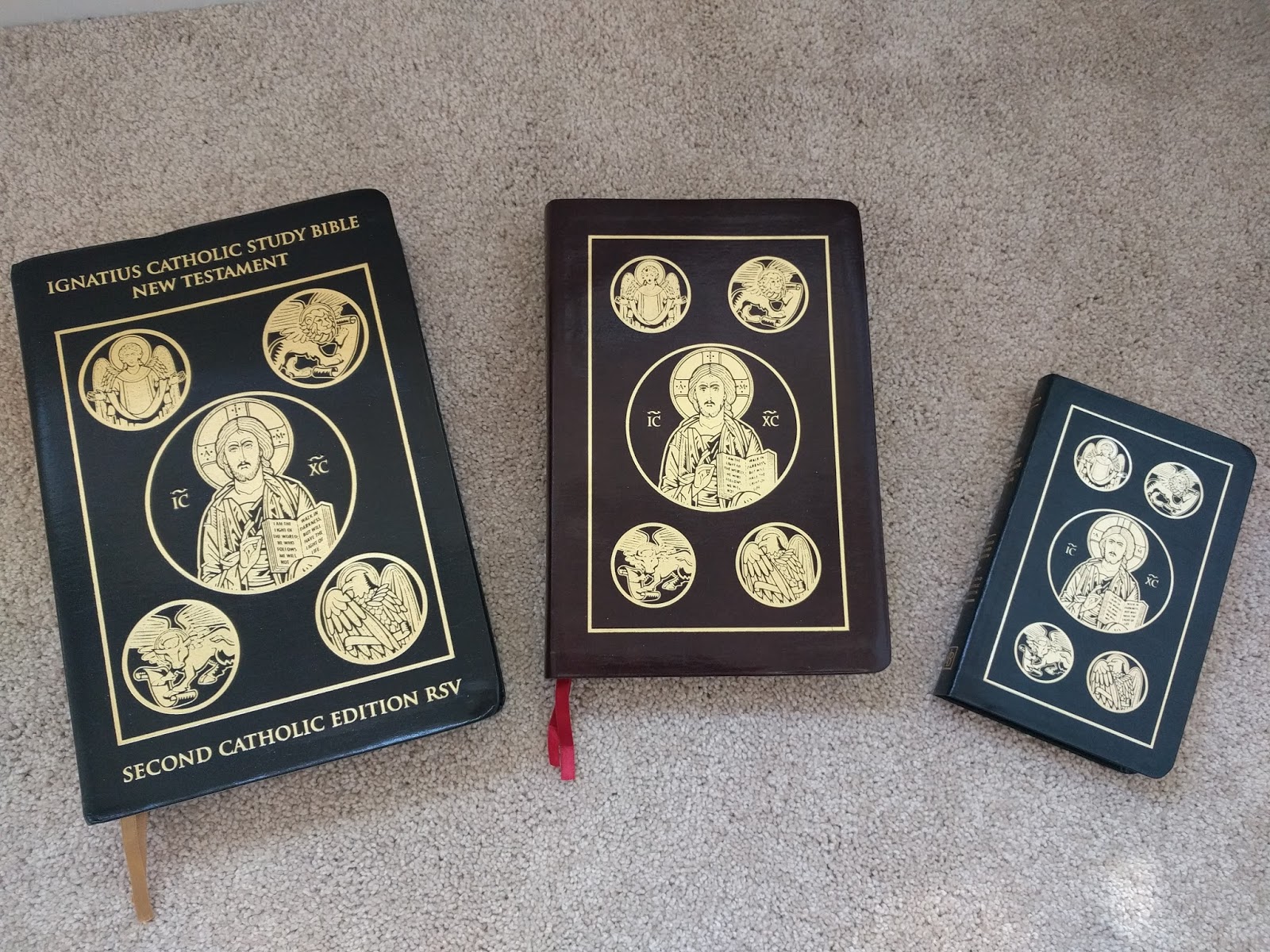
The Ignatius New Testament and Psalms (RSV-2CE) has a lot going for it, not the least of which is its size. Here you can see it alongside the standard Ignatius Bible and Ignatius Study Bible New Testament for comparison. It’s much smaller, and thus perfectly suited for a travel edition.


At basically 4” x 6” it’s extremely easy to stuff in the front pouch of my work satchel, along with the small moleskine journal I use to keep notes and draft poetry.


It’s also a match in size for Christian Prayer and the Liturgy of the Hours, so if you travel with that, it’s a good companion.


Obviously, reducing the size requires a different typesetting than the standard edition. The 9/10 font size used in this little volume is still easy to read, while maximizing space even in a dual-column layout. Subsection titles stand out from the text of scripture in an easy-to-read sans serif font.


It has some additional features that I like, including two ribbon markers (at least in the leather edition), a preface from Albert Cardinal Meyer, Archbishop of Chicago, and introductions to both the New Testament and the Psalms. It even reprints the original 1965 letter from Richard Cardinal Cushing, Archbishop of Boston to the Catholic Biblical Association of Great Britain who produced the original RSV Catholic Edition.


I can understand not including a copy of Dei Verbum in the interest of keeping the volume compact, but I really would have appreciated a lectionary calendar of daily mass readings. Sadly, in order to maximize the amount of scripture on each page, the explanatory notes are printed in an appendix rather than inline with the text, similar to the way Oxford handles them in its RSV-CE compact volume.


The most distinguishing feature of Ignatius’ RSV Second Catholic Edition is the way it addresses the criticisms of the Catholic NRSV by simply removing archaic verbs and pronouns from the original Catholic RSV and adjusting some vocabulary for liturgical considerations. It’s in a volume like this where those characteristics stand out the most: it’s in the Psalms where the original RSV maintained the archaic addresses to God, and the New Testament is where a lot of the changes required by Liturgiam authenticam occur. Even more than a full Bible, this New Testament and Psalms has the feel of a Catholic ESV.

For lack of a better description, it’s actually a rugged, “manly” little volume, rather like the one used on the Catholic Gentleman blog to model their rugged rosaries. It’s the Catholic answer to those little NT and Psalms the Gideons used to pass out in front of my high school. I recommend it highly.

Christopher Buckley holds an M.A. in Religion from the Claremont School of Theology. He began as a United Methodist and passed through the Episcopal Church before being confirmed into the Catholic Church as an adult. He lives and works in Seattle with his wife and two children, and blogs occasionally at StoryWiseGuy.com. Connect with him on Twitter, Google+, Pinterest, Flickr, and LinkedIn.

Monday, March 13, 2017

All Didache Bibles on Sale at MTF

Thanks to Eric for pointing out that all Didache Bibles (both the RSV-2CE and NABRE) are on sale at Midwest Theological Forum.  Follow this link for more information.  You can preview the content of the Didache Bible here.

Wednesday, April 27, 2016

Guest Post: Would an ESV-CE kill the RSV-CE?

Thanks to Gerald for this post.

It came rather as a surprise to Catholics that ESV was for consideration for the English language Lectionary when the NRSV-based lectionary was dropped from the table by the International Committee of the English Language (ICEL) in view of the changes brought by Liturgiam Authenticam. This project was deemed necessary to complement the more literal changes to the Roman Missal.

And from then on, some Catholics have been eager for a consequent ESV-Catholic Edition. Many spectators believed that it would be a challenge given the failure with the negotiations with NCC for the NRSV, the ESV would likely to pose more difficulties, knowing Crossway.  Now that the ESV lectionary project had been pronounced dead by the ICEL, it leaves the hypothetical question: "Should the ESV lectionary project and an ESV-CE became a success, would it kill the demand the demand for the RSV-CE?"

In this post, I will offer both sides of the coin of what could had happened to the Catholic world if ESV-CE penetrates the elusive arena of Catholic Bible market.

* YES, IT COULD REPLACE THE RSV-CE.
1. ESV corrected some of the "un-Christian" renderings in the Old Testament without looking at light from the New Testament, usually in the more scholarly critical path, bearing the RSV "liberal" in many Protestant circles. 
Knowing the RSV-CE's patronage by Catholic apologists, theologians and serious students of Scripture, an ESV-CE would certainly shift the market, provided that necessary Catholic emendations be made to rid of its apparent Evangelical slant.

2. ESV is an easier read due to modern formal English while being a bit literal from the RSV. Moreover, ESV used the 27th Nestle-Aland for the Greek, while RSV in its base used the 17th NA.

3. ESV is recently finding adoption by the Evangelicals, particularly brought by the mishaps by the NIV 2011. And this is phenomenon right now, the once unbeatable NIV is being replaced by ESVs. Most Protestants are already familiar with the ESV as a major translation, even competing to the good old NASB. Should an ESV-CE exist, it would further bring the ESV's popularity to great heights.

4. Since ESV is a light revision of the RSV, most study tools that are keyed to RSV would probably still be useful and would make the shift seamless to those who are already familiar with the RSV.

5. ESV is already widely distributed, not only by Crossway but also by Gideons and foreign Bible societies outside North America. And having an ESV Catholic Edition will surely fill the void of a formal translation for Catholics that can be widely available to most people.


*NO, IT CANNOT REPLACE RSV-CE.
1. ESV and its translation committee had never been ecumenical in the first place. Especially with the Crossway earning integrity as solidly conservative Protestant. Having an ESV-CE will put a doubt on its Protestant readers. 
This was not a problem to the RSV, since at the beginning, NCC did not paved way for evangelical revisions recommended to it in the early 60's. However, NCC gladly accommodated the Catholic and Orthodox reservations to make amendments to RSV and to provide the extended canon.

2. The Church authorities would probably not grant a recognitio to an ESV-CE.
The ESV is not an ecumenical committee and had not included Catholic members in the development of ESV. On the other hand, NRSV included Catholics from the beginning of their translation, and RSV only later after the Protestant release of the RSV upon the permission by Dei Verbum. 
Dei Verbum 22 specifies that other translations by "our separated brethren" may be considered, and that would also include our Orthodox brethren. ESV, still ia not finding any traction on Orthodox circles.

3. The ESV with Apocrypha by Oxford publishing likewise did not caught significant attention to Catholic specialists, nor the RSV-CE readers that could be the target market by the ESV w/ Apocrypha. NRSV with Apocrypha, immediately found support to some Catholic bishops. In fact, it first got the imprimatur before the NRSV-CE. It was the patronage of Catholics to the NRSVA that compelled NCC to release a specific NRSV-CE for Catholics. RSV with Apocrypha, likewise immediately found clamor from the Catholic authorities especially upon the immediate need for a version that would be compliant to Dei Verbum section 22.

4. Should an ESV-CE be anyways approved by Crossway, it would be likely that minimal changes will be allowed by Crossway to be done to ESV. I suppose much less than changes approved to both RSV-CE and NRSV-CE.

5. ESV textual decisions that are usually in preference to the Hebrew Massoretic Text and deferring most of the emendations offered by the Septuagint except for some theologically important verses will be a challenge if it aims to be compliant with Liturgiam Authenticam.  LA prescribes that while reference to the Hebrew texts should be the basis, emendations from either the Septuagint and the Vulgate should also be given weight, especially in view of Patristic understanding of biblical text for the Septuagint and preserving the latin liturgical tradition from the Vulgate.

Your opinions?

Monday, March 28, 2016

Guest Post: Ignatius RSV-2CE (Large Print)

 Thank to long-time friend of this blog, Rolf, for this guest review of the new RSV-2CE Large-Print from Ignatius Press.

As some of you know, I have been commenting (and yes, a little ranting) on this blog since 2008 about the whereabouts of a large/giant print RSV-2CE Bible from Ignatius Press. I bought the first RSV-2CE Bible when it first came out in 2006, so when Tim's blog started up in 2008 I had already been waiting 2 years! Well it has finally arrived!

This Ignatius Bible Second Edition Large Print is in reality a 'giant print' Bible. It uses size 14 font.  When the Bible arrived, the first thing my wife said when she picked up the box on our porch was, "man that is heavy!" This is a large and heavy Bible (see photos). 


This giant print Bible measures 10 1/4 x 7 1/4 x 2 3/8 inches and has 2100+ pages. It is quite a bit larger and heavier than the RSV-CE large/giant print Bible from Oxford/Ignatius Press/Scepter (see comparison photos). The reason for this is the paper thickness. The newer RSV-2CE Bible uses a heavier paper unlike the RSV-CE Bible which has tissue paper feel.

Is it worth the extra weight and size? To me it is, the words pop off the page on this new Ignatius Bible. It is a combination of the thicker paper, the creamy page coloring, and the very bold size 14 font that makes it the best reading Bible that I have ever owned! But this readability comes at a cost! To me it is worth it but to others it may not be. Giant print Bibles are not for everybody, they are great for teaching from and of course are a must for people with poorer eye sight.

I purchased the bonded leather cover (blue) which is practically the same cover that is on the regular print Ignatius Bibles. For bonded leather it is flexible and comfortable, and has the now familiar icons on the cover ( which I like). Since Ignatius uses the heavier paper in this Bible, it works well with the thin bonded leather cover and is not 'too floppy' when you hand hold it.

The layout and contents are practically the same as the regular print RSV-2CE, including the 16 pages of color maps and no extras. My one complaint is they did not include any ribbon markers, even with the bonded leather edition? Hopefully Ignatius will include them in future editions! 

If you like the Ignatius Press RSV-2CE regular print Bible and you have a hard time with the size 9 print, this might be a good read at home Bible. If you teach from the Bible this giant print is wonderful, as long as you don't have to hand hold it for a long time!

I have since bought the hardcover version also which I have tabbed and added some ribbon markers. The hard cover stays in my brief case for my RCIA sessions and I will keep the bonded leather Bible for home reading and maybe one day, a journey to Leonard's? Hmmm... Burgundy hand dyed rustic goatskin!!!


Monday, January 11, 2016

Updates to Ignatius/Lighthouse App

Thanks to Chris for this fine article.

An interesting development: Ignatius and Lighthouse catholic Media updated their joint Catholic Study Bible App today. In addition to refreshing the UI, they've made an interesting change to the available texts.

Before, the default text was the RSV-2CE, which also allowed you to toggle to the original "1965/1966 RSV-CE" as an option. Now, the new menu differentiates between the two text options as follows:
  • "Ignatius Study Bible RSV-CE (English) - A completely new typeset and designed edition of the popular Ignatius Revised Standard Version Bible, with minor revisions to some of the archaic language used in the first edition."
          NOTE:
    • It's still the RSV-2CE, but no longer called out as such
    • If you've purchased the Ignatius commentary as an expansion, this option contains the links to the ICSB commentaries
  • Revised Standard Version Catholic Edition RSV-CE (English) - The Revised Standard Version Catholic Edition is an English-language adaptation of the Revised Standard Version (RSV) of the Bible for use by Catholics."
          NOTE:
  • Interesting that the version nomenclature is now the same between the two - both just treatments of the RSV-CE
  • If you've purchased the Truth and Life audio NT expansion, the audio will play alongside both versions, however the ICSB commentary is ONLY available with the default "Ignatius Study Bible RSV-CE" (i.e. the -2CE text)

Not to make too much of this: substantively, it's the same arrangement as prior versions of the app. But there is a clear impact to branding: whether intentionally or not, the effect is to steer away from use of RSV-2CE and toward more consistent branding as an "Ignatius Bible." 

  • Notice, that aligns with the licensed use in the Didache Bible, which is primarily branded the "Ignatius Bible Edition" to differentiate it from the NABRE
  • This may be an additional branding firewall to stem discussion and misunderstanding around whether or not it is "published with ecclesiastical approval." Think of it this way: 
    • So long as it's called a "Second Catholic Edition" RSV, then it begs the question about its approval
    • Eliminate that nomenclature, however, and it's just the RSV-CE "with minor revisions" for use with the Ignatius Bible products. Then the spectre of additional approvals (arguably) goes away

I don't see that there are any changes to the copyright notices on the app, which reads in part:

The original Catholic edition of the RSV translation was prepared by the Catholic Biblical Association of Great Britain in A.D. 1965

This edition was revised according to Liturgiam Authenticam 

2001

Ignatius Press San Francisco

Published with ecclesiastical  approval.

Original RSV Bible text:
Nihil obstat: Thomas Hanlon, S.T.L., L.S.S., Ph.L.
Imprimatur: + Peter W. Bertholome, D.D.
Bishop of St. Cloud Minnesota
May 11, 1966

Second Catholic Edition approved under the same imprimatur by the Secretariat for Doctrine and Pastoral Practices, national Conference of Catholic Bishops
February 29, 2000

Introduction, commentariesm and notes:
Nihil obstat: Rev. Msgr. J. Warren Holleran, S.T.D.
Imprimatur: + Most Rev. George Niederauer
Archbishop of San Francisco
January 13, 2010

I haven't noticed before these statements (are they new to this update?):

Second Catholic Edition approved by the National Council of the Churches of Christ in the USA

and

Bible text: Revised Standard Version, Second Catholic Edition
©2000 and 2006 by the Division of Christian Education of the national Council of the Churches of Christ in the United States of America
All rights reserved

Anyone care to compare to other print editions?

So what do you think: just basic housekeeping and design refresh?

Or intentional rebranding back toward the original RSV-CE, away from the idea of a -2CE and all that entails?


Wednesday, December 30, 2015

RSV-2CE Large-Print?

Thanks to Eric for the scoop!

For more: http://www.ignatius.com/IProducts/278853/ignatius-bible-rsv-2nd-edition-large-print--hardcover.aspx?bCategory=BIBLES

For a look inside:
http://www.ignatius.com/Content/Site107/FilesSamples/278853LargePrin_00000018382.pdf

The Revised Standard Version of the Bible is acclaimed by many as the clearest, most accurate and most beautiful modern translation of the Bible. This newly designed and typeset 2nd edition of the popular Ignatius RSV Catholic Bible is a contemporary English translation that revises archaic language of the first edition, but avoids dumbing-down the text. It retains the beauty of the RSV language that makes the Ignatius Bible such a joy to read. Now the only contemporary Catholic Bible translation in standard English is even more beautiful in word and design, and much easier to read with the large print!

This large print version, in three different versions – leather, hard and soft covers - makes this popular yet beautiful Bible translation more accessible and appealing to a wider reading audience.

The Large Print Edition is the perfect option for devotional reading for those who prefer larger print, have impaired vision, or are reading from a lectern. It features large, clear type and additional materials of interest to all readers.

Special Features: 

  • Completely re-designed and newly typeset with large 14 point font size
  • The RSV, second Catholic edition, is the only Bible translation that uses standard (non-feminist) English and is in conformity with the Church's translation guidelines found in the Vatican document, Liturgiam Authenticam
  • 16 pages of color maps
  • Large 7 x 10 trim size
  • Handsome dark blue cover with gold icons

Tuesday, December 15, 2015

New Lectionary in England and Wales?

Thank you to reader Mike for passing along this piece of news from England and Wales:

"The Bishops’ Conference agrees to seek the approval of the Holy See for the use of the Revised Standard Version (2nd Catholic edition 2010) and the Revised Grail Psalter (2010) in the preparation of a Lectionary for use in England and Wales."

Can any of my fine readers in England or Wales confirm this?

Monday, August 24, 2015

Rebound RSV-2CE

Thank you to Raymond for sharing these wonderful pictures of his rebound RSV-2CE.  I love posting these rebinding projects. They are a reminder to me that it is important to continue to encourage our Catholic publishers to consider creating Catholic Bibles that can match the ones produced by our Protestant brothers and sisters, so that we don't have to always resort to getting our favorite Bible rebound.  That said, I am thankful to the fine work that is done by Leonard's and Diego. And now, here is Raymond, with a brief description with pictures:

After reading several articles on this blog about people sending in their bibles to Leonard's to be rebound, I decided to try them out for myself. I sent Leonard's my Ignatius RSV-2CE bonded leather edition. This bible is my everyday reading bible, and I wanted to do something with it so it will last me for a good long time to come. I chose a pebble grain cowhide in green, which is my favorite color. I also think the green gives it a pleasant, and unique look. I had them remove the two red ribbons and replace them with three green ribbons. Originally I had asked them to do blind imprinting, but was informed by them that it doesn't always come out well on the leather I chose, so I went with their suggestion of black instead, especially since I wanted to avoid gold and silver. I must say that the end result of the work that Leonard's did for me far exceeded my expectations. I love the way that my bible lays nice and flat now, along with the softness of the leather. I am so happy that I took a chance on having my bible rebound!


Tuesday, July 14, 2015

A Didache Rebound

You knew it was going to happen soon, right?  Well, veteran of the comment box and reader of this blog, Rolf, had his Didache Bible (RSV-2CE) rebound by Leonard's.  I know there are more of you out there who are contemplating doing the exact same thing.  I hope this helps your discernment!

Thanks Rolf for sharing a few words and these great pictures with us:

This is my second Bible rebind from Leonard's. As many of you know, last July I had my Oxford NABRE large print Bible rebound (see review) and has been my main Bible for most of last year. 
In January the Didache Bible (RSV-2CE) was published and I really like that Bible and use it as much (maybe more). So since it has been a year since I rebound the NABRE, I thought I would rebind the Didache Bible as well. I chose a forest colored pebble grain cowhide and added one forest green ribbon marker to the two existing markers. The genuine cowhide is not only soft but very flexible! The Bible lays flat in all positions. It is one of the leathers that Leonard's recommends for larger size B
ibles. 

These are the two Bibles that I use everyday so I feel that the extra expense is worth it! I don't spend money on much else.  Unfortunately Catholic book publishers have not figured out that we also would like to have a nice Bible! At least offer genuine leather, but few even offer that? So some of us have to take a different route, and Leonard's is a good choice! 


Thursday, February 12, 2015

Guest Review: The Didache Bible: Ignatius Bible Edition

I am happy to share with you a guest review from longtime reader Eric:

I received my copy of the Didache Bible a couple weeks ago (thanks Rose at Ignatius Press!), and I have been very impressed.  As with my other reviews, this one is written from the everyman-in-the-pew perspective.

First, out of the box...  I think Ignatius/MTF hit a home run with the physical size of this Bible:  it fits in the hand comfortably, isn't too big or too small, and has two ribbon markers (thanks!  ribbons good!).  The binding is nice and tight and has survived multiple trips to work in my briefcase for lunchtime reading.  I do like the synergy with it and the Catechism (both covers are a 

similar color), but the glossy cover on the Didache Bible isn't my personal cup of tea.  I would have preferred a hardcover material like on their regular Second Catholic edition hardcovers (a more matte simulated leather - I seem to remember it being called skivtex or something like that).  But, it's only a cover, and what's on the inside is what's important.  No worries anyways, I'm planning to pick up a leather-bound copy once they become available.

Physically, the interior layout is much improved over the regular Ignatius second Catholic edition.  I like the cross-references separated from the text by a red line, and separated by another from the footnotes.  I'd suggest maybe another half-point thicker on the line so it stands out more, but otherwise it's great!  The ghosting is well controlled, and I'm not sure what the difference in font or paragraph spacing are, but I do like it better than the regular 2CE. It's very comfortable on the eyes to read, and I don't think I would have had a problem before getting my bifocals.

We've had the RSV-2CE translation for almost a decade, so nothing more needs to be said about the it.  What really makes this edition even better is the footnotes.  And, here is where the Didache Bible truly shines.  For lack of a better term, the notes are theological.  They don't really go into textual variants from what I've seen (although they do address Is 7:14 virgin/young woman issue quite nicely).  They explain the 'why' quite nicely.    The apologetics inserts are very helpful; they give enough information to get the reader going on the subject, without trying to go into overwhelming detail.  I haven't had a chance to read through too many of them yet, but they reference both scripture and catechism.  The notes don't go into a lot of of the more historical explanations like other study Bibles, but do point out the symbolism behind various passages (such as explaining Jesus appearing to the poor and the pagans when discussing the visit of the wise men in Matt 2).  And much of it is based on the Catechism, but also references some saints and early church fathers along the way.

In many ways, this is the study Bible that a lot of Catholics have been waiting for.  I think this Bible fits nicely in the spectrum of RSV-2CE offerings; we have a very portable devotional NT & Psalms; a still portable mainly text Bible, a theological treatment of scripture, and the full-bore study Bible (well, NT plus parts of the OT).  This will be a great resource to help teach CCD students about the Bible by relating it directly to church teaching.  I think pairing the Didache Bible with either the Ignatius Catholic Study Bible or one of the NABRE or Jerusalem Bibles would make a truly powerful tool for a Bible study, by pulling scripture out of a vacuum and integrating it directly with church teaching.  Maybe we'd have to call it Bible-and-Church study if this is used.

Some other good features:
- Maps.  Lots of maps.  Easy to understand maps.  Non-boring maps.  Awesome!
- Book intros - a perfect length.  
- Indexes and glossaries to reference important terms and the apologetics inserts.

One thing I wish would have been included would be the actual Didache.  I know this may seem silly, but to me, if you're going to name a Bible after the Didache, it would be nice to actually have the Didache in there (as a back of the book appendix would be fine).  I also hope that in the future, they would do a Didache Bible using the NABRE.  Why?  Not because I'm a fan of the NABRE (I'm not, despite my enjoyment of the Little Rock study Bible), but since it is the translation I think all the US Dioceses use for CCD, attaching it only to the RSV-2CE will keep it out of a lot of parish classrooms, where I think it would excel.

Overall, I think Ignatius and Midwest Theological Forum hit a home run with this.  I look forward to the leather edition.  (When I asked Rose at Ignatius,her reply was the leather version was several weeks or months away, and that could always change.)  Either way, if you don't have the RSV-2CE translation, this is a great and unique version.  Even if you do, it would be a great addition, as the commentary is great and much needed and appreciated.  Five stars out of five (if it came in a premium leather, six stars out of five).

And, a second thank you to Rose at Ignatius Press for providing me a review copy for this review.

Monday, January 26, 2015

Review of The Didache Bible: Ignatius Bible Edition

Of all the "upcoming" Bibles that my readers have been waiting for over the past year, The Didache Bible: Ignatius Bible Edition ranks as likely one of the highest in anticipation.  Of course, as often happens with such eager expectations, one may feel let down when the final product is finally in their hands.  Sometimes, particularly in the area of quality Catholic Bibles, anticipation often is greater than the delivery.  Fortunately, this is not the case with The Didache Bible.  In almost every way, this Bible delivers on what it was promised to be.  Those who have wished for a Bible that incorporated the Catechism of the Catholic Church in a comprehensive, yet readable way with the inclusion of useful study aids will be utterly satisfied.  Those who have wanted commentary and annotations for a full one-volume edition of the RSV-2CE, they need not wait any longer.  The Didache Bible is a great achievement and many will be thanking Midwest Theological Forum (MTF) and Ignatius Press for a long time.

One aspect of reviewing Bibles that has become more important for me over the years is page presentation and layout.  Content is, of course, important, but if I am not led or drawn into the text, it will ultimately serve no real purpose.  The Didache Bible excels in how the Biblical text, cross-references, and annotations are presented on the page.  I don't think the RSV-2CE has ever looked so good.  The white page against the dark black type really makes the text pop.  Between the scriptural text and the commentary is placed the cross-references, which are bracketed off with a thin red line.  This serves as an aesthetically beautiful break between the two.  It is subtle, but I think it really works, much like the use of red in the HarperOne NABRE.  The commentary, which in the New Testament is quite extensive, is only slightly smaller in size that the scriptural text.  The paper does not lend itself to ghosting, although it is by no means opaque.  If you have ever owned a prayer book or missal from MTF you will notice a similarity in this regard.  One last point that I wanted to highlight about this edition is its size.  I don't know why, but I was expecting it to be much bigger.  However, it is remarkably compact for a study Bible.  Its size reminds me of the NOAB RSV published back in the late 70's and still available today.   What this means is that not only do you have a fine study Bible, but also one that you could take with you pretty much everywhere.  All in all, this is a beautiful Bible to read.  I think its size and page layout are the real highlights of this Bible.

The edition I am reviewing is the hardcover one.  The bonded leather edition is due out later this year, although I think this Bible deserves to be bound in a nicer genuine or goatskin cover.  However, I will be sure to let you know when I receive confirmation on a date for the bonded leather one.  The hardcover edition is quite sturdy and opens up flat from the first day.   It came with two bible ribbons, which is a nice touch.  This bible was advertised as having a sewn binding, which I still believe it has.  However, they have enhanced the binding with some glue, which at a few spots is clearly noticeable.  I would like to hear back from some of my readers as to what they think about this.   This edition was printed in India.

Now, as for the content found in this book.  As mentioned earlier, the translation is the RSV-2CE.  I am not going to spend any time discussing translations, which we do here so often anyways.  However, since I am a theology teacher who uses MTF's Didache Semester Series in my classroom, I will say that this serves as a perfect compliment to that classroom text which utilizes the RSV and NRSV in the textbooks.  

The introductory material includes a foreword from emeritus Cardinal-Archbishop of Chicago Francis George, followed by an introduction by Fr. James Socias.  What follows are a couple of short essays by the editors explaining how Catholics read the Bible.  Here you find reference to Dei Verbum and those early paragraphs of the CCC which discuss the literal and spiritual reading of the Bible.  Following that, there is a "Brief Summary of Sacred Scripture" which gives a very short overview of the main theme(s) of each Biblical book.  The introductory material concludes with a chronology of Old Testament and New Testament events and a list of passages of scripture for personal meditation, including the parables and miracles of Christ.  These opening aids are more geared toward the beginner, but can be consulted by a seasoned Bible reader.  I could see them being extremely helpful to someone in RCIA.

Looking at the commentary based off the CCC, you will immediately notice that a lot of work has been put into adapting the CCC to work in this format.  For the most part, there are not direct quotations found in the annotations.  To be sure, there are indeed some, but most have been re-worded in order to make them applicable to a particular biblical passage.  Each of them, however, contains a direct reference to the CCC paragraph that has been re-worded.  And there are plenty of these CCC cross-references!  I should say that you often don't realize that it has been edited, since what you read sounds like it is coming directly from the CCC.  I would imagine that this took the bulk of the editors time.  Some of the pages, primarily in the New Testament, you will find that the CCC-based commentary takes up over half the page.  While most of the pages are concerned with referencing the CCC, there are numerous annotations that point the reader to connections with the Liturgy, occasional quotes from recent Popes and the Church Fathers, analysis of lexical issues, and allegorical interpretations of OT passages.  I found the liturgical connections to be very helpful and insightful.   For example, there is a note in Daniel 6:10 which connects Daniel praying three times a day to a passage in the General Instruction of the Liturgy of the Hours.  There will be much to consider and pray about for years in these commentaries.  As you might guess, there is more commentary, per page, in the NT than in the OT.  Certain places, like in portions of the historical, wisdom, and prophetic books, have less than a quarter of a page of commentary on them.  Judith would be a perfect example.  Let me also say that if you are looking for commentary that is more historical in nature, as found in more academic study Bibles, the Didache Bible is not for you.  One last study help, in regards to the commentary, that the editors of The Didache Bible included are these occasional red in-text boxes which are found at the bottom of certain pages.   For example, there are two of these found in Genesis 3, where they explain the "Rebellion of Satan and His Angels"  and "Sin, Suffering, and Death."  These are not found on every page, but do pop-up and provide some helpful insights which are always references to, you guessed it, the CCC.

I should also note that each biblical book comes with an introduction, which looks at authorship, dating, audience, and main themes.  I would call the content of each generally conservative, but not without acknowledging difficult issues relating to authorship and dating.  You see this most notably in the intros to the books of the Pentateuch.  Overall, I think it strikes a good balance.  They are not as extensive as found in the Ignatius Catholic Study Bible or those in the most of the entries in the NABRE.

There are also over 100 apologetical explanation pages that are scattered, without any real order, throughout the Bible.  I breathed a big sigh of relief when I found out that they were not printed on glossy paper, but instead the same paper that the other pages are printed on.  While I think a Bible like the New Catholic Answers Bible is great, all those glossy pages make it difficult for the Bible to open flat.  These apologetics pages are comprehensive, yet not overwhelming.  They provide ton of scriptural cross-references, as well a referring to the CCC.  The issues range from the importance of the Protoevangelium to the Rosary.  In the end, this make this Bible not only the best CCC-based Bible on the market, but also the best apologetics one.  (The info in the index also assists those engaged in apologetics.)

Looking at the study aids in the back of the Bible, I think the maps provided may be the best in any Catholic edition I have ever seen.  There are a total of 27 unique maps that are both colorful and full of great information.  These maps cover everything from Abraham's migration to 7 Churches of Revelation, including the period of the Maccabees. Most helpful are the numerous maps showing the journeys during the patriarchal period of Genesis.  They are printed on glossary paper, and the only curious thing about the set of maps, is that they are placed immediately after Revelation, but before the rest of the material in the appendix which is printed on regular paper.  I wonder why the glossy maps weren't just placed at the end of the Bible?  Whatever the case, following the maps section is a helpful 43-page glossary of names, places, and terms.  Each entry contains about a sentence or two of information, including scriptural references.  There are then indexes to the apologetics materials, which are scattered throughout the Didache Bible.  At the very back is a 20-page subject index, including biblical names, which includes a ton of scriptural references and cross-references.  One noticable omission would be a table of Sunday and Feast Day readings from the Lectionary.

Again, this is a wonderful resource in a truly compact size.  As I mentioned above, there will be many people who are going to be excited to get their hands on this.  In particular, if you are interested in apologetics and studying the three-fold spiritual sense of Scripture, as outlined in Dei Verbum and the CCC, you will have a lot to love in the content of this Bible.  I have included some photos of this Bible on a previous post.  You can also go to MTF for a sneak peak.

I would like to that Ignatius Press for providing a review copy. There was no pressure in me providing a positive review of this Bible.