Showing posts with label Bible Edition Review. Show all posts

Monday, March 23, 2015

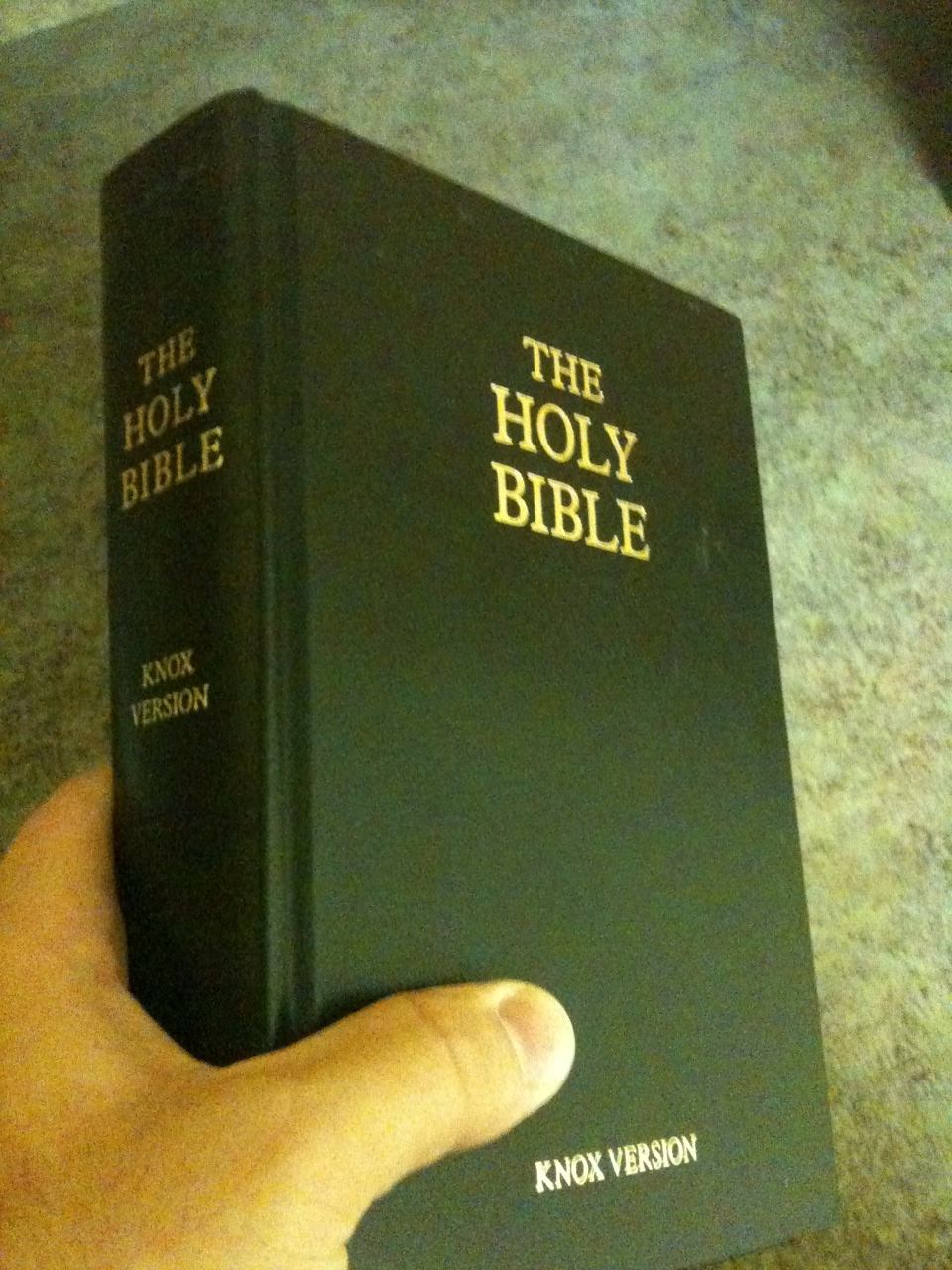
Knox Bible Three Volume Hardcover (1950-1951)


Since the inauguration of this blog, I have had the privilege to get to know some of you through emails, some via Facebook, or others even in person.  Recently, one of my readers, who lives very close to me, dropped off a bag of extra Bibles and missals that he was no longer in need of anymore.  Thank you Larry! I hope to find a suitable home for them in the near future.  (One of them, the NOAB4 already does.)  

However, on other occasions, readers have helped me to get into contact with people who were looking to find homes for older, more collectible Bibles.  James, who comments from time to time on the blog, graciously introduced me to Fr. Peter.  Fortunate for me, Fr. Peter is a fellow admirer of Msgr. Ronald Knox.  Over the course of a number of correspondences, I was able to acquire this amazing treasure pictured here.  It is a 1950-1951 Sheed & Ward three volume Knox Bible in hardcover. For being well over 60 years old, each volume is in remarkable condition.  The pages are as crisp and bright as if they had come of from the printers only a year earlier.  Even the original box, though showing signs of wear, is still in good shape and does its job of protecting the three volumes. 


The font, though similar to the Baronius edition, reads a bit better because of the spacing between verses and paragraphs.  This certainly has the feel of a readers bible, one which is meant for lengthy reading.  There are no extras within each volume of this boxed set, other than a brief translator's note or preface and, of course, the annotations from Knox.  

One of the real surprises of this set, which I was strangely unaware, is the inclusion of a second translation of the Psalms.  Knox's original translation of the Psalms came from the Clementine Vulgate rendering.  However, in 1945 Pope Pius XII approved a new Latin edition from the Hebrew published by the Biblicum (Pontifical Biblical Institute).  Knox translated this new edition and it is found as an appendix to volume two of this set.  I hope to be able to analyze and compare for you the two Psalters in the future.  I can tell you that the Baronius Press Knox Bible utilizes the 1945 Biblicum translation of the Psalter.  


Yet, there was another surprise!  Slipped in between two pages of the New Testament volume I found a newspaper cut-out of the announcement of Knox's death.  Seeing that truly touched my heart.  What a treasure, within a treasure.  It reads: "Monsignor Ronald Knox, the historian and theologian, died on Saturday at Mells, Somerset, where he had been staying for some months.  He had an internal operation in January.  He was 69.  Six weeks ago Msgr. Knox finished his translation into English of the autobiography, in French, of St. Theresa of Lisieux.  There will be a Requiem Mass at Westminster Cathedral on Thursday."

Thank you to James and Fr. Peter. 

"What is faith?  It is that which gives substance to our hopes, which convinces us of things we cannot see.  It was this that brought credit to the men who went before us (Hebrews 11:1-3)."

Thursday, March 5, 2015

Bible Review: Baronius Press Standard and Large Douay-Rheims Editions


I know that many of you love the venerable Douay-Rheims Bible.  I have a deep appreciation for it as well, and think, like many Protestants do about the KJV, that every Catholic should own a copy of the Douay-Rheims.  It is an important part of our English-speaking Catholic heritage.  Occasionally, people have emailed me in the past with the question as to where should one go to purchase a Douay-Rheims edition?  That may be the easiest question I regularly receive since starting this blog.  For my money, nothing compares to the work Baronius Press does with their classic Catholic Bibles.  Their bibles, missals, breviaries, and books are the finest in the Catholic publishing world and show a commitment to producing literary treasures that can be read and prayed with for a lifetime.  They are not a large publisher, so there is never a guarantee that their products will be in stock for long, like the traditional breviary or some of their Douay editions.  So, if you want one of these Douay-Rheims Bibles, I wouldn't wait too long to purchase one.  (Don't forget about the Knox Bible either, which is, in my humble opinion, the gem of their entire catalogue.) 

Almost two years ago, I gave a glowing review of their pocket Douay-Rheims.  There is so much packed into that little Bible, yet without any lack of the quality.  Again, this is something I have come to expect from Baronius Press.  Since then I have been eager to examine, and re-examine, some of their other Douay editions.  I know that for some of you a pocket edition may have too small of a print.  Fortunately, I recently received a copy of both their standard and large edition Douay-Rheims Bibles and, once again, I was not disappointed.  Both of them are in black, with the standard being in the leather "flexible" and the large being in the leather hardcover.

Both Bibles contain the exact same features, which are:
*1898 Edition of the Douay-Rheims
*1,512 Pages
*Leather bound cover with stitched edges
*Gold gilt edged pages and 2 ribbons.
*Completely retypeset to reproduce the original 1899 edition.
*Eleven coloured maps digitally redrawn by hand and fully coloured
*32 beautiful engravings that recreate key moments in Biblical History
*Family Register section
*Printed in India
*Three Papal encyclicals regarding the importance of the Holy Bible:
       PROVIDENTISSIMUS DEUS 
       SPIRITUS PARACLITUS
       DIVINO AFFLANTE SPIRITU 

Both editions come in sewn bindings, which, if you really care about using a Bible any longer than a couple years, is a must.  The standard edition is in the flexible leather, which Baronius describes as being "leather, hand covered over flexible boards, which are specially designed to flex many times without breaking. The corners are rounded and the edges are then meticulously stitched to create an elegant and durable appearance."  Yes, it is of high quality, but it is not really flexible.  In comparison to the hardcovers it is, but don't expect anything resembling the supple covers of most leather or even bonded leather covers.  The size of the standard edition is 6" x 8 1/4" which makes it perfect for prayerful reading and for taking to Bible studies.  

The large size edition comes in at 7" x 10", which should be appreciated by those who are in need of a large-print bible.  Or, perhaps, you love the Douay-Rheims and would like a Bible to serve as the Family Bible, this would be a great choice.  The cover is a very elegant black leather hardcover, much like my beloved Knox Bible.  According to Baronius, they "use the same leather covered over 1/8" (1/12" for smaller titles) thick, stiff boards, to create strong and durable books that will last for generations."  This will indeed last for generations.  

Each edition comes with two bible ribbons, red and yellow, and the paper is gold gilded.  This makes the overall look to this Bible simply amazing and classy, fitting the translation contained in it.

When you get to reading this text, you will find it to be very readable.  While the paper is a thin and bright white in tone, I don't thing ghosting is too much of an issue.  Included with the Douay translation are cross-references, occasional notes, and chapter headings that give an overview of the chapter. Like the pocket edition, maps and engravings are included and printed on a very thin glossy paper.  This adds a nice touch, without hindering page turning like in some other Bible editions which use a thicker glossy paper for their inserts.  For those of you who regularly attend the Extraordinary Form of the Mass, you will welcome the inclusion of the Mass readings for Sundays, Holy Days, and Saints Days.  In addition, there is a two-page Table of References which can serve as an aid to doing apologetics or study. 

So, yeah, I think these editions are wonderful in almost every way.  However, my biggest critique about the work Baronius does with their Bibles is that they haven't moved to having their Bibles covered in goatskin, calfskin, or any of the other premium leather possibilities.  I know that there is a great tradition in the Church of having beautifully bound hardcover Bibles and Missals, but it would be amazing to see the standard Douay-Rheims in a soft goatskin.  Even the flexible black leather cover of the standard edition is a bit misleading, since it simply isn't flexible in the way most people, who haven't handled one of these bibles, would expect.  These beautiful editions are begging to be wrapped in some soft premium leather options.  Perhaps, in the future, they should consider working with R. L. Allan's in providing them some of their best editions, including the Knox.  Hey, they are both located in London!

Thank you to the fine folks at Baronius Press for providing these review copies.

Monday, January 26, 2015

Review of The Didache Bible: Ignatius Bible Edition

Of all the "upcoming" Bibles that my readers have been waiting for over the past year, The Didache Bible: Ignatius Bible Edition ranks as likely one of the highest in anticipation.  Of course, as often happens with such eager expectations, one may feel let down when the final product is finally in their hands.  Sometimes, particularly in the area of quality Catholic Bibles, anticipation often is greater than the delivery.  Fortunately, this is not the case with The Didache Bible.  In almost every way, this Bible delivers on what it was promised to be.  Those who have wished for a Bible that incorporated the Catechism of the Catholic Church in a comprehensive, yet readable way with the inclusion of useful study aids will be utterly satisfied.  Those who have wanted commentary and annotations for a full one-volume edition of the RSV-2CE, they need not wait any longer.  The Didache Bible is a great achievement and many will be thanking Midwest Theological Forum (MTF) and Ignatius Press for a long time.

One aspect of reviewing Bibles that has become more important for me over the years is page presentation and layout.  Content is, of course, important, but if I am not led or drawn into the text, it will ultimately serve no real purpose.  The Didache Bible excels in how the Biblical text, cross-references, and annotations are presented on the page.  I don't think the RSV-2CE has ever looked so good.  The white page against the dark black type really makes the text pop.  Between the scriptural text and the commentary is placed the cross-references, which are bracketed off with a thin red line.  This serves as an aesthetically beautiful break between the two.  It is subtle, but I think it really works, much like the use of red in the HarperOne NABRE.  The commentary, which in the New Testament is quite extensive, is only slightly smaller in size that the scriptural text.  The paper does not lend itself to ghosting, although it is by no means opaque.  If you have ever owned a prayer book or missal from MTF you will notice a similarity in this regard.  One last point that I wanted to highlight about this edition is its size.  I don't know why, but I was expecting it to be much bigger.  However, it is remarkably compact for a study Bible.  Its size reminds me of the NOAB RSV published back in the late 70's and still available today.   What this means is that not only do you have a fine study Bible, but also one that you could take with you pretty much everywhere.  All in all, this is a beautiful Bible to read.  I think its size and page layout are the real highlights of this Bible.

The edition I am reviewing is the hardcover one.  The bonded leather edition is due out later this year, although I think this Bible deserves to be bound in a nicer genuine or goatskin cover.  However, I will be sure to let you know when I receive confirmation on a date for the bonded leather one.  The hardcover edition is quite sturdy and opens up flat from the first day.   It came with two bible ribbons, which is a nice touch.  This bible was advertised as having a sewn binding, which I still believe it has.  However, they have enhanced the binding with some glue, which at a few spots is clearly noticeable.  I would like to hear back from some of my readers as to what they think about this.   This edition was printed in India.

Now, as for the content found in this book.  As mentioned earlier, the translation is the RSV-2CE.  I am not going to spend any time discussing translations, which we do here so often anyways.  However, since I am a theology teacher who uses MTF's Didache Semester Series in my classroom, I will say that this serves as a perfect compliment to that classroom text which utilizes the RSV and NRSV in the textbooks.  

The introductory material includes a foreword from emeritus Cardinal-Archbishop of Chicago Francis George, followed by an introduction by Fr. James Socias.  What follows are a couple of short essays by the editors explaining how Catholics read the Bible.  Here you find reference to Dei Verbum and those early paragraphs of the CCC which discuss the literal and spiritual reading of the Bible.  Following that, there is a "Brief Summary of Sacred Scripture" which gives a very short overview of the main theme(s) of each Biblical book.  The introductory material concludes with a chronology of Old Testament and New Testament events and a list of passages of scripture for personal meditation, including the parables and miracles of Christ.  These opening aids are more geared toward the beginner, but can be consulted by a seasoned Bible reader.  I could see them being extremely helpful to someone in RCIA.

Looking at the commentary based off the CCC, you will immediately notice that a lot of work has been put into adapting the CCC to work in this format.  For the most part, there are not direct quotations found in the annotations.  To be sure, there are indeed some, but most have been re-worded in order to make them applicable to a particular biblical passage.  Each of them, however, contains a direct reference to the CCC paragraph that has been re-worded.  And there are plenty of these CCC cross-references!  I should say that you often don't realize that it has been edited, since what you read sounds like it is coming directly from the CCC.  I would imagine that this took the bulk of the editors time.  Some of the pages, primarily in the New Testament, you will find that the CCC-based commentary takes up over half the page.  While most of the pages are concerned with referencing the CCC, there are numerous annotations that point the reader to connections with the Liturgy, occasional quotes from recent Popes and the Church Fathers, analysis of lexical issues, and allegorical interpretations of OT passages.  I found the liturgical connections to be very helpful and insightful.   For example, there is a note in Daniel 6:10 which connects Daniel praying three times a day to a passage in the General Instruction of the Liturgy of the Hours.  There will be much to consider and pray about for years in these commentaries.  As you might guess, there is more commentary, per page, in the NT than in the OT.  Certain places, like in portions of the historical, wisdom, and prophetic books, have less than a quarter of a page of commentary on them.  Judith would be a perfect example.  Let me also say that if you are looking for commentary that is more historical in nature, as found in more academic study Bibles, the Didache Bible is not for you.  One last study help, in regards to the commentary, that the editors of The Didache Bible included are these occasional red in-text boxes which are found at the bottom of certain pages.   For example, there are two of these found in Genesis 3, where they explain the "Rebellion of Satan and His Angels"  and "Sin, Suffering, and Death."  These are not found on every page, but do pop-up and provide some helpful insights which are always references to, you guessed it, the CCC.

I should also note that each biblical book comes with an introduction, which looks at authorship, dating, audience, and main themes.  I would call the content of each generally conservative, but not without acknowledging difficult issues relating to authorship and dating.  You see this most notably in the intros to the books of the Pentateuch.  Overall, I think it strikes a good balance.  They are not as extensive as found in the Ignatius Catholic Study Bible or those in the most of the entries in the NABRE.

There are also over 100 apologetical explanation pages that are scattered, without any real order, throughout the Bible.  I breathed a big sigh of relief when I found out that they were not printed on glossy paper, but instead the same paper that the other pages are printed on.  While I think a Bible like the New Catholic Answers Bible is great, all those glossy pages make it difficult for the Bible to open flat.  These apologetics pages are comprehensive, yet not overwhelming.  They provide ton of scriptural cross-references, as well a referring to the CCC.  The issues range from the importance of the Protoevangelium to the Rosary.  In the end, this make this Bible not only the best CCC-based Bible on the market, but also the best apologetics one.  (The info in the index also assists those engaged in apologetics.)

Looking at the study aids in the back of the Bible, I think the maps provided may be the best in any Catholic edition I have ever seen.  There are a total of 27 unique maps that are both colorful and full of great information.  These maps cover everything from Abraham's migration to 7 Churches of Revelation, including the period of the Maccabees. Most helpful are the numerous maps showing the journeys during the patriarchal period of Genesis.  They are printed on glossary paper, and the only curious thing about the set of maps, is that they are placed immediately after Revelation, but before the rest of the material in the appendix which is printed on regular paper.  I wonder why the glossy maps weren't just placed at the end of the Bible?  Whatever the case, following the maps section is a helpful 43-page glossary of names, places, and terms.  Each entry contains about a sentence or two of information, including scriptural references.  There are then indexes to the apologetics materials, which are scattered throughout the Didache Bible.  At the very back is a 20-page subject index, including biblical names, which includes a ton of scriptural references and cross-references.  One noticable omission would be a table of Sunday and Feast Day readings from the Lectionary.

Again, this is a wonderful resource in a truly compact size.  As I mentioned above, there will be many people who are going to be excited to get their hands on this.  In particular, if you are interested in apologetics and studying the three-fold spiritual sense of Scripture, as outlined in Dei Verbum and the CCC, you will have a lot to love in the content of this Bible.  I have included some photos of this Bible on a previous post.  You can also go to MTF for a sneak peak.

I would like to that Ignatius Press for providing a review copy. There was no pressure in me providing a positive review of this Bible.

Monday, September 29, 2014

NRSV Hardcover with Deuterocanicals by ABS


I would like to start off by thanking reader Daniel for pointing the edition out to me.  As I have mentioned before, but not often enough, I have some wonderful readers of this blog.  Thank you!


The American Bible Society, which has become more and more involved in providing Catholic resources in recent years, provides various Catholic editions of the Bible.  This includes not only a number of NABRE volumes, but also some NRSV Bibles as well.  Last year they published the intriguing Poverty and Justice Bible Catholic Edition, which utilized the NRSV-CE text.  I like it in many ways, unfortunately like most of the NRSV Bibles on the market, it did not include any cross-references.  This remains a continual issue for those who want a nice edition of the NRSV with them included.


Well, reader Daniel recently pointed out to me an economy Bible the ABS publishes called the NRSV Hardcover with Deuterocanonicals.  Let me say this up front: It is not a premium or HarperOne type edition in any way.  In many ways, this would make a great pew Bible if Catholic Churches actually utilized pew Bibles in our churches.  (That is, of course, another issue for another time.)  For this edition, the paper is thin, the printing is not very bold, the maps are laughable, and the binding is glued.  Yuck right?  Rebinding this edition may not be either an option or desired.


However, there are two things going for it.  First off, it only costs $10.99, making it a fairly cheap purchase for most.  Those of you who are a bit suspicious of the NRSV, might like to consider this edition.  You can also purchase it in a case of a sixteen for under nine dollars each.   Secondly, and most importantly, it contains cross-references.  Yes, this is an NRSV with cross-references.  I will repeat that statement one last time, it is an NRSV with cross-references.  Such a rare thing really.  Most other editions that have cross-references are study bibles or expensive (or out-of-print) reference Bibles.  Now get this, not only are there bottom-of-the-page cross-references, they even reference the Deuterocanonical books.  Take for example the image I have for you here on the right.  It comes from 1 Corinthians 15:14-50.  If you look, you will see references to 2 Maccabees, as well as 4 Maccabees.  The Deuterocanonical books, themselves, have cross-references linking to both the Old and New Testaments.


So, this is a nice find.  If ABS would consider creating a Catholic edition of this, with a little bit nicer materials, it could make a great candidate for a rebinding.  

Wednesday, July 2, 2014

Oxford NABRE Large Print

As has been mentioned on this blog on numerous occasions, we Catholics do not have anywhere near the number of quality, premium leather Bibles that our Protestant brothers and sisters do.  I dare say that we may have a handful at best.  The NABRE, like the other Catholic translations, can be found in plenty of paperback and hardcover editions, not to mention what seems like an infinite number of pseudo and imitation leather editions.  One would think that of all the Catholic translations, the NABRE, since it sold by a number of different publishers would, but alas that is not the case.

There is, however, one company that has produced the NABRE in genuine leather, that being Oxford University Press.  In the past, they have offered genuine leather NAB's in their study bibles, compact editions, readers editions, and large print ones.  When the NABRE was published back in 2011, I was expecting the same treatment.  Except for the large print version, this has yet to happen.

As a matter of fact, I was truly looking forward to the readers edition of the NABRE, much like the NAB, but they seem to not have bothered even publishing one.  Which is a real shame, since the text was extremely readable, with the notes and cross-references delegated to the back of each biblical book.  Therefore, it was an edition that would be perfect for spiritual reading and lectio divina.

The Catholic Study Bible seems to have also received very little attention.  Not only has it not been updated in its reading guides, but it is not available in genuine leather either.  All previous editions had been, which is a real shame.

So, this leads me to the NABRE Large Print from Oxford, which is covered in a marbled genuine leather.  It isn't the smooth and flexible one that they covered the NOAB NRSV 4th Edition in, but it is actually genuine leather and not bonded.   It is almost identical to the genuine leather RSV-CE readers edition that came out about 10 years ago.  Dei Verbum is included with the biblical text and the notes/cross-references. The box it came in, as well as some sellers, mention that the full lectionary readings are included, this is not the case.  The compact NABRE and the Catholic Study Bible editions do contain all weekday and Sunday lectionary readings.

The binding is also sewn.  As you can see with the photos, the text is very readable, the notes and cross-references being placed at the back of each book.  This makes it good for prayerful reading or for teaching. The gold gild edges give it a classy look to it, as well as the gold ribbon marker.  Some people don't like the Oxford tabs, but I think they are just fine.

Overall, this may be one of the nicest NABRE bibles in print.   I would dare say that it may be the most luxurious, if I may say so, Catholic bible in print today.  The only bibles that would come would be from Baronius Press, that being either their Knox or Douay editions.  The NRSV's from HarperOne are close, but unfortunately they are often printed on super-thin paper and wrapped in cheap imitation leather.

So, if you are looking for a genuine leather Catholic Bible, without having it rebound, I'd recommend this edition.

Tuesday, September 10, 2013

Oxford NRSV-CE Readers Edition

One of my earliest reviews on this blog was for the delightful NRSV-CE Readers Edition from Oxford, which is now sadly out-of-print.  I thought I would re-publish it here with a few additions, which you will see in bold.

Here is the info given for this edition by the publisher, Oxford University Press:

In addition to U.S. and Canadian imprimaturs, the Reader's Text contains "The Dogmatic Constitution on Divine Revelation", 64 in-text maps, 12 in-text charts and line drawings, a unique NRSV Catholic concordance, a Presentation and Family Record Section, eight pages of full color New Oxford Bible Maps, Prayers and Devotions of the Catholic Faith, and a Table of Sunday and Weekday Lectionary Readings for the Canadian NRSV Lectionary.

I must say that I find this edition of the NRSV a true joy to read and use daily. I own the burgundy berkshire leather edition, although I am still unsure as to what berkshire leather actually is.  (Berkshire Leather is high quality pigskin. It is tanned to enhance its appearance and durability.)  It doesn't feel like the rather cheap bonded leather that you sometimes see used in Bibles, but it certainly is not lamb-skin either. The fact that I paid a decent amount for it suggests to me that it is a better quality leather binding. The Bible fits nicely in the hand and will open up flat when placed on a table.

It's size is 9.9 x 7.5 x 1.8 inches and it weights only 3 pounds, making it very easy to take with you to Bible studies, Holy Mass, or Panera. In addition, the text size is very readable, the print is clear, it contains paragraph headings, and there is a fair amount of space to write notes if desired. The binding is sewn.

Probably the main reason I like this Bible is that it contains a lot of Bible extras, something that most Bibles of this size do not. As many of you know, I love a Bible with a lot of maps. With this edition, not only do you get the standard "Oxford Maps" in the back, but there are 64 in-text maps placed throughout the Bible at appropriate places. For example, if you are reading through 1 Samuel about David fleeing from King Saul, you will find in 1 Samuel 22 a nice in-text map of David's escape route to En Gedi.   In the New Testament,  there are some wonderful maps of "Jerusalem during Jesus Time" as well maps of the individual cities that Paul visited. In addition to the maps, there are some very helpful charts placed within the text, like a "Harmony of the Gospels" and "Chronology of the Postexilic Era" in the Book of Ezra. The appendix includes the full table of Mass readings for Sundays and Weekdays, which is really nice to have when taking this Bible to Mass. There is also a nice 6 page section on Catholic prayers and devotions. Finally, there is a concise NRSV concordance in the back. This 100 page concordance, which helps you to find familiar phrases and words in the Bible, is the most thorough concise concordance that I have seen for a Bible this size. It is particularly helpful when looking up a Biblical name or place.  It has more entries than what you would find in the HarperOne editions of the NRSV.

The one drawback to this Bible is that it doesn't contain any cross-references. Certainly having the concordance helps that a bit, but overall it would have been nice to have cross-references for those passages that are explicitly quoted elsewhere in the Bible.  You will notice my final picture shows how I copied and glued the "Old Testament References in the New Testament" chart found in the appendix of the HarperCollins Study Bible into the back of this Bible.  Problem solved.

Overall, this is a great Bible! I would highly recommend it to anyone looking for an NRSV Catholic edition.  If you can find one!

Wednesday, June 19, 2013

Saint Benedict Press Douay-Rheims

Back in April, I reviewed the newly re-released Douay-Rheims pocket Bible from Baronius Press.  Now, I am happy to give a short review of one of the editions of the Douay-Rheims produced by our friends at Saint Benedict Press.  Much like the King James Version, the Douay-Rheims continues to have a strong connection to many of the faithful.  However, up until recent years, one could find the KJV in many different editions and attractive styles.  That wasn't the case with the venerable Douay-Rheims.  Things have been changing over the past decade or so, however, principally due to the work of Baronius Press and, of course, Saint Benedict Press.  

The edition I have is the burgundy premium ultra-soft one, and I chose to review this one for a reason.  For while I think the Baronius Press edition has more of a "classic" feel to it, including a superior binding, which will likely appeal to a certain group of Catholics, I do find the Saint Benedict Press edition, particular in this format, has a more contemporary/up-to-date look and feel to it.  I mentioned once in a post, which I couldn't find, that I think one thing that would increase the popularity of the older Douay-Rheims was to be able to find it in a more "hip" binding and presentation.  If you ever go to a Christian book store and look at all the KJV offerings, you will know what I am talking about.  There are KJV youth Bibles, study Bibles, and other themed Bibles that come in all kinds of different formats, many of which are appealing to youth and young adults.  The Douay-Rheims, like many Catholic translations, doesn't have the variety that it deserves.

The SBP edition, however, goes a long way in providing the traditionally-minded Catholic an edition of the Douay-Rheims that doesn't look like it has been transported from the early 20th century.  Along with the editions that come in genuine leather and paperback, as well as large print editions, this premium ultra-soft version includes:

The standard cross-references and annotations as found in most Douay-Rheims (Challoner) edition, the words of Christ in red, updated full color New Testament maps, beautiful pictures depicting the life of Christ., family record and Presentation pages, an historical index, an index to important Catholic apologetic verses, the Mass readings according to the Extraordinary Form, a section of "Beloved Prayers", and a list of the Popes through Benedict XVI.  

So, as you can see, this medium sized Bible is packed with Bible aids and devotional materials.


Even with all that is included, I believe the best feature of this Bible is its overall feel and readability.  I love the premium ultra-soft cover, which is wonderful to hold and read from.  I actually prefer it to the genuine leather editions which SBP produces.  And again, this style of cover, with its blind imprinting, gives the Bible an overall contemporary look and feel to it.  The readability of the text is also quite good as well.  The print on my edition is very dark, including the words of Christ in red, compared to most other Bibles I own.  It is actually quite striking.  They even left a good inch of space in the margins and at the bottom of each page for personal note taking.  

In future editions, I would like to see the inclusion of a few Old Testament Bible maps to compliment the New Testament ones.  Also, it would be great to see the Douay-Rheims in a single-column page format, much like the Knox Bible from Baronius Press.  Overall, however, this is a fun Bible that I think would be perfect for someone who desires the traditional text in a contemporary format.  


If you are considering purchasing from Saint Benedict Press, if you follow the link below your humble blogger will receive a small percentage of the sale. Grazie!
Saint Benedict Press - The Source for Catholic Bibles

Thank you to Saint Benedict Press from providing me a review copy

Wednesday, April 24, 2013

Bible Edition Review: Baronius Press Pocket Douay-Rheims


“And thou shalt say in that day: I will give thanks to thee, O Lord, for thou wast angry with me: thy wrath is turned away, and thou hast comforted me.” –Isaias 12:1

Within the past few weeks, Baronius Press has released its fourth impression of their Pocket Douay-Rheims.  For some time it had been unavailable, but fortunately that is now not the case.  As you would come to expect with any publication from Baronius Press, the overall presentation is of the highest quality.  The gold gilt edged pages and the classical-looking page layout (with only minimal ghosting) make this pocket Bible a true pleasure to read and carry around.  In many ways, this is the nicest pocket Catholic Bible that I have seen, probably along with the Cambridge Pocket RSV New Testament and Psalms. 

 As you will notice below, where I list the features found in Bible, this pocket Bible is packed with stuff.  The maps and engravings are printed on a very thin glossy paper, which add a nice touch, without hindering page turning.   I have pointed out in the past some Bibles that include glossy inserts and how they have a tendency to kind of get-in-the-way.  Those who regularly attend the Extraordinary Form of the Mass will appreciate the inclusion of the Mass readings for Sundays, Holy Days, and Saints Days.  The Table of References is nice two page addition which can be of help for doing apologetics or study. Also included are three Papal encyclicals, although I wouldn’t have mind having Dei Verbum included.  As it has been noted by others elsewhere on this blog, if they are going to include Divino Afflante Spiritu, why not include Dei Verbum as well. 

Again, this is a really wonderful pocket Bible.  My only, although slight, disappointment is that the cover is made of a rather stiff bonded leather.   While this may allow for greater protection of the pages from being bent, it does hinder the Bible’s ability to be opened flat on a table.  This may change in time with regular use, but at this point I am unsure. Perhaps someone else who owns this edition will be able to chime in.

Everything else about this volume has the feel and look of a well-crafted Bible that will last a lifetime.  As their website state, Baronius Press strives “to raise the quality of traditional Catholic books in order to make them more appealing to a wider audience. In an age of mass production and cost cutting overriding aesthetic beauty, Baronius Press is re-typesetting (rather than producing facsimiles) classic Catholic books, to obtain clear text which is easy to read. These are then published in high quality bindings that are beautiful and durable.”  I hope they continue to produce high quality Bibles, and I would love to see them produce a pocket edition of their Knox Bible in the future.

The Features in this Bible include:
-1512 Pages
-4.25" x 6.85"
-Bonded, Flexible Leather bound cover (black, white, & burgundy) with stitched edges
-Enlarged text from previous edition
-Gold gilt edged pages and 2 ribbons.
-Completely retype-set to reproduce the original 1899 edition
-Eleven colored maps digitally redrawn by hand and fully colored
-32 beautiful engravings that recreate key moments in Biblical History
-Family Register section
-Three Papal encyclicals: PROVIDENTISSIMUS DEUS, SPIRITUS PARACLITUS, & DIVINO AFFLANTE SPIRITU
-Historical and Chronological Index of the Old and New Testaments
-A Table of References to Catholic Doctrines
-A Table of Epistle and Gospel Readings for the Extraordinary Form Mass for Sundays, Holy Days, and Feast/Saint Days

The Baronius Press website contains sample pages for you to look through.

Thank you to Baronius Press for providing a review copy


Friday, October 19, 2012

The Holy Bible: Knox Version (Baronius Press)


One of the common complaints on this blog is the serious lack of quality, high-end Catholic Bibles.  While there are certainly enough good Catholic translations to choose from, the way in which they are produced often leaves a lot to be desired.  For example, the recently released HarperOne NABRE came in a very attractive page-layout, but the imitation leather cover and binding was a serious disappointment.  

When I look at the Bibles in my library, which are way too many if you ask my wife, the only one I would ever consider a premium Bible would be the Cambridge NRSV Reference with Apocrypha in French Morocco leather.  (Technically speaking, of course, that one is not even a specifically Catholic edition.)  However, I am happy to report, that I can now add another Bible to my list: The Knox Bible by Baronius Press.

This Bible is beautifully made and crafted in such a way that it will last a lifetime.  Here are the particulars of this new edition:
** The Bible comes in at a size of 6”x8 ¼”, encompassing 1,472 pages

**Set in a single-column format with verse references placed at the side of the text


**Printed on light cream paper


**Re-Typeset based on Burns & Oats and Macmillian & Co. 1963 edition


**Translator’s notes and cross-references are located at the bottom of each page


**Beautifully bound in hardcover (black leather) 1/8” thick, with gilt edges


**2 Ribbon Markers, headbands, and marbled endpapers


**Foreword by Scott Hahn


**Included with this new edition is a paperback copy of On Englishing the Bible by Knox 


**Imprimatur from Archbishop of Westminster Vincent Nichols dated 8th of January 2012

The Knox translation is certainly unique, however this review will not be analyzing the pros and cons of Msgr. Knox’s work.  I hope to do so in posts that will appear in the coming weeks that look at the translation in a bit more detail.  Instead, I am going to focus on the product itself.  But before I do, I thought it would be interesting to at least show you a bit of his style, by reproducing his version of the Christ-hymn of Philippians 2, with footnotes:

“Yours is to be the same mind which Christ Jesus shewed. 6 His nature is, from the first, divine, and yet he did not see, in the rank of Godhead, a prize to be coveted;[a] 7 he dispossessed himself, and took the nature of a slave, fashioned in the likeness of men, and presenting himself to us in human form; 8 and then he lowered his own dignity, accepted an obedience which brought him to death, death on a cross. 9 That is why God has raised him to such a height, given him that name which is greater than any other name; 10 so that everything in heaven and on earth and under the earth must bend the knee before the name of Jesus, 11 and every tongue must confess Jesus Christ as the Lord, dwelling in the glory of God the Father.”
  1. Philippians 2:6 ‘Did not see, in the rank of Godhead, a prize to be coveted’; others would render, ‘thought it no usurpation to claim the rank of Godhead’.
  2. Philippians 2:11 ‘Dwelling in the glory’; the Greek is perhaps more naturally rendered ‘to the glory’.
Now on to what Baronius Press has done with Msgr. Knox’s translation.   What immediately stands out is the craftsmanship involved in producing this volume.  (I have experienced this type of quality production before with their Little Office of the Blessed Virgin Mary volume.) The quality of the binding, the paper, ribbon markers, and endpapers make this Bible standout from all of the other ones I own.  This Bible is sturdy, yet very comfortable to read both by placing it flat on a table or by holding it in your hand or lap.  This is the case no matter where in the text you are reading, from Genesis to Revelation (the Apocalypse).  While this is not a portable, compact Bible, it can easily be brought to study and prayer groups, even Holy Mass.  It is simply a standard sized Bible.  I wonder if Baronius Press will eventually make different editions of the Knox Bible, like in a compact form or flexible leather, similar to what they have done with their Douay-Rheims editions.

For me, the highlight of this Bible is its single-column page layout.  It is very easy on the eyes, and the quality cream colored Bible paper minimizes any issues with ghosted print image from the reverse of the page.  That being said, I am not sure if I will ever write in this Bible.  It is just too pretty!  While having the verse numbers on the side can be a bit tricky at first, it becomes quite easy to use after only a few minutes.  The many notes, both textual and commentary, from Msgr. Knox are clearly visible at the bottom of each page.  I should mention that while there are not a ton of cross-references in this Bible, the notes in the New Testament do indicate where there are direct quotes from the Old Testament, as well as referencing similar passages found in the among the four Gospels.  In addition, there are cross-references in the notes in the Old Testament as well, but not as many as are found in the New Testament.    

If there is one criticism, and this is only minor, I would have appreciated a small selection of Bible maps in the appendix.  The older Knox Bible that I own contained two line-drawn maps, which would have been a nice conclusion to this beautiful Bible.  While it is always nice to have “the extras” with any Bible edition you purchase, the quality of this Bible allows me to easily overlook this minor omission. 

Having now spent a few days with the Knox Bible, as well as reading On Englishing the Bible, I want to conclude by making three comments.  First, bravo to Baronius Press for crafting such a beautiful Bible that I am sure will be appreciated by many people on both sides of the Atlantic.  The quality of this Bible is a testament to the attention and care that was given to its production.  There is no question that it was well worth the wait and the $54.95 price tag. 


Secondly, while there are certainly other translations that may be more useful for study, here I am thinking of the RSV, NRSV, or NABRE, the style of translation and flow of reading from the Knox Bible, even with the occasional archaic rendering or anglicized vocabulary, is refreshing and truly enjoyable to read.  I must admit that even though I own an older Knox Bible edition, I never did spend much time reading it because I just assumed that it would be too close to the Douay-Rheims in style.   I was wrong.  In a similar way, I can imagine that people who first experienced fresh translations like the Jerusalem Bible or New English Bible half a century ago, which departed from the Douay-Rheims or KJV traditions, had that same sort of feeling that I did as I began to read the Knox Bible.  I truly did not anticipate the amount of joy I would have reading through large portions of the Old and New Testaments in this translation over these past few days.  While this certainly has a lot to do with the translation, itself, Baronius Press must also be given credit for the achievement of this publication.  

Finally, having read all of Knox’s On Englishing the Bible, which I did in one sitting, along with my reading of the Knox Bible, the ultimate compliment I can pay to Msgr. Knox, as well as Baronius Press, is that I now have a greater desire to read more from Msgr. Ronald Knox.  His style of writing, and his unexpected wit and candor, I found to be very attractive and insightful.  I look forward to adding a few of his other works to my Christmas list.  I have avoided his writings for way too long.  Any recommendations?

Friday, June 29, 2012

My Favorite Bible 2.0

Back in October 2009, I posted on this blog that my favorite Bible edition was Cambridge's NRSV Reference Bible with the Apocrypha--French morocco leather.  Almost three years later, I feel the same way.  While we have certainly seen some improvement in the quality of Catholic Bibles, none match this edition.  Granted, this is technically not a "Catholic" Bible in the sense that it isn't the NRSV Catholic Edition.  However, it does contain all the Deuterocanonicals and the translation, itself, is the exact same as found in the NRSV-CE. 

The original edition I had received back in 2009 was a used copy purchased from Christianbook.com.  It had been returned for some reason, but was in pretty good shape.  The only real issues were that there was a name imprinted on the cover and some of the pages were worn.  It was still in very good condition and it was purchased at a great price.  I had used this NRSV often over the past three years.  In fact, this was the one that I used for many of the major exams I took during the course of my S.T.B. studies, due to all the cross-references.  During the past year, however, as I have been spending a bit more time with the NABRE, my Cambridge NRSV has seen only occasional use.  Recently, I have felt the need to return to this edition, due to its clear text, copious cross-references, useful glossary, fine maps, and quality binding/premium cover. 

When I began to flip through my original edition, I found that it had gotten wet somehow, thus some of the pages weren't in the best condition.  Also, the fact that someone else's name was on the cover always kind of bugged me.  So, I decided to contact my friend Louis, of Baker Book House in Grand Rapids, to see if he could acquire a new copy of Cambridge's NRSV.  (It also helped that I had a gift card to use!)  He was successful, and I received my new edition, with my own name inscribed on the cover, in the mail on Wednesday.  Expecting an identical, albiet new, edition of the Cambridge NRSV, I was suprised to immediately notice a number of differences between the older and new Cambridge NRSV. 

At first touch, the cover felt different.  While my older edition had a rather stiff morroco leather cover, this newer one, though still morroco leather, was more limp.  It had a more smooth feel to it as well, and when I bent the cover it recovered its shape better.  The next thing I did was to get my older edition and place it next to the newer one.  As you can see from the first photo, the bottom one, which is the newer edition, is clearly thinner than the older one.  The other dimensions of this Bible are the exact same and include the same pages of material.  Next, I decided to open up my new Bible to the first few pages.

Taking a look at the copyright, I noticed that my new edition was a 2006 reprint of the 1997 first edition.  I had no idea that my older edition was the first edition, since I didn't know that it had been reprinted.  (It is not like you see this Bible at local secular or religious bookstores typically.)  In addition, I had never seen anyone else carrying this Bible in order to compare mine to it.  Needless to say, the reality of a second printing of this edition was news to me.  As I have been spending some time comparing the two versions since Wednesday, I am very happy to have purchased the reprinted (2006) edition of this Cambridge NRSV.  In my mind, it is clearly a better product overall.

One other difference that I noticed was that the print, although still the same typset, was noticeably darker than the older one.  It is difficult to tell by my second picture earlier in the post, but it is clearly darker in person.  Again, another positive change from the original printing.
All in all, I am very happy with my new edition of the Cambridge NRSV Reference Bible with the Apocrypha--French morocco leather.  The changes to the first edition, though slight, are much appreciated.  This edition remains my favorite Bible and it fits perfectly with my favorite daily prayer book: The Little Office of the Blessed Virgin Mary (1962 edition). 

(I wonder if anyone finds it strange that I am Catholic who prefers the Ordinary Form (Novus Ordo) Mass, prays the 1962 Little Office daily, and uses the NRSV?) 

Again, thanks to Louis (and Mason) at Baker Book House in Grand Rapids for their wonderful customer service!

Thursday, June 28, 2012

Retro Review: NRSV Go-Anywhere Bible Catholic Edition

Any one else besides me think this is a pretty sweet and unique Bible?  Crickets.....

I really do appreciate HarperOne's imagination in producing this Bible.  It is, for those of you who are unaware, the NRSV Go-Anywhere Bible Catholic Edition, which was published back in 2007.  It was, for me, the first edition of the NRSV that I actually purchased and read.  Up until that point, I had stayed away from the NRSV due to the perceived inaccuracies of the translation due its use of inclusive language.  (Since then, I have come to greatly appreciate the NRSV and its more than helpful textual notes.)

What is most unique about this particular edition is its dimensions: 8.6 x 6.6 x 1.2 inches.  It is a very slender, portable Bible, but one where the text is not cramped like most compact ones.  Some, like myself, have liked the extra length in this edition, while others have not.  Included with the Sacred text is a helpful concordance, but that is about it.  (The typical issues that plague most of HarperOne's releases, lack of cross-references and too thin paper, is also present in this NRSV.)

However, with that said, the binding is sewn and the Italian Nu-Tone cover is quite soft and has lasted for almost five years with no issues.  Also, unlike the most recent NABRE imitation leather release from HarperOne, this edition does come with a ribbon marker!  All in all, it is certainly a unique Bible, one that will be appreciated by only a handful of people, depending on their taste for strangely shaped Bibles!

Tuesday, June 12, 2012

Bible Edition Review: HarperOne NABRE Imitation Leather

Back in April, I reviewed the hardcover edition of the HarperOne New American Bible: Revised Edition.  Needless to say, I was impressed with what HarperOne was able to do with the NABRE.  I still contend that the hardcover HarperOne NABRE is the best edition of the NABRE on the market today.  Last week, however, I received the imitation leather edition and found myself to be quite disappointed.  While the content and the page layout is the exact same as the hardcover edition, I was hoping that the binding would be sewn and the cover would be sturdy.  Unfortunately, the imitation leather edition is neither of those two things.  Upon examining this edition, I instantly felt like I had seen something like this before.  Alas, I remembered where!  If any of you own the black imitation leather NRSV Catholic Gift Bible, also by HarperOne, than you know what I am talking about.  While the size and translation of the editions are different, the binding and cover are identical.  In addition, both do not come with a ribbon marker!  The HarperOne NABRE binding is clearly glued and the imitation leather cover doesn't maintain its shape.  I would have much preferred something closer to what is found on the bonded leather, yet sewn NRSV Go-Anywhere editions from HarperOne. 

So, all I can recommend, at this point, is to purchase the hardcover edition, which is sewn, and find yourself a leather Bible cover.  Or perhaps have it rebound in premium leather.

Wednesday, April 25, 2012

Bible Edition Review: HarperOne NABRE (Hardcover)

Over the past decade, HarperOne has been known for its unique editions of the NRSV translation. With editions like the Standard, Thinline, Live Youth, and Family Bible, HarperOne has made the NRSV more attractive and accessible to many Catholics. Now, for the first time, HarperOne has been licensed to publish the New American Bible Revised Edition. The HarperOne NABRE currently comes in hardcover, soon to be followed by E-book and imitation leather editions in May. For those looking for an edition of the NABRE that is visually different than many of the previous, cookie-cutter ones, this one might just be the NABRE you are looking for. I am not providing any personal pictures of the hardback edition that I own, since you can view a considerable number of sample pages here.

There are many positive elements to the HarperOne NABRE. First, and foremost, is the fact that it comes in a beautiful and attractive layout. The size of the font is pretty standard for a Bible of its size, but the real bonus is the intelligent use of red ink to highlight paragraph headings and for chapter/verse references in the notes. This subtle addition makes reading from this Bible certainly more pleasurable, while also giving the overall layout a more contemporary look and feel. Along with the Little Rock Catholic Study Bible, and its single-column format, the HarperOne NABRE is easily one of the nicest looking NABRE on the market today.
The overall look of this Bible is enhanced by the wise ordering of the notes and cross-references. Instead of the standard NAB(RE) look, this edition’s notes and cross-references are organized into three columns at the bottom of each page. While smaller than the sacred text, the notes are not so small as to be difficult to read.  Along with the notes, some have complained about the cross-referencing tool found in a number of NAB(RE)’s of the past.  In this edition, however, they are easily found in the third column after the notes. The use of asterisks alerts the reader to a note, while a simple letter indicates a cross-reference.  Again, very simple and very easy to use.

Three additional features make this edition standout. First of all, in the appendix are found 14 full-color Zondervan maps, with map index. While in the past, many of the HarperOne Bibles have either been produced absent of maps or have contained a limited number of drawn or black and white maps, this edition provides large, full-color maps that span the biblical period. The only missing period, which is unfortunate for a Catholic Bible, is the Greek/Maccabean period. Perhaps that was to be expected with maps from Zondervan. At the front of the Bible are 8 Presentation pages, including a photo of Pope Benedict XVI. The presentation pages include sections to record family and Sacramental highlights, including baptism, first communion, confirmation, and matrimony. However, there are no specific sections for children, which is unfortunate. The photo of Pope Benedict is a nice touch. Finally, and quite significantly, this Bible comes in a sewn binding! No need to worry whether or not the binding on this Bible will last.

With all these positive features, I need to mention a few of the negative features. The biggest problem with this edition is that the paper is fairly thin, much like the other NRSV editions. This continues to be an issue with most of the HarperOne Bibles. What makes this even more strange is that this Bible is advertised to come “with fine Bible paper to maximize readability” on the dust cover. Yet, the thin paper actually makes reading the text more difficult. It is not huge problem, don’t get me wrong, but a more opaque Bible paper is desirable. The only other minor deficiency with this Bible, besides the absence of one or two maps covering the Maccabean period, is the lack of Sunday Mass readings. That, of course, is a personal preference, but one which I think should be mandatory in all Catholic Bibles.

I hope to provide a brief review of the imitation leather edition when it is released later in May.