What is your favorite version of the RSV?

Showing posts with label RSV. Show all posts
Showing posts with label RSV. Show all posts
Wednesday, April 20, 2016


Monday, September 2, 2013
Your Bible: Ronald's RSV
 Gone Wrong?
I once had a Murphy’s Law calendar
which offered a daily page with a humorous variation on the famous maxim,
whatever can go wrong will go wrong. It
may seem this piece is a perfect example of the truth of Murphy’s Law; I’m not
following my gracious host’s plan that a few guest writers talk about the Bible
they use daily for study and prayer. Even
so, I do propose to share a little about a Bible I use every day, just in
another way. It’s sitting on the desk
next to me now, in fact, not being read, but still in an important way, in use
nonetheless. The story of this little
Bible parallels my own faith journey; it’s been with me through it all and is
with me still, every day. I’ll begin by
telling you about the Bible itself, and then how it fits into my story.
It’s
easy to provide you a description of the volume – it's an RSV edition published
by Thomas Nelson & Sons in the early 1950s.
It’s quite small, only 5 ½ by 7 ½ .
As you might expect with such a small book, the print is small although
still legible; it has few study aids, no maps, concordance or the like. It’s a no nonsense little volume, typical of
Bibles its age. Because of its age, the
wear and tear it’s seen is clearly visible and so I no longer risk putting it
through daily use.
As
for my faith journey, when I was seven years old I was baptized in a Lutheran
church in St Clair Shores, Michigan. My
parents wanted to let me choose when I was ready to take such a step, so I
wasn’t baptized as an infant. When they
decided it was time to ask me, I agreed, obviously being led by the Spirit
because I don’t think I clearly understood what I was doing. After my baptism, on beautiful April morning,
much to my surprise, my aunt and uncle gave me this Bible to commemorate the
event. It was enclosed in a maroon box wrapped
in white wrapping paper and I loved it. All
through my elementary and high school years, by which time we were
Presbyterians, I used my Bible for reading and taking to church each week for
Sunday school and to refer to during the pastor’s sermons.
 Back
then, I was pretty ardent in my faith and my Scot’s Calvinist aunt was
absolutely certain I would grow up to become a famous Presbyterian pastor,
along the lines of Peter Marshall. It
wasn’t to be; about the time I graduated from high school I decided that I was
through with “organized religion.” When
I joined the Air Force soon after, I knew I was no longer a believer. Yet, this Bible, now a little worn but still
in good shape, went with me to Lackland AFB for basic training and, later, to
Sheppard AFB where I spent two years of my enlistment. I don’t know why I other than to say it was
God acting in my life, maybe trying to keep me from straying too far. It could only have been the Spirit which made
me pick up my Bible now and then and read a familiar passage, Psalm 23 perhaps,
or the first chapter of Genesis. Perhaps
God was reminding me that He was near and wanted me to come back to Him.
Back
then, I was pretty ardent in my faith and my Scot’s Calvinist aunt was
absolutely certain I would grow up to become a famous Presbyterian pastor,
along the lines of Peter Marshall. It
wasn’t to be; about the time I graduated from high school I decided that I was
through with “organized religion.” When
I joined the Air Force soon after, I knew I was no longer a believer. Yet, this Bible, now a little worn but still
in good shape, went with me to Lackland AFB for basic training and, later, to
Sheppard AFB where I spent two years of my enlistment. I don’t know why I other than to say it was
God acting in my life, maybe trying to keep me from straying too far. It could only have been the Spirit which made
me pick up my Bible now and then and read a familiar passage, Psalm 23 perhaps,
or the first chapter of Genesis. Perhaps
God was reminding me that He was near and wanted me to come back to Him.
When
I went to Viet Nam, however, the Bible stayed with my parents and I forgot
about it, sort of like my faith, until my mother passed away roughly 15 years later. One day I was sorting out her things and
found it carefully stored in her dresser drawer. She had kept it safe for me and must have used
it herself, judging by the signs of wear it now showed.
I
was shocked and, surprisingly, elated at the same time; it was like finding an
old, long lost but still much loved friend. Even though I still claimed I didn’t believe
in God, I think it was at His instigation that I again opened up my Bible on
occasion and reread those familiar passages from my youth. It must
have been so, because it was only a couple of years later I began my journey
back to faith by becoming a member of a Presbyterian church in El Paso,
Texas. Once more I was using my Bible regularly,
but by now it was obvious it wouldn’t hold up to that, it was tattered and
becoming fragile and so I purchased a nice new NIV version for daily use.
Within five years I found myself receiving
the sacraments of the Church at the Easter Vigil in 1995. Just a few days later I happened to spot my first
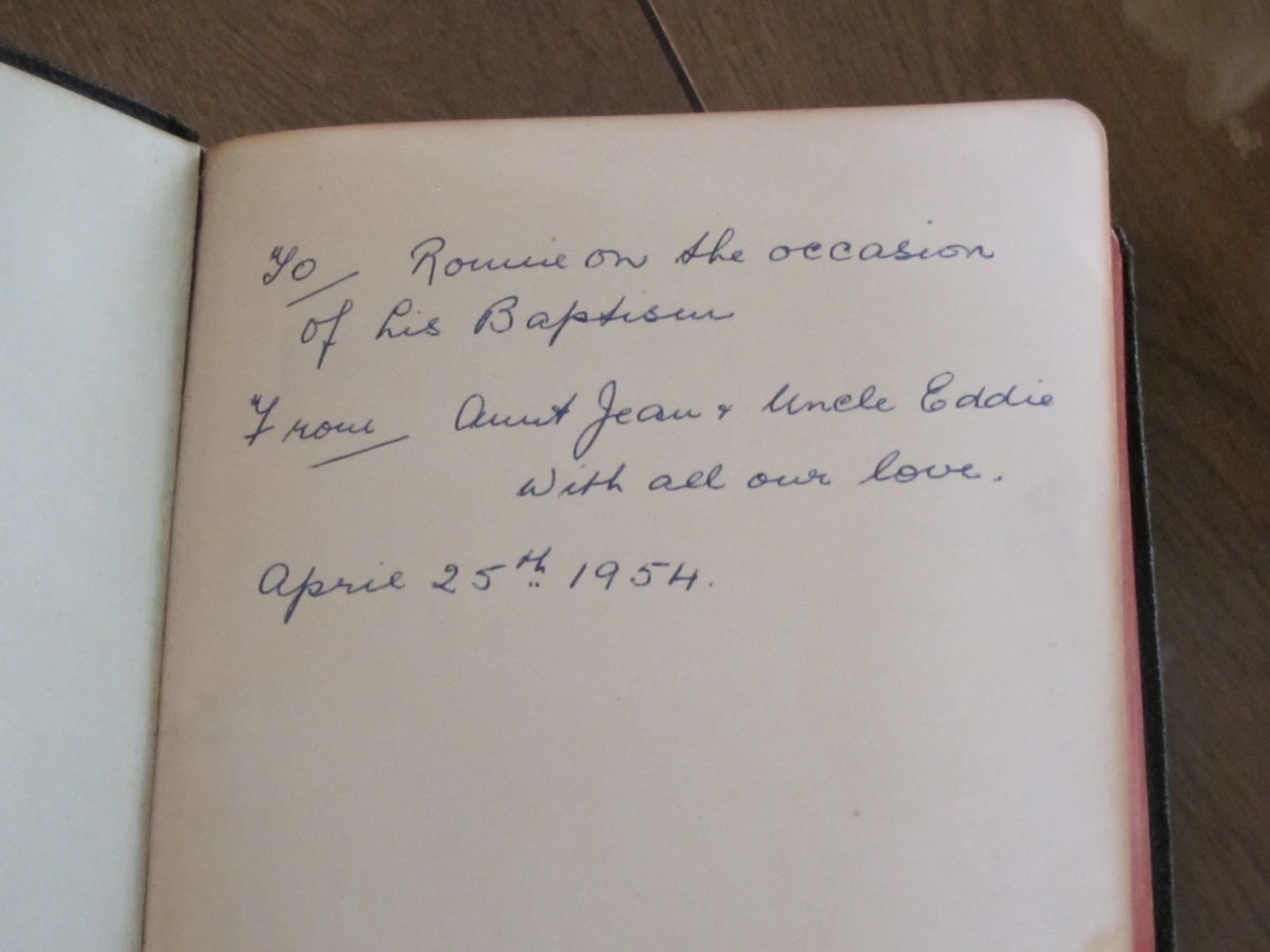
Bible on the bookshelf. I picked it up and opened it to my aunt's inscription, written
nearly 41 years to the day of our reception into the Church.
 It’s because of that inscription, and
the occasion it marks, that my Bible is never far from me; I look at it often
because it reminds me of the incredible journey I’ve been on, a long and hard
one, beginning with my baptism so long ago.
While it started with an ill-informed decision, I see it could only have
been through the working of the Spirit that I made it at all. Also, I can’t help but see that, when I chose
to run away from God, I left my Bible behind too. And when I woke up to the truth, my old
friend was there again to help me return to the God I thought I’d left behind
so long ago.
It’s because of that inscription, and
the occasion it marks, that my Bible is never far from me; I look at it often
because it reminds me of the incredible journey I’ve been on, a long and hard
one, beginning with my baptism so long ago.
While it started with an ill-informed decision, I see it could only have
been through the working of the Spirit that I made it at all. Also, I can’t help but see that, when I chose
to run away from God, I left my Bible behind too. And when I woke up to the truth, my old
friend was there again to help me return to the God I thought I’d left behind
so long ago.
Finally, my Bible shows me that God
can work in mysterious ways indeed. I
know my Scots Calvinist aunt had a plan that, in giving me that Bible, she thought
she was guiding me to become a Presbyterian minister. She could never have imagined it would lead
me to Rome instead. It calls to mind a
saying from that old Murphy’s Law calendar: “The best laid plans of mice and
men are usually about equal.” My Bible
offers daily proof of that, my own and my aunts. Come to think of it, maybe things haven’t
gone too wrong after all.
Thank you to Ronald for sharing with us. If you would be interested in participating in the "Your Bible" series, just send an email to me at: mccorm45(at)yahoo(dot)com.
Monday, May 20, 2013
George Weigel Quotes from the NAB!

As the Revised Standard Version renders the 14th chapter of the Acts of the Apostles, Paul and Barnabas remind the proto-Christians of Antioch that it is only “through many tribulations” that we enter the Kingdom of God. The New American Bible translation drives the point home even more sharply: “It is necessary for us to undergo many hardships to enter the Kingdom of God.”
The rest of the column entitled "Tribulation compounded by blasphemy" is fantastic and is well worth your time.
Wednesday, February 6, 2013
More NAB Bashing at First Things

So what is new with the latest article from Eleanor Pettus? Not too much really, except this time her main argument is that the NAB actually hinders Protestant conversions to the Church.
She says:
"Many Protestants believe, rightly or wrongly, that Catholics do not respect Scripture—they don’t want to revel in the God’s Word and get to know Him intimately through this great gift. The NAB is a confirmation to Protestants that they are right—Catholics, or at least the Catholic bishops, really don’t care. If they did, how could these leaders deny their people the liturgical use of a good translation?"
And then concludes her article with:
"The NAB is not just a problem for Catholics. If the Catholics are serious about wanting Protestants to 'Come Home' they need to give them a translation they can respect."
Having done ecumenical Bible studies for over ten years I have never heard any Protestant even mention that this was an issue. In my experiences, the vast majority of Protestants I know use some version of the NIV, not the "KJV, RSV, NASB, NKJV, ESV" that she recalls from her experiences in college. Just take a look at the most recent CBA sales ranking of Bible translations and you will see that the NIV remains ever popular, even though its most recent revision was panned by some in the Evangelical community. Consider how many people purchase and use a translation like Peterson's The Message, which is a true paraphrase. Other translations, like the NIV and NLT, which are more dynamic than the NAB(RE) in their translation style continue to be sold, not to mention the almost continuous publication of new translations in the Protestant community. So, personally, I do not buy this argument at all. If she means a certain segment of the Evangelical population won't accept the NAB then that is possible, but certainly not all or most Protestants.
Examining the specific complaints against the NAB, she brings up the usual whipping-boy verse found in the NAB, Isaiah 9:5:
"Truly, then, to a Protestant who has been raised to love and treasure the language of the word, the New American Bible or “NAB” used in most Catholic parishes is a scandal. To the Christian who knows little of sacraments and much of Scripture, a good translation provides their clearest window into the divine mystery. Yet the NAB’s terrible translations are in particular relief when Protestant strangers are most likely to be visiting. On Christmas we are forced to hear “Wonder-Counselor, God-Hero, Father-Forever, Prince of Peace”—in place of a verse which every English-speaking Christian knows because we’ve heard Handel. What editor thought it would be good to render those beautiful words in that way? One does not have to make an idol of Scripture to regard an unreadable translation as dishonorable."
Ouch! Of course, if you read the rest of the article, and most of the reader comments, very few other examples from the NAB are brought up. Nothing like referring to a translations as "terrible" yet only referencing one example. Now to be sure, the NAB, or the much improved NABRE, is not likely to win any literary awards anytime soon. Yet, it is still a very good translation overall, which I have tried to demonstrate on this blog from time to time. There are indeed places where I prefer renderings from a slightly more formal translation like the RSV, but having spent some time comparing the two over the past couple of years, including teaching both high school and adult learners, I believe that the main complaints against the NAB are greatly exaggerated. So, for example, while I think the RSV does a better job, overall, with a book like Genesis, I would prefer to use the NABRE when teaching from the Gospel of John. The NAB's renderings of John 1:18, the "Amen, Amen" sayings, and the all important "I AM" sayings makes it far better to teach from than the RSV since the Christological connections are handled better. So, in the end, I am very comfortable recommending the NABRE, as well as the RSV-2CE, to pretty much anyone who wants to study the Bible.
My advice is to own and use both for study, pick one as your daily reading Bible, and just stop the never-ending complaining. The NAB, in whatever form it takes during this next decade of revision, is not going away anytime soon. When completed, I believe it will be even better than the improved NABRE. Yet, no doubt there will continue to be its detractors. While there certainly has been enmity between those who like the NAB and those who don't since 1971, I think this continued assault on the NAB is actually harmful to the Church in America. The insinuation by the NAB haters always seems to be that the Bishops are either biblically unsophisticated or either greedy being only interested in gaining royalties from sales of the NAB. In either case, this kind of thinking promotes division during a time in our nation's history where we need to be supportive of our Shepherds. I pray that we do not find ourselves engaged in the same type of public disputes concerning translations that are found in some segments of the Evangelical community. While it is already present, to some extent, in the Catholic Church in America, I would hate to see the same kind of characterizations that occur in the Evangelical community, where the type of Evangelical one is (good/bad, liberal/conservative) being tied to the Bible translation they might read, whether the KJV, NASB, ESV, or NIV. Although I am afraid that we already see this, perhaps not as publicly though.
Am I saying that we shouldn't critique the NAB? By no means! (Or perhaps I should render that: "Of course not!") Rather, let us be glad that there are numerous good translations out there, including the NRSV, JB, NJB, CCB, NCB, Knox, and even the Douay-Rheims, for people to choose from. In discussing the revision of the NAB last summer, Cardinal Wuerl stated: "The goal — it’s a very simple goal — the goal is to produce a single translation, to arrive at a single translation." Ultimately, that translation is going to be the New American Bible.
My advice is to own and use both for study, pick one as your daily reading Bible, and just stop the never-ending complaining. The NAB, in whatever form it takes during this next decade of revision, is not going away anytime soon. When completed, I believe it will be even better than the improved NABRE. Yet, no doubt there will continue to be its detractors. While there certainly has been enmity between those who like the NAB and those who don't since 1971, I think this continued assault on the NAB is actually harmful to the Church in America. The insinuation by the NAB haters always seems to be that the Bishops are either biblically unsophisticated or either greedy being only interested in gaining royalties from sales of the NAB. In either case, this kind of thinking promotes division during a time in our nation's history where we need to be supportive of our Shepherds. I pray that we do not find ourselves engaged in the same type of public disputes concerning translations that are found in some segments of the Evangelical community. While it is already present, to some extent, in the Catholic Church in America, I would hate to see the same kind of characterizations that occur in the Evangelical community, where the type of Evangelical one is (good/bad, liberal/conservative) being tied to the Bible translation they might read, whether the KJV, NASB, ESV, or NIV. Although I am afraid that we already see this, perhaps not as publicly though.
Am I saying that we shouldn't critique the NAB? By no means! (Or perhaps I should render that: "Of course not!") Rather, let us be glad that there are numerous good translations out there, including the NRSV, JB, NJB, CCB, NCB, Knox, and even the Douay-Rheims, for people to choose from. In discussing the revision of the NAB last summer, Cardinal Wuerl stated: "The goal — it’s a very simple goal — the goal is to produce a single translation, to arrive at a single translation." Ultimately, that translation is going to be the New American Bible.
A couple of additional random thoughts:
1) Has Eleanor Pettus actually read significant portions of the new NABRE?
2) Does she know about the revision that will be taking place over the next decade?
3) What kind of Protestant is she referring to?
4) Why does there continue to be such venom out there for this translation?
5) This whole issue reminds me of a post I did a year ago concerning those who have labeled the NAB(RE) as a paraphrase. Utter nonsense.
6) I am surprised she didn't mention the NAB notes!
5) This whole issue reminds me of a post I did a year ago concerning those who have labeled the NAB(RE) as a paraphrase. Utter nonsense.
6) I am surprised she didn't mention the NAB notes!
Monday, December 10, 2012
Bible Gateway Now Has the RSV and NRSV

From the Blog:
We have some very exciting news today: the Revised Standard Version (RSV) and New Revised Standard Version (NRSV) Bibles are now available on Bible Gateway!
Both the RSV and NRSV have been published in several different editions for different audiences, and they’re all available on Bible Gateway. In addition to the RSV and NRSV, you’ll find the Anglicized NRSV, Catholic editions of the RSV and NRSV, and the Anglicized Catholic NRSV.
Monday, October 8, 2012
Infant Baptism and Matthew 19:13-15

Now what makes the NABRE more helpful than the RSV, particularly in regards to the issue of infant Baptism, is that the same Greek word κωλύω is also used in Acts 8:36, where Philip baptizes the Ethiopian eunuch. The NABRE reads: "As they traveled along the road they came to some water, and the eunuch said, 'Look, there is water. What is to prevent my being baptized?'" However, in the RSV-2CE, κωλύω is translated as "prevent" instead of "hinder" on this occasion. (This change also occurs in the original RSV and ESV.) So, by not consistently translating the Greek word κωλύω as "prevent" or "hinder" in both cases, the English language reader, using the RSV-2CE, may miss the connection.
And get this, the NABRE commentary, which is castigated more often than the translation itself, notes this important connection.
Friday, May 18, 2012
Dr. Peter Williamson on Ephesians for Ascension
Most of us will celebrate the Solemnity of the Ascension of the Lord this Sunday, instead of on its proper, biblical date of forty days after the Resurection, which was yesterday. In any case, the second reading we will hear has a number of options, most notably from St. Paul's Epistle to the Ephesians. Dr. Peter Williamson, professor at Sacred Heart Major Seminary in Detroit and editor of the Catholic Commentary on Sacred Scripture, offers the following reflection on Ephesians 4:9-10:
What does “he ascended” mean except that he also descended . . . ? What is Paul’s logic? Paul is interpreting Ps 68:19, which addresses God, saying, “You went up.” He makes the logical inference that to speak of God ascending implies that he had previously descended, since God’s dwelling is in heaven, above everything else. The Old Testament sometimes describes God’s intervention in human affairs as his coming down or descending (e.g., Gen 18:21; Exod 3:8).
Paul understands Ps 68 to be speaking of Christ. After all, it begins, “Let God arise, let his enemies be scattered” (RSV). When did God arise and scatter his enemies? At the resurrection of the Messiah, of course! And Paul tells us to where the Messiah descended: he went down into the lower [regions] of the earth. There are various interpretations of this descent. Most likely it refers either to Christ’s incarnation, when he emptied himself of heavenly glory (Phil 2:7) and came down among us (John 3:13), or to his burial in the earth. Alternatively, it could refer to Christ’s descent into the realms of the dead upon his death, where he preached “to the spirits in prison” (1 Pet 3:18–22).
In any case, the one who descended is the same person who has now ascended far above all the heavens, namely, Christ. As in Phil 2:6–11, Paul marvels that the one who came so far down has now been raised so high up. God had a purpose for this: that he might fill all things. Here, as in 1:23, “fill” means to exercise divine authority everywhere (echoing Jer 23:24) so that the Messiah might be Lord over all.
This reflection, as well as others, can be found on the CCSS blog. And yes, consider purchasing the CCSS commentaries!
What does “he ascended” mean except that he also descended . . . ? What is Paul’s logic? Paul is interpreting Ps 68:19, which addresses God, saying, “You went up.” He makes the logical inference that to speak of God ascending implies that he had previously descended, since God’s dwelling is in heaven, above everything else. The Old Testament sometimes describes God’s intervention in human affairs as his coming down or descending (e.g., Gen 18:21; Exod 3:8).
Paul understands Ps 68 to be speaking of Christ. After all, it begins, “Let God arise, let his enemies be scattered” (RSV). When did God arise and scatter his enemies? At the resurrection of the Messiah, of course! And Paul tells us to where the Messiah descended: he went down into the lower [regions] of the earth. There are various interpretations of this descent. Most likely it refers either to Christ’s incarnation, when he emptied himself of heavenly glory (Phil 2:7) and came down among us (John 3:13), or to his burial in the earth. Alternatively, it could refer to Christ’s descent into the realms of the dead upon his death, where he preached “to the spirits in prison” (1 Pet 3:18–22).
In any case, the one who descended is the same person who has now ascended far above all the heavens, namely, Christ. As in Phil 2:6–11, Paul marvels that the one who came so far down has now been raised so high up. God had a purpose for this: that he might fill all things. Here, as in 1:23, “fill” means to exercise divine authority everywhere (echoing Jer 23:24) so that the Messiah might be Lord over all.
This reflection, as well as others, can be found on the CCSS blog. And yes, consider purchasing the CCSS commentaries!
Tuesday, May 15, 2012
Weigel on Bible Babel

Weigel's argument consists of decrying the lack of Biblical literacy among Catholics since Vatican II, even though this was one of the Council's main objectives. At first, the main reason for this, he argues, is the promotion of the historical-critical method in both the parish and the academy. As he says, "the historical-critical method of biblical study has taught two generations of Catholics that the Bible is too complicated for ordinary people to understand." I tend to agree that for many years since the 60's too much emphasis, particularly by pastors, has been focused only on the historical-critical analysis of the text, to the neglect of principles of interpretation as set forth in CCC 112-114. Yet, it must be pointed out that, as Pope Benedict wrote in the preface to Jesus of Nazareth, the historical-critical method is an "indispensable tool" for studying the Bible. Without a doubt, there have been excesses in how the historical-critical method has been utilized, as the Pope has mentioned on numerous occasion. However, it remains an important tool for scripture study, even with its limitations. The Church supports its use and the historical-critical method will not be going away any time soon.
Next up on Weigel's list is the New American Bible, which he refers to as "the pedestrian translation to which U.S. Catholic are subjected in the liturgy." For a moment, I though I was reading an article by the late Fr. Richard John Neuhaus. We have had plenty of discussions about the NAB/NABRE on this blog, so I am not going to rehash my views about it. As I mentioned last year, I think the NABRE is a considerable improvement over the previous edition which allows it to stack up well against the RSV-CE in many ways. I wonder if he is even aware of the recent NABRE update, particularly with the improvements to the Psalter?
For the remainder of the article, Weigel follows very closely to Jeffrey's essay. He points out, and rightly so in my opinion, the proliferation of "niche" Bibles that are being published each year, like HarperOne's Green Bible or the Woman Thou Art Loosed edition. I might also point out the CS Lewis Bible, the American Patriot's Bible, or Joel Osteen's Hope for Today Bible. While I would agree that these are not necessary and my even be self-serving or simply money-making ventures, how am I to respond to some similar Catholic Bibles like the upcoming Saints Devotional Bible, the New Catholic Answers Bible, or even the CSSI Study Bible RSV-CE? There are certainly extremes, like the American Patriot's Bible, but is having various "niche" Bibles that focus on the Church Fathers or the Saints or Apologetics a bad thing? What about Youth Bibles?
Weigel, then, takes aim at the lack of traditional language found in many modern Bibles, most notably the Common English Bible. However, his complaint against the translation philosophy of the CEB, which avoids traditional terminology and classical English sentence structure as found in the KJV (or RSV), is actually represented in the NABRE, which he had previously panned earlier in the article. Just take a look at his example of Psalm 122:1 in the NABRE and the sacral vocabulary he promotes, both of which are typically found in the NABRE. Now, I am not saying the NABRE is identical to the RSV in this, but it is much closer to the RSV than the CEB.
Finally, Weigel concludes by writing: "My suggestion is to get yourself the Ignatius Press edition of the Revised Standard Version, and read it over and over again until its language works its way into the crevices of your mind and the texture of your prayer. Maybe, some day, we can hear that translation at Mass." A couple of thoughts immediately pop into my mind. First, yes! We need to read good versions of the Scriptures over and over again, so, I completely agree with him there. However, is the RSV-CE the only acceptable version for Catholics? Second, is Weigel aware of the RSV-2CE? Third, does sacral language mean using archaic English? Fourth, what are the benefits of memorizing the Holy Scriptures from a translation which will never likely be heard at a majority of English-speaking Catholic Masses? Remember, the NAB is not likely to change in the USA anytime soon, the NRSV is approved in Canada, and the ESV is being prepared for many of the remaining English-speaking countries.
Your thoughts?
HT: Reader Tim
Thursday, December 15, 2011
The Offering of Leviticus 3
One of the things I do when I am preparing for a lecture for the CBSM class I teach is to compare the major translations as much as possible. This often means looking at the RSV, NRSV, and NABRE. This week, I am giving a summary lecture on the book of Leviticus. I am sure many of you know the old joke about those who desire to read the whole Bible in one year starting on January 1, but stopping completely in February after reaching Leviticus. However, while perhaps the experience for some, its unfortunate because Leviticus is an important book, not only for understanding Jewish worship, but also for coming into a more profound understanding of Christ's sacrifice on the Cross. You cannot fully understand a book like Hebrews, unless you have spent some serious time reading and meditating on Leviticus. But before you begin a study of Leviticus, make sure to have a good commentary or study Bible while doing it. I would highly recommend Oxford's Jewish Study Bible and the Catholic Study Bible. Both are fantastic resources!
This brings me to Leviticus 3, which describes the third offering prescribed by God through Moses. (Please note that Leviticus 7:11-36 goes into more detail about the three different types of this offering.) Depending on the translation, the Hebrew word shelamim may be translated in a number of different ways. Often, it is referred to in English as the Peace Offering, which is followed most notably by the RSV. Some scholars prefer this due to the closeness to the Hebrew word shalom. However, the NRSV and JPS translations prefer to go with Well-Being Offering, which is connected to the idea of peace. Lastly, the NABRE (and the NJB) went with Communion Offering. So which one is better?
In this offering, a herd animal was brought to the sanctuary, divided into several parts with the fatty portions being placed on the fires of the altar and given to God. A choice portion was given to the priest, while the remainder was returned to the offerer and his family to be eaten. It seems that his type of offering was the most common. The note in the NJB gives a good indication as to why it was so popular: "In early times, this sacrifice was the most common and formed the central rite at festivals, being the most perfect way of expressing the communal life, covenantal bond and fellowship existing between the worshipper and his God." In addition, the note found in the JSB points out: "Well-being offerings are thus the natural expression of gladness, the worshipper celebrating by feasting in the presence of God in acknowledgment of His loving-kindness (210)." Finally, Fr. Lawrence Boadt, who died last year, insisted in his introduction to Leviticus in the CSB that our understanding of the Eucharist is greatly enhanced by what we find in Leviticus.
So, with that brief background I provided, both of the Hebrew term and the ritual of the shelamim offering/sacrifice, which English translation better captures the intended meaning?
This brings me to Leviticus 3, which describes the third offering prescribed by God through Moses. (Please note that Leviticus 7:11-36 goes into more detail about the three different types of this offering.) Depending on the translation, the Hebrew word shelamim may be translated in a number of different ways. Often, it is referred to in English as the Peace Offering, which is followed most notably by the RSV. Some scholars prefer this due to the closeness to the Hebrew word shalom. However, the NRSV and JPS translations prefer to go with Well-Being Offering, which is connected to the idea of peace. Lastly, the NABRE (and the NJB) went with Communion Offering. So which one is better?
In this offering, a herd animal was brought to the sanctuary, divided into several parts with the fatty portions being placed on the fires of the altar and given to God. A choice portion was given to the priest, while the remainder was returned to the offerer and his family to be eaten. It seems that his type of offering was the most common. The note in the NJB gives a good indication as to why it was so popular: "In early times, this sacrifice was the most common and formed the central rite at festivals, being the most perfect way of expressing the communal life, covenantal bond and fellowship existing between the worshipper and his God." In addition, the note found in the JSB points out: "Well-being offerings are thus the natural expression of gladness, the worshipper celebrating by feasting in the presence of God in acknowledgment of His loving-kindness (210)." Finally, Fr. Lawrence Boadt, who died last year, insisted in his introduction to Leviticus in the CSB that our understanding of the Eucharist is greatly enhanced by what we find in Leviticus.
So, with that brief background I provided, both of the Hebrew term and the ritual of the shelamim offering/sacrifice, which English translation better captures the intended meaning?
Monday, October 10, 2011
NOAB RSV Changes?
This news from reader Jonny:
I ordered The New Oxford Annotated Bible with Apocrypha (RSV) in genuine leather a few months ago, and have been very pleased with its overall quality and usefulness as a study tool. I was so impressed , in fact, that I ordered two more for relatives as a Christmas gift! I was very pleasantly surprised to see when I received these, that Oxford University Press has completely overhauled and improved the quality of construction of the book!
Yes, my first copy was probably the best quality and my overall favorite Bible to use for personal study, but it had a couple of small quirks that I did not really mind. It was in genuine leather, but it was kind of a stiff, leather wallet looking leather that bent inside with the spine when the book was opened. Also, there were small creases near the top inside corners at some places throughout.
The newer edition is just beautiful. It is still has the sewn binding, but it is bound in a softer, more textured genuine leather that does not bend inside the spine when opened. Also, it is slightly smaller. In addition to being an eighth of an inch shorter it is actually a half inch thinner (just a bit shy of 1 1/2/”)! And the amazing thing is that that the pages look more opaque than the previous edition.

I ordered these both times from Amazon and got them delivered with free shipping. I have found that usually the new products that are shipped by Amazon are the most current edition, so I think this change must be very recent. I did not think that I would ever see a Catholic-approved Bible (minus the “expanded” Apocrypha books included in this edition) that would rival the overall quality of the Cambridge KJV that I own, but I think Oxford has done it now.
I wonder if the leather cover is the same as the one use for the NOAB 4th edition?
I ordered The New Oxford Annotated Bible with Apocrypha (RSV) in genuine leather a few months ago, and have been very pleased with its overall quality and usefulness as a study tool. I was so impressed
 , in fact, that I ordered two more for relatives as a Christmas gift! I was very pleasantly surprised to see when I received these, that Oxford University Press has completely overhauled and improved the quality of construction of the book!
Yes, my first copy was probably the best quality and my overall favorite Bible to use for personal study, but it had a couple of small quirks that I did not really mind. It was in genuine leather, but it was kind of a stiff, leather wallet looking leather that bent inside with the spine when the book was opened. Also, there were small creases near the top inside corners at some places throughout.
The newer edition is just beautiful. It is still has the sewn binding, but it is bound in a softer, more textured genuine leather that does not bend inside the spine when opened. Also, it is slightly smaller. In addition to being an eighth of an inch shorter it is actually a half inch thinner (just a bit shy of 1 1/2/”)! And the amazing thing is that that the pages look more opaque than the previous edition.

I ordered these both times from Amazon and got them delivered with free shipping. I have found that usually the new products that are shipped by Amazon are the most current edition, so I think this change must be very recent. I did not think that I would ever see a Catholic-approved Bible (minus the “expanded” Apocrypha books included in this edition) that would rival the overall quality of the Cambridge KJV that I own, but I think Oxford has done it now.
I wonder if the leather cover is the same as the one use for the NOAB 4th edition?
Monday, June 13, 2011
Psalm 139 in the RSV
Recently, while I was doing an introductory talk on Scripture in front of a group of adults, in the middle of the talk I was inspired to refer and quote from Psalm 139. Of course, Psalm 139 is a fairly well-known Psalm, and I decided to quote from the middle portion of the Psalm, consisting of verses 13-18. I had my NOAB RSV with me at the time, so when I began to quote from it, I quickly had to choose whether or not to use the archaic language or translate on the fly. I decided to translate on the fly, and I must say that I fumbled through the verses. It didn't come off the way I had hoped.
Psalm 139: 13-18 (RSV):
"For thou didst form my inward parts, thou didst knit me together in my mother's womb. I praise thee, for thou art fearful and wonderful. Wonderful are thy works! Thou knowest me right well; my frame was not hidden from thee, when I was being made in secret, intricately wrought in the depths of the earth. Thy eyes beheld my unformed substance; in thy book were written, every one of them, the days that were formed for me, when as yet there was none of them. How precious to me are thy thoughts, O God! How vast is the sum of them! If I would count them, they are more than the sand. When I awake, I am still with thee."
Ultimately, in my attempt to make something, which I figured would be difficult for the audience to understand, more clear, I actually made it a lot worse. While this is hardly one of the more difficult passages in regards to archaic language, a few thoughts came to mind as I reflected on this incident:
1) Perhaps translating archaic language on the fly isn't the best idea. I always make sure that I am prepared when I give a talk, but I also try to be docile to the promptings of the Spirit as well.
2) Is having archaic language in my primary Bible a problem? Not sure. Certainly the RSV-2CE or NRSV are legitimate alternatives. (I should point out that this isn't an issue at my day job at the high school, since the Bibles we use with the students don't have archaic language in them.)
3) Is there any value to using a Bible that contains archaic language for the typical parish Bible study or introductory Scripture course? The audience matters, right?
Psalm 139: 13-18 (RSV):
"For thou didst form my inward parts, thou didst knit me together in my mother's womb. I praise thee, for thou art fearful and wonderful. Wonderful are thy works! Thou knowest me right well; my frame was not hidden from thee, when I was being made in secret, intricately wrought in the depths of the earth. Thy eyes beheld my unformed substance; in thy book were written, every one of them, the days that were formed for me, when as yet there was none of them. How precious to me are thy thoughts, O God! How vast is the sum of them! If I would count them, they are more than the sand. When I awake, I am still with thee."
Ultimately, in my attempt to make something, which I figured would be difficult for the audience to understand, more clear, I actually made it a lot worse. While this is hardly one of the more difficult passages in regards to archaic language, a few thoughts came to mind as I reflected on this incident:
1) Perhaps translating archaic language on the fly isn't the best idea. I always make sure that I am prepared when I give a talk, but I also try to be docile to the promptings of the Spirit as well.
2) Is having archaic language in my primary Bible a problem? Not sure. Certainly the RSV-2CE or NRSV are legitimate alternatives. (I should point out that this isn't an issue at my day job at the high school, since the Bibles we use with the students don't have archaic language in them.)
3) Is there any value to using a Bible that contains archaic language for the typical parish Bible study or introductory Scripture course? The audience matters, right?
Tuesday, June 7, 2011
Hell, Hades, Netherworld, or Powers of Death?

The discussion on Matthew 16 has continued into this week, with well over 35 comments. It has been a good discussion, which, at the very least, has shown the difficult task that translators have in both respecting and being true to the original languages, while making a translation understandable to a modern reader. It is certainly not an easy job, and I am thankful to those who devote their lives to this work.
I just wanted to make a few observations on the topic of Hades and Matthew 16. Feel free to disagree with me on this. I had always felt that the RSV's "powers of death" was a bit too free of a translation of "ᾅδου", and so was quite happy when the RSV-2CE, following the NRSV, changed it to "gates of hades". Literal is always better right? Well, I am not too sure in this case anymore. It is certainly the case that "hades" may confuse some readers, linking it to Greek pagan mythology as some astute comments have already pointed out. Yet, as Theophrastus said: "the NRSV and RSV-2CE (but not the RSV or RSV-CE) must be correct, because they simply repeat the Greek term."
Then there is the whole issue with CCC 633 which is about Christ's descent into "hell" or the "abode of the dead". So "hell" is legitimate and a traditional option for this translation as well. But as Jonny pointed out: "Modern translations ofter speak of this collectively as "Hades" or the "Netherworld" because the term "hell" has become synonymous with Gehenna in modern English." So there still is a bit of problem simply with translating it as "hell".
With all that being said, I am somewhat leaning towards the original RSV's "powers of death" simply because it does leave the term a bit ambiguous. Certainly, as Theophrastus points out, there needs to be at the very least a textual note indicated the Greek behind it, but also some commentary would be necessary as well. There is also the issue of consistency in translation of "ᾅδου", which would also need to be addressed.
I throw these thoughts out there for discussion. For my part, this has been a good exercise in the challenges of translation, hopefully it has been interesting as well for many of you. Thanks for all the interesting comments and links on this discussion thus far.
Tuesday, May 17, 2011
Sort of Retro Review: NOAB RSV Extended Edition

The New Oxford Annotated Bible RSV with Apocrypha Extended Edition is in many ways a remarkable study Bible. Not only because of its unique ecumenical origins, but more specifically because it has remained in print for over thirty years. Over the past thirty years, Oxford has published three additional editions of the NOAB, along with an augmented 3rd edition, with the NRSV translation, as well as two (and soon to be three) editions of the Catholic Study Bible NAB. Yet, the NOAB RSV remains in print, both in the hardbound and genuine leather edition. Why is that so?
In my mind there are a couple of reasons for this. First off, the RSV remains popular in a number of circles still today, most notably Catholic, some Orthodox, and the academy/seminary. The seminary where I received my degree encouraged the RSV-CE for its Scripture and theology classes. In addition, the RSV is still being published, in various editions, by Oxford University Press, Ignatius Press, Scepter, and Saint Benedict Press. It should also be noted that the RSV was the base text for the ESV and the RSV-2CE. It is used in the Catechism of the Catholic Church (English language edition), along with the NRSV, and is the main translation used in many of Pope Benedict’s works. Therefore, any thought that the RSV would recede into history with the publication of the NRSV in 1989 has simply not happened.
Secondly, the NOAB RSV is a beautiful and useful study Bible even today. Does it have a lot of the nice study aids that the current 4th edition does, like in-text maps and charts, a concordance, and updated essays? No. However, it does posses a number of advantages over the newer editions of the NOAB, not counting the use of the RSV (including 1971 updated NT). Here are a few:
** The overall size, while certainly not compact, is a very portable 9 x 6 x 1.7 inches.
** Strong binding and genuine leather cover. My edition has always opened flat from day one.
** The type and page layout is very readable. There are no paragraph headings, but that is easily resolved by examining the commentary which is organized by pericope. You can get a closer look of the page layout here.

** The inner margin, as well as the bottom of each page, provides enough space to include your own personal notes.
** The notes contain plenteous cross-references and concise, yet helpful commentary. Rarely does the commentary take up more than half of a page, usually around a quarter. The commentary gives you the basic historical information you would need in an academic study Bible. The Old Testament commentary does reference the New Testament, most often through cross-references. Even the Deuterocanonical/Apocrypha section, although unfortunately placed at the back, references New Testament allusions to these books. While the commentary is not Catholic, there has been very little that I could find objectionable. For example, while the section on John 6 could, one may argue, point out the Eucharistic overtones a bit more, there are other places, like in Matthew 13:55 which concerns Jesus’ “brothers”, which go out of their way to point out Catholic/Orthodox belief. If one keeps in mind that this is an ecumenical study Bible, he will find little to be concerned with.
For those of you who would like to have a one-volume study edition of the RSV, this is really your best, and perhaps only, option until the Ignatius Catholic Study Bible project is completed. I use this study Bible often and would recommend it to anyone.
(I did a shorter examination of this a few years back, which you can read here.)
Revised on May 18
Wednesday, May 11, 2011
Spot Check: Acts 2:14a, 36-41
This week, we will look at the first Sunday reading which comes from the Acts of the Apostles. Again, the translations below are the NAB(RE), RSV, and NRSV. As always, which one is which and what do you like/dislike?
1) But Peter, standing with the eleven, raised his voice and addressed them: 'let the entire house of Israel know with certainty that God has made him both Lord and Messiah, this Jesus whom you crucified.’ Now when they heard this, they were cut to the heart and said to Peter and to the other apostles, ‘Brothers, what should we do?’ Peter said to them, ‘Repent, and be baptized every one of you in the name of Jesus Christ so that your sins may be forgiven; and you will receive the gift of the Holy Spirit. For the promise is for you, for your children, and for all who are far away, everyone whom the Lord our God calls to him.’ And he testified with many other arguments and exhorted them, saying, ‘Save yourselves from this corrupt generation.’ So those who welcomed his message were baptized, and that day about three thousand persons were added.
2) Then Peter stood up with the Eleven, raised his voice, and proclaimed:
“Let the whole house of Israel know for certain that God has made both Lord and Messiah, this Jesus whom you crucified.” Now when they heard this, they were cut to the heart, and they asked Peter and the other apostles, “What are we to do, my brothers?” Peter said to them, “Repent and be baptized, every one of you, in the name of Jesus Christ for the forgiveness of your sins; and you will receive the gift of the Holy Spirit.For the promise is made to you and to your children and to all those far off, whomever the Lord our God will call.” He testified with many other arguments, and was exhorting them, “Save yourselves from this corrupt generation.” Those who accepted his message were baptized,and about three thousand persons were added that day.
3) But Peter, standing with the eleven, lifted up his voice and addressed them: 'Let all the house of Israel therefore know assuredly that God has made him both Lord and Christ, this Jesus whom you crucified." Now when they heard this they were cut to the heart, and said to Peter and the rest of the apostles, "Brethren, what shall we do?" And Peter said to them, "Repent, and be baptized every one of you in the name of Jesus Christ for the forgiveness of your sins; and you shall receive the gift of the Holy Spirit. For the promise is to you and to your children and to all that are far off, every one whom the Lord our God calls to him." And he testified with many other words and exhorted them, saying, "Save yourselves from this crooked generation." So those who received his word were baptized, and there were added that day about three thousand souls.
1) But Peter, standing with the eleven, raised his voice and addressed them: 'let the entire house of Israel know with certainty that God has made him both Lord and Messiah, this Jesus whom you crucified.’ Now when they heard this, they were cut to the heart and said to Peter and to the other apostles, ‘Brothers, what should we do?’ Peter said to them, ‘Repent, and be baptized every one of you in the name of Jesus Christ so that your sins may be forgiven; and you will receive the gift of the Holy Spirit. For the promise is for you, for your children, and for all who are far away, everyone whom the Lord our God calls to him.’ And he testified with many other arguments and exhorted them, saying, ‘Save yourselves from this corrupt generation.’ So those who welcomed his message were baptized, and that day about three thousand persons were added.
2) Then Peter stood up with the Eleven, raised his voice, and proclaimed:
“Let the whole house of Israel know for certain that God has made both Lord and Messiah, this Jesus whom you crucified.” Now when they heard this, they were cut to the heart, and they asked Peter and the other apostles, “What are we to do, my brothers?” Peter said to them, “Repent and be baptized, every one of you, in the name of Jesus Christ for the forgiveness of your sins; and you will receive the gift of the Holy Spirit.For the promise is made to you and to your children and to all those far off, whomever the Lord our God will call.” He testified with many other arguments, and was exhorting them, “Save yourselves from this corrupt generation.” Those who accepted his message were baptized,and about three thousand persons were added that day.
3) But Peter, standing with the eleven, lifted up his voice and addressed them: 'Let all the house of Israel therefore know assuredly that God has made him both Lord and Christ, this Jesus whom you crucified." Now when they heard this they were cut to the heart, and said to Peter and the rest of the apostles, "Brethren, what shall we do?" And Peter said to them, "Repent, and be baptized every one of you in the name of Jesus Christ for the forgiveness of your sins; and you shall receive the gift of the Holy Spirit. For the promise is to you and to your children and to all that are far off, every one whom the Lord our God calls to him." And he testified with many other words and exhorted them, saying, "Save yourselves from this crooked generation." So those who received his word were baptized, and there were added that day about three thousand souls.
Monday, March 28, 2011
More on Isaiah 7:14
Thank you to reader Keith for alerting me to this post from the new Speaking of Scripture blog. The post is by Dr. Peter Williamson, co-editor of the Catholic Commentary on Sacred Scripture. In his post, he discusses the recent news of the NABRE's decision to go with "young woman" over "virgin" for Isaiah 7:14. It is worth a read through.
Wednesday, February 23, 2011
Review: Cambridge RSV New Testament and Psalms

This is sort of a retro mini-review. I was blessed to receive a wonderful little pocket RSV New Testament and Psalms from reader Tim. So, thank you, once again, Tim!
This pocket RSV was published by Cambridge back in 2003, and I must say that it is a delightful little volume. The edition I received is the brown, French Morocco Leather one which has a similar feel to the NRSV Reference Bible with Apocrypha. For Catholics who are looking for a Bible with high quality leather binding, the Cambridge Bibles are often the number one option. What makes this pocket RSV so unique, besides the Moroccan leather binding, is the fact that the text is in a one-column format. This edition is very easy to read and definitely a pleasure for the eyes. An added bonus is that the paper is opaque, much like the NRSV Reference Bible with Apocrypha.
If you can find one, and you are a fan of the RSV, than I highly recommend it. One quick note, this Bible uses the 1971 revised RSV New Testament. Also, the only other pocket RSV that I can compare this to is the Ignatius RSV-2CE New Testament and Psalms. If you are looking for the non-archaic and updated RSV-2CE, than go with Ignatius. If you want a more high-end cover and binding, than the Cambridge edition will delight you! (For some additional photos of this edition, you can check out the listing on Amazon here.)
This pocket RSV was published by Cambridge back in 2003, and I must say that it is a delightful little volume. The edition I received is the brown, French Morocco Leather one which has a similar feel to the NRSV Reference Bible with Apocrypha. For Catholics who are looking for a Bible with high quality leather binding, the Cambridge Bibles are often the number one option. What makes this pocket RSV so unique, besides the Moroccan leather binding, is the fact that the text is in a one-column format. This edition is very easy to read and definitely a pleasure for the eyes. An added bonus is that the paper is opaque, much like the NRSV Reference Bible with Apocrypha.
If you can find one, and you are a fan of the RSV, than I highly recommend it. One quick note, this Bible uses the 1971 revised RSV New Testament. Also, the only other pocket RSV that I can compare this to is the Ignatius RSV-2CE New Testament and Psalms. If you are looking for the non-archaic and updated RSV-2CE, than go with Ignatius. If you want a more high-end cover and binding, than the Cambridge edition will delight you! (For some additional photos of this edition, you can check out the listing on Amazon here.)
Monday, February 7, 2011
Your Favorite RSV Edition

Yeah, I really like this Oxford RSV w/ Apocrypha 50th Anniversary Bible that reader Tim sent to me last week. It just has a really nice feel to it, and it truly is inviting to read. I don't say that often about most Bible editions, but this one really deserves it. As a matter of fact, I think I may look for one in genuine leather in the future.
So that brings me to my question for today, which hopefully will engage those of you who love the RSV. (BTW, I like the RSV quite a bit as well!)
What is your favorite edition of the RSV and why?
(Feel free to refer to the original, Catholic, w/Apocrypha, or RSV-2CE editions.)
Friday, February 4, 2011
Spot Check: NAB(RE) or RSV?
Today’s spot check comes from this coming Sunday's second reading from 1 Corinthians 2:1-5. It has become pretty obvious which one is which, but which one do you like best and why?
When I came to you, brethren, I did not come proclaiming to you the testimony of God in lofty words or wisdom. For I decided to know nothing among you except Jesus Christ and him crucified. And I was with you in weakness and in much fear and trembling; and my speech and my message were not in plausible words of wisdom, but in demonstration of the Spirit and of power, that your faith might not rest in the wisdom of men but in the power of God.
Or
When I came to you, brothers, proclaiming the mystery of God, I did not come with sublimity of words or of wisdom. For I resolved to know nothing while I was with you except Jesus Christ, and him crucified. I came to you in weakness and fear and much trembling, and my message and my proclamation were not with persuasive words of wisdom, but with a demonstration of Spirit and power, so that your faith might rest not on human wisdom but on the power of God.
When I came to you, brethren, I did not come proclaiming to you the testimony of God in lofty words or wisdom. For I decided to know nothing among you except Jesus Christ and him crucified. And I was with you in weakness and in much fear and trembling; and my speech and my message were not in plausible words of wisdom, but in demonstration of the Spirit and of power, that your faith might not rest in the wisdom of men but in the power of God.
Or
When I came to you, brothers, proclaiming the mystery of God, I did not come with sublimity of words or of wisdom. For I resolved to know nothing while I was with you except Jesus Christ, and him crucified. I came to you in weakness and fear and much trembling, and my message and my proclamation were not with persuasive words of wisdom, but with a demonstration of Spirit and power, so that your faith might rest not on human wisdom but on the power of God.
Tuesday, February 1, 2011
A Thank You

I just wanted to take a moment to thank reader Tim, who sent me a beautiful Oxford 50th Anniversary Edition Revised Standard Version w/Apocrypha. It really is a lovely reading Bible, due to its clear, readable print and overall size. Too bad that it appears to be out of print.
Thursday, January 20, 2011
Spot Check: NAB or RSV
The Gospel reading for Mass today comes from Mark 3:7-12. Below, I have placed two different translations of it, one from the NAB(RE) and the other from the RSV. Without cheating, which one is which? Which one do you prefer and why?
Jesus withdrew with his disciples to the sea, and a great multitude from Galilee followed; also from Judea and Jerusalem and Idumea and from beyond the Jordan and from about Tyre and Sidon a great multitude, hearing all that he did, came to him. And he told his disciples to have a boat ready for him because of the crowd, lest they should crush him; for he had healed many, so that all who had diseases pressed upon him to touch him. And whenever the unclean spirits beheld him, they fell down before him and cried out, "You are the Son of God." And he strictly ordered them not to make him known.
Or
Jesus withdrew toward the sea with his disciples.
A large number of people followed from Galilee and from Judea.
Hearing what he was doing,
a large number of people came to him also from Jerusalem,
from Idumea, from beyond the Jordan,
and from the neighborhood of Tyre and Sidon.
He told his disciples to have a boat ready for him
because of the crowd, so that they would not crush him.
He had cured many and, as a result, those who had diseases
were pressing upon him to touch him.
And whenever unclean spirits saw him they would fall down
before him and shout, “You are the Son of God.”
He warned them sternly not to make him known.
Jesus withdrew with his disciples to the sea, and a great multitude from Galilee followed; also from Judea and Jerusalem and Idumea and from beyond the Jordan and from about Tyre and Sidon a great multitude, hearing all that he did, came to him. And he told his disciples to have a boat ready for him because of the crowd, lest they should crush him; for he had healed many, so that all who had diseases pressed upon him to touch him. And whenever the unclean spirits beheld him, they fell down before him and cried out, "You are the Son of God." And he strictly ordered them not to make him known.
Or
Jesus withdrew toward the sea with his disciples.
A large number of people followed from Galilee and from Judea.
Hearing what he was doing,
a large number of people came to him also from Jerusalem,
from Idumea, from beyond the Jordan,
and from the neighborhood of Tyre and Sidon.
He told his disciples to have a boat ready for him
because of the crowd, so that they would not crush him.
He had cured many and, as a result, those who had diseases
were pressing upon him to touch him.
And whenever unclean spirits saw him they would fall down
before him and shout, “You are the Son of God.”
He warned them sternly not to make him known.
Subscribe to:
Posts (Atom)