Thursday, October 25, 2012

Sunday Knox: Jeremiah 31:7-9

Over the coming weeks, I am going to provide some passages from the Knox Bible in relation to an upcoming reading at Mass, Sunday or Holy Day.  I will place the Knox translation first, followed by the NAB lectionary version (including significant variations found in the NABRE in bold).  This week, I will be picking from the first reading from this Sunday's Mass, coming from the prophet Jeremiah:


“Rejoice, the Lord says, at Jacob’s triumph, the proudest of nations greet with a glad cry; loud echo your songs of praise, Deliverance, Lord, for thy people, for the remnant of Israel! From the north country, from the very ends of earth, I mean to gather them and bring them home; blind men and lame, pregnant women and women brought to bed, so great the muster at their home-coming. Weeping they shall come, and I, moved to pity, will bring them to their journey’s end; from mountain stream to mountain stream I will lead them, by a straight road where there is no stumbling; I, Israel, thy father again, and thou, Ephraim, my first-born son.” --Knox

“Thus says the LORD: Shout with joy for Jacob, exult at the head of the nations;
proclaim your praise and say: The LORD has delivered (saved) his people, the remnant of Israel. Behold (Look), I will bring them back from the land of the north; I will gather them from the ends of the world (earth), with the blind and the lame in their midst, the mothers (pregnant women) and those with child (those in labor); they shall return as an immense throng. They departed in tears, but I will console them and guide them; I will lead them to brooks of water (streams of water), on a level road, so that none shall stumble. For I am a father to Israel, Ephraim is my first-born.” 
-- NAB(RE)


Wednesday, October 24, 2012

The Anchoress + the Knox Bible

Reader Chad sent me an interesting link to Patheos and First Things blogger Elizabeth Scalia and her review of the Knox Bible.  It is definitely worth reading.  It was a reminder to me, at least, that there is a place for dynamic-equivalence translations.  As I refer back to Knox's On Englishing the Bible, it becomes very clear that Knox would have been a proponent of that style of translation.  I wonder what he would have thought about translations like the Jerusalem or New Jerusalem Bibles? Or how about the NLT?

At the end of her review Elizabeth mentions how she just opened to a particular verse of the Song of Songs in the Knox translation and:

Yes, I read it and I wept. Not in fear, not in despair, but in consolation at the reminder, rendered so beautifully by Knox, that the world has resided in the madness of sin and shadow since Eden, but we are never abandoned, and need never be afraid.

 It is always good to remember how powerful the Holy Scriptures can be, even in a non-formal translation.  Like I said, check it out.

Tuesday, October 23, 2012

Guest Blog: Overview of Knox Bible


Thank you to Jonny who provided this guest post, which will serve as a kick-off to an ongoing series of discussions surrounding the Knox translation.


There is much that can be said of Msgr. Knox’s translation of the Holy Bible.  First and foremost, it should be mentioned that the Knox version is a translation of the Clementine Latin Vulgate.  That is indicated quite clearly in the new edition from Baronius Press, on the title page which reads: “Translated from the Latin Vulgate by Msgr. Ronald Knox.”  However, in the old edition, (the one I am referring to is from Sheen and Ward in 1956) it states on the title page that it is “A translation from the Latin Vulgate in the light of the Hebrew and Greek originals.”  From that statement, I had previously thought that in places the Latin had been set aside in favor of Greek or Hebrew, according to the whim of the translator.  Yes, I thought that the Knox Bible was basically a hybrid translation, so I never really took it seriously.
            
After receiving the Baronius edition, with the complementary copy of Msgr. Knox’s “On Englishing the Bible,” I found that my assumptions were quite incorrect.  In the first article of the above mentioned book, Msgr. Knox states that it is the Clementine Vulgate he is translating, and he only goes back to other editions (Hebrew, Greek, critical editions of the Latin) to gain a better understanding of the Vulgate.  This is a big plus for me, and should be for anyone who likes to read the Douay Rheims Bible.  In the Knox translation, you have someone looking at the Vulgate and the other editions to give you a fresh translation of the Bible in lucid, modern English.  I don’t know of any other source that is more helpful to those who may struggle with the archaic English and sometime awkward sentence structures in the D-R, besides actually learning Latin and using the Clementine Vulgate itself!
           
So on to the translation itself.  Being, as it is, translated from the Vulgate, it is going to have many traditional renderings that Catholic Bible readers expect to see in a Catholic Bible.  In Genesis 3:15 you will find, “she is to crush thy head,” although regrettably the “enmities” from the Douay are replaced with “a feud.”  There are many places that I cheer the Knox translation, and in others I groan with disappointment.  I was pleased to see in many places that the angelic world was not translated out: such as in Psalms 103:4 “Thou wilt have thy angels be like the winds, the servants that wait on thee like a flame of fire,” the “angel” who “visits…with no kindly message” in Proverbs 17:11, and even “Lucifer” in Isaias 14:12.  Of course, fans of the Douay-Rheims will be pleased to see, “Hail, thou who art full of grace,” “Holy Ghost,” “charity” (often rendered “love” in modern versions), and the traditional spellings of the proper names.  Yes, there are many places in the Knox Bible I must applaud, and many places leave me longing for the more traditional renderings in the Douay, KJV, and RSV versions.  In particular I wish that Knox retained “spirit of God” in Genesis 1:2.  “Breath of God” is adequate as a translation, but after this verse was infallibly defined in the Catechism of the Council of Trent as a direct reference to the Holy Ghost (part 1, chapter II, question XXIII), it seems unnecessarily un-Catholic for a Catholic translation to render this phrase otherwise.
           
Finally, my biggest cheer for the style of the Knox version: the use of the singular and plural forms for the “you” pronouns.  Msgr. Knox reveals that he would have rather dispensed with the archaic pronouns altogether, but I am glad he felt compelled to leave them in.  The archaic forms reflect more accurately the original languages in this regard, and can give greater clarity to any given reading.  Consider Jesus words to Nicodemus: “Do not be surprised, then, at my telling thee, You must be born anew.”  Aside from this detail, there are examples all throughout the Knox Bible where the English is dignified, creative, and just plain fun to read.
            
One might get the impression in this article that I still prefer the Douay Rheims translation of the Vulgate, and that would be correct (no offence to Msgr. Knox.)  I am thinking now that I have the Baronius edition, it might get as much attention as my RSV!  Perhaps another top 5 Bible translations vote on the Catholic Bibles Blog is in order! 

Friday, October 19, 2012

The Holy Bible: Knox Version (Baronius Press)


One of the common complaints on this blog is the serious lack of quality, high-end Catholic Bibles.  While there are certainly enough good Catholic translations to choose from, the way in which they are produced often leaves a lot to be desired.  For example, the recently released HarperOne NABRE came in a very attractive page-layout, but the imitation leather cover and binding was a serious disappointment.  

When I look at the Bibles in my library, which are way too many if you ask my wife, the only one I would ever consider a premium Bible would be the Cambridge NRSV Reference with Apocrypha in French Morocco leather.  (Technically speaking, of course, that one is not even a specifically Catholic edition.)  However, I am happy to report, that I can now add another Bible to my list: The Knox Bible by Baronius Press.

This Bible is beautifully made and crafted in such a way that it will last a lifetime.  Here are the particulars of this new edition:
** The Bible comes in at a size of 6”x8 ¼”, encompassing 1,472 pages

**Set in a single-column format with verse references placed at the side of the text


**Printed on light cream paper


**Re-Typeset based on Burns & Oats and Macmillian & Co. 1963 edition


**Translator’s notes and cross-references are located at the bottom of each page


**Beautifully bound in hardcover (black leather) 1/8” thick, with gilt edges


**2 Ribbon Markers, headbands, and marbled endpapers


**Foreword by Scott Hahn


**Included with this new edition is a paperback copy of On Englishing the Bible by Knox 


**Imprimatur from Archbishop of Westminster Vincent Nichols dated 8th of January 2012

The Knox translation is certainly unique, however this review will not be analyzing the pros and cons of Msgr. Knox’s work.  I hope to do so in posts that will appear in the coming weeks that look at the translation in a bit more detail.  Instead, I am going to focus on the product itself.  But before I do, I thought it would be interesting to at least show you a bit of his style, by reproducing his version of the Christ-hymn of Philippians 2, with footnotes:

“Yours is to be the same mind which Christ Jesus shewed. 6 His nature is, from the first, divine, and yet he did not see, in the rank of Godhead, a prize to be coveted;[a] 7 he dispossessed himself, and took the nature of a slave, fashioned in the likeness of men, and presenting himself to us in human form; 8 and then he lowered his own dignity, accepted an obedience which brought him to death, death on a cross. 9 That is why God has raised him to such a height, given him that name which is greater than any other name; 10 so that everything in heaven and on earth and under the earth must bend the knee before the name of Jesus, 11 and every tongue must confess Jesus Christ as the Lord, dwelling in the glory of God the Father.”
  1. Philippians 2:6 ‘Did not see, in the rank of Godhead, a prize to be coveted’; others would render, ‘thought it no usurpation to claim the rank of Godhead’.
  2. Philippians 2:11 ‘Dwelling in the glory’; the Greek is perhaps more naturally rendered ‘to the glory’.
Now on to what Baronius Press has done with Msgr. Knox’s translation.   What immediately stands out is the craftsmanship involved in producing this volume.  (I have experienced this type of quality production before with their Little Office of the Blessed Virgin Mary volume.) The quality of the binding, the paper, ribbon markers, and endpapers make this Bible standout from all of the other ones I own.  This Bible is sturdy, yet very comfortable to read both by placing it flat on a table or by holding it in your hand or lap.  This is the case no matter where in the text you are reading, from Genesis to Revelation (the Apocalypse).  While this is not a portable, compact Bible, it can easily be brought to study and prayer groups, even Holy Mass.  It is simply a standard sized Bible.  I wonder if Baronius Press will eventually make different editions of the Knox Bible, like in a compact form or flexible leather, similar to what they have done with their Douay-Rheims editions.

For me, the highlight of this Bible is its single-column page layout.  It is very easy on the eyes, and the quality cream colored Bible paper minimizes any issues with ghosted print image from the reverse of the page.  That being said, I am not sure if I will ever write in this Bible.  It is just too pretty!  While having the verse numbers on the side can be a bit tricky at first, it becomes quite easy to use after only a few minutes.  The many notes, both textual and commentary, from Msgr. Knox are clearly visible at the bottom of each page.  I should mention that while there are not a ton of cross-references in this Bible, the notes in the New Testament do indicate where there are direct quotes from the Old Testament, as well as referencing similar passages found in the among the four Gospels.  In addition, there are cross-references in the notes in the Old Testament as well, but not as many as are found in the New Testament.    

If there is one criticism, and this is only minor, I would have appreciated a small selection of Bible maps in the appendix.  The older Knox Bible that I own contained two line-drawn maps, which would have been a nice conclusion to this beautiful Bible.  While it is always nice to have “the extras” with any Bible edition you purchase, the quality of this Bible allows me to easily overlook this minor omission. 

Having now spent a few days with the Knox Bible, as well as reading On Englishing the Bible, I want to conclude by making three comments.  First, bravo to Baronius Press for crafting such a beautiful Bible that I am sure will be appreciated by many people on both sides of the Atlantic.  The quality of this Bible is a testament to the attention and care that was given to its production.  There is no question that it was well worth the wait and the $54.95 price tag. 


Secondly, while there are certainly other translations that may be more useful for study, here I am thinking of the RSV, NRSV, or NABRE, the style of translation and flow of reading from the Knox Bible, even with the occasional archaic rendering or anglicized vocabulary, is refreshing and truly enjoyable to read.  I must admit that even though I own an older Knox Bible edition, I never did spend much time reading it because I just assumed that it would be too close to the Douay-Rheims in style.   I was wrong.  In a similar way, I can imagine that people who first experienced fresh translations like the Jerusalem Bible or New English Bible half a century ago, which departed from the Douay-Rheims or KJV traditions, had that same sort of feeling that I did as I began to read the Knox Bible.  I truly did not anticipate the amount of joy I would have reading through large portions of the Old and New Testaments in this translation over these past few days.  While this certainly has a lot to do with the translation, itself, Baronius Press must also be given credit for the achievement of this publication.  

Finally, having read all of Knox’s On Englishing the Bible, which I did in one sitting, along with my reading of the Knox Bible, the ultimate compliment I can pay to Msgr. Knox, as well as Baronius Press, is that I now have a greater desire to read more from Msgr. Ronald Knox.  His style of writing, and his unexpected wit and candor, I found to be very attractive and insightful.  I look forward to adding a few of his other works to my Christmas list.  I have avoided his writings for way too long.  Any recommendations?

Thursday, October 18, 2012

Jesus of Nazareth III due in December

Jesus of Nazareth III: His Infancy and Childhood will be released, in English, by Ignatius Press this coming December. Ignatius Press is already beginning to take pre-orders.

From Ignatius:
The momentous third and final volume in the Pope's international bestselling Jesus of Nazareth series, detailing the stories of Jesus' infancy and boyhood. This third part of the trilogy dedicated to Jesus of Nazareth begins with the Gospels and concludes with the contemporary man. 

 As the Pope wrote in volume two of this series, he attempts to "develop a way of observing and listening to the Jesus of the Gospels that can indeed lead to the personal encounter and that, through collective listening with Jesus' disciples across the ages, can indeed attain sure knowledge of the real historical figure of Jesus." 

 "I can at last consign to the reader the long promised little book on the narratives of Jesus' childhood . . . Here I have sought to interpret, in dialogue with exegetes of the past and of the present, what Matthew and Luke recount at the beginning of their Gospels about the infancy of Jesus." - Pope Benedict XVI

Wednesday, October 17, 2012

Knox Bible Arrives

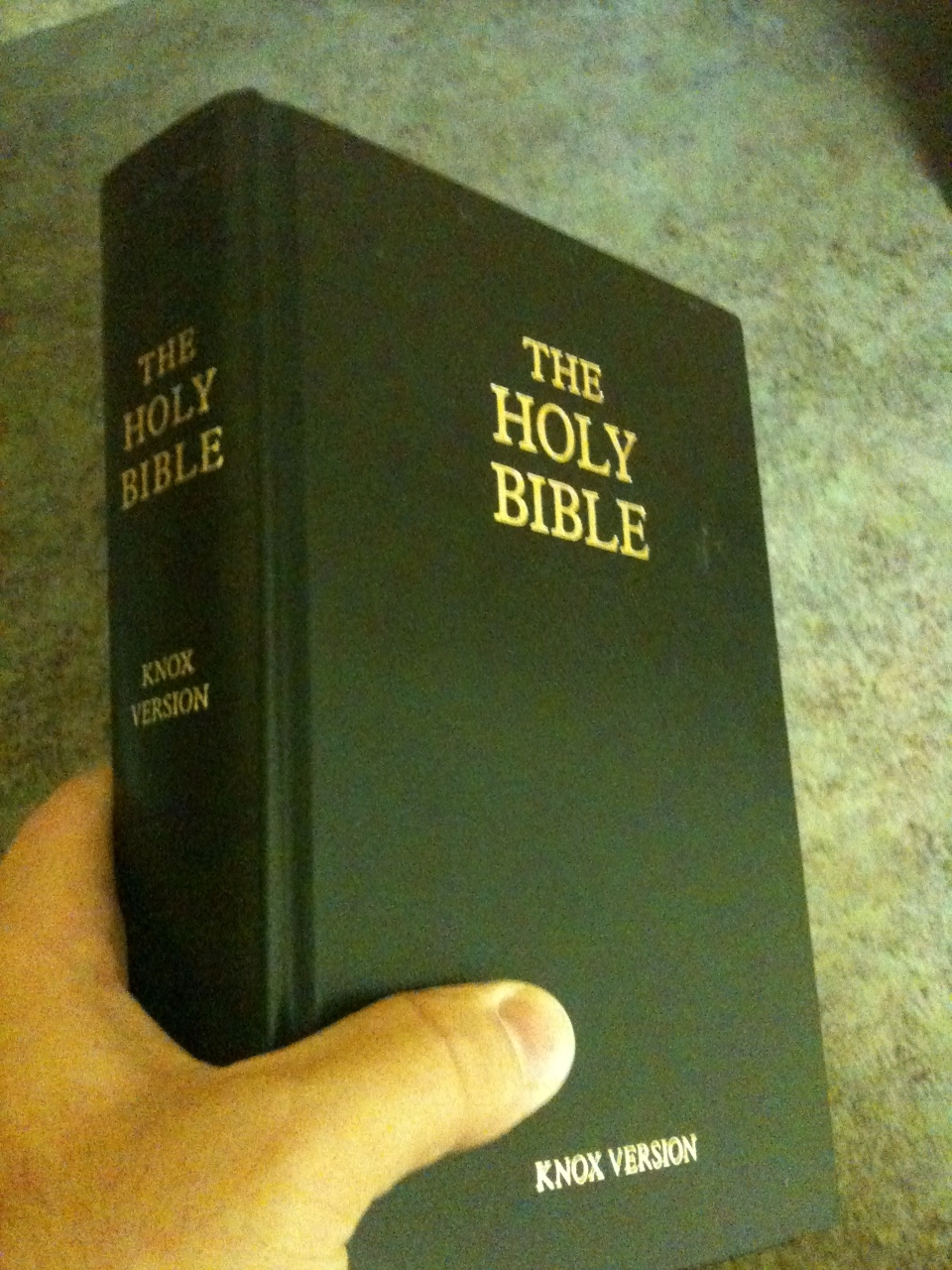
Baronius Press has kindly sent along to me a review copy of their new edition of the Knox Bible.  Without giving too much away before my formal review, I will say it is a high-end Catholic bible, produced by a group of people who clearly wanted to create a beautiful Catholic bible.  It was well worth the wait!

In addition to the Bible, all orders receive a very enlightening collection of essays called On Englishing the Bible by the translator himself.    Trust me, this is not just a throw-in, it is a very witty and honest account by Msgr. Knox about his translation of the Bible.

I hope to have the review up in the next couple of days or by early next week.  I should mention that reader Vincent commented on an early post that the Knox Bible is now available at Bible Gateway.  Included on the Gateway site is an endorsement from the Archbishop of Canterbury Rowan Williams, who says of the Knox Bible:
"Ronald Knox's translation of the Bible remains an exceptional achievement both of scholarship and of literary dedication. Again and again it successfully avoids conventional options and gives the scriptural text a fresh flavour, often with a brilliantly idiosyncratic turn of phrase. It most certainly deserves republication, study and use."