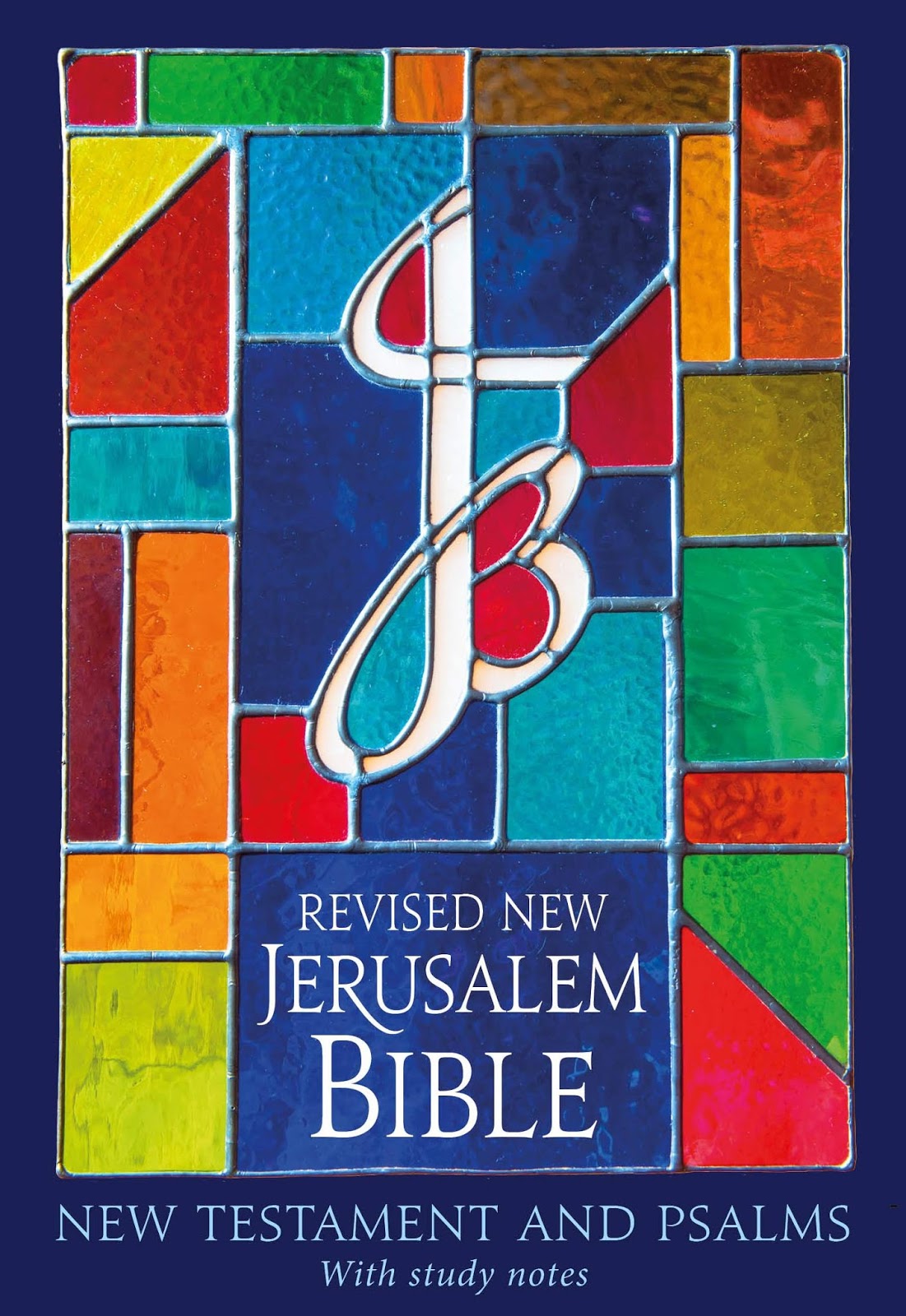
Showing posts with label Wansbrough. Show all posts

Monday, April 30, 2018

Fr. Henry Wansbrough Answers Your Questions


Henry Wansbrough, O.S.B., M.A., S.T.L., L.S.S., is an eminent biblical scholar and the General Editor of The New Jerusalem Bible and Revised New Jerusalem Bible. A Benedictine monk of Ampleforth Abbey in northern England, he received an M.A. from the University of Oxford, a Licentiate of Sacred Theology from the University of Fribourg, and a Licentiate in Sacred Scripture in Rome. A member of the Pontifical Biblical Commission from 1997 to 2007, he has published more than twenty books, numerous scholarly articles, and more than a thousand book reviews.


The NJB came about after the 1973 revision of the French JB. The French was revised again in 1998 but never addressed in a corresponding English revision. Does that edition serve as a reference for the RNJB now? If so how? 

I did not make any use of or reference to the 1998 French edition. For the translation I used Nestle-Aland 27 as a basis, and the Stuttgartensia, but not slavishly. In cases of doubt I used the apparatus criticus of these two editions, and in a few cases departed from those editions – not many. For the introductions and notes I simply used my judgment, right or wrong. I know I still have a lot to learn, but I did my best, and still listen attentively to many sources and try to keep up with current scholarship.
  

Does the RNJB Old Testament more closely follow the Masoretic text than the Jerusalem and New Jerusalem Bible?

I treated the Masoretic Text with great reverence, but kept constantly in mind that the LXX was the original Bible of the Christian Church  


You position the RNJB as a Bible for proclamation. Does that mean you adhere to the Nova Vulgata, per Liturgiam authenticum? If so, how and where does that affect the text away from the witness of the original languages?   

I am not sure that I adhered to the Nova Vulgata as closely as LA would like (certainly on the later books of the OT), but I bore in mind that it was an edition made by serious scholars. The RNJB is not a translation from Latin, but the scholars who toiled over the Nova Vulgata deserve respect, and their decisions are often worth considering. I had constantly in mind that the text should be proudly proclaimed.


Could you comment on the differences between translating by committee, versus working as an individual translator? What advantages or disadvantages might the RNJB enjoy over committee-based translations? 

A major advantage is consistency throughout the volume. Amusingly, despite Alec Jones’ list of contributors, I found many tricks of style constant throughout the original JB, which clearly stemmed from Alec. An individual does at least get the work done! For a committee you need either a brilliant group of dedicated friends (like the three editors of the Jerome Commentary) or unlimited funds and an outstanding chairman (like Bruce Metzger, who, incidentally, took the trouble to thank me for the NJB which was used for the NRSV). Do such Titans still exist?


What is the connection of the RNJB with the Ecole Biblique's "Bible in its Traditions" text (if any)? What is the role of the Ecole with the Jerusalem Bible tradition, at this point? Is the RNJB still a product of the Ecole, or have the two gone their own ways now?  

The RNJB has grown out of the Ecole, not least from my period of study there under such great scholars as Benoit and Boismard, not to mention Barthelemy, under whom I also studied, but it is more through the skills and ways of working acquired at that great institution (building on my Oxford training) than any actual theories. I have differed from all these three scholars just mentioned.


Why did you decide to prefer a formal equivalence style of translation over the more dynamic equivalence style of the original Jerusalem Bible and the New Jerusalem Bible?  

I was persuaded to it partly by the Australian Bishops, especially Mark Coleridge, for whose scholarship I have a high respect. It also shows that the RNJB stands in a great tradition, going back to Wm Tyndale.


Will the Old Testament continue to spell out the Divine Name, or follow the tradition of LORD?  

I don’t know what you mean by ‘spell out the Divine Name’, but we have kept to ‘Lord’ (small caps). I was on the Papal Biblical Commission when it was chaired by Ratzinger. One of his early acts as Pope was to ask us what we would do about this, and we made this decision as a body. I think it is the right decision, and I also have unlimited respect for Benedict XVI as a scholar and as a listener.


If this is essentially a whole new translation then why use “Jerusalem bible” in the title? Why not just give it a completely new translation name? 

1.     It is not wholly new.
2.     I have great respect for the Ecole and a great love for Jerusalem.
3.     Loyalty to DLT
4.     I am, after all, a Jew by birth.


Are discussions underway to revise the British lectionary around this translation? If so, how does Magnum Principiam change the process for approval? Did it allow you any greater freedom in your chosen rendering (vis a vis the preference for the Nova Vulgata mentioned above)? 

I am not party to the discussions of the EW Bishops’ Conference. If they ask me, I shall recommend that they adopt the RNJB. I was consistently conscious of the need for a revised lectionary, and hoped that the RNJB would be judged suitable. Many of the decisions were made with this possibility in mind.


If lectionary use was in mind during the revision process for the RNJB, were you able to consult with any representatives from the bishops' conference concerning the types of translation choices that would be needed to gain final approval? In the same vain, did you have any formal or informal access to information concerning the attempts of adapting the NRSV or the ESV by the ICPELL? 

I was, of course, Executive Secretary of ICPEL, but all our efforts were stymied by the working-methods of the Vatican. That Congregation is now under new management, Archbishop Arthur Roche! But the Congregation can act only on what is submitted to them by the local hierarchy.

  
Father Wansborough -- you have had a long and splendid career, and have touched many people with your writings and Bible translations. Looking beyond 2019, will you nominate a body or a person to manage future revisions or changes to the English Jerusalem Bible family of translations, or will the RNJB be the final word under the title of the "Jerusalem Bible"?

Thanks for the kind endorsement! I guess that the Lord will provide a scholar or scholars in due time with the necessary skill and enthusiasm to keep the tradition of translation and commentary going. I would not like to predict whether they will feel close enough to the tradition to continue to use the name. 


A big thank you, first of all, to Fr. Henry Wansbrough OSB for taking the time to answer these questions.  In addition, a special thanks to Chris Buckley for helping to facilitate this interview with David Moloney, Editorial Director at Darton, Longman & Todd.   

Friday, April 20, 2018

DLT's New RNJB Website

Darton, Longman, & Todd have created a lovely new website to showcase the upcoming release of the full Revised New Jerusalem Bible.  On the website, you can find info regarding the various editions (RNJB, NJB, JB) that are currently in print by DLT, but I would image that future editions of the RNJB will be posted as well.  You will also find a three part interview with Fr. Henry Wansbrough along with some other biographical and historical information.  Some really good stuff there, so make sure to check it out.

We will be hearing back from Fr. Henry at some point in the future after he is finished answering the questions we submitted to him.  So, stay tuned!

Monday, March 19, 2018

More on the RNJB and Your Chance to Submit a Question to Fr. Henry

Thanks to some inquiries sent to the Darton, Longman and Todd Ltd from frequent commentator and guest blogger Chris Buckley, I am happy to publish the responses from the editorial director at DLT David Moloney concerning the RNJB.


Questions Submitted by Chris Buckley to DLT Editor David Moloney:
1) Is this a new translation, or an "in house" editorial revision of the NJB (similar to the RSV-2CE from Ignatius Press)?

2) If it's a new translation, who is the translation team?

3) Is the the École biblique involved in these revisions at all? If so, is it based on its "Bible in its Traditions" text?

4) Will it carry an imprimatur?

Responses from David Moloney:
1) The RNJB is essentially a new translation, in that Fr Henry has returned to the original scriptures throughout (rather than just updating the NJB). In many cases he has made the same translation choices as he did for the NJB, so sections of the text have remained the same, but overall the extent of the differences between RNJB and NJB is substantial enough to call it a new translation.

The Study Notes have been completely replaced (with notes written by Fr Henry but only previously seen in the CTS Catholic Bible), bringing the scholarly content up to date. The Psalms for the RNJB, as you will have seen, now comprise Fr Henry’s slight adaptation of the 2010 Revised Grail Psalter.

2) Fr Henry is the principal translator, as he was for the NJB. He has consulted widely throughout this process – notably with Professor Francis J Moloney SDB (no relation!) on the New Testament, and Andrew Carter of Ampleforth College on the Old Testament.

3) Fr Henry has liaised with L’École Biblique throughout the process but they have not been directly involved in the translation.

4) The Old Testament has not yet been completely finalised but we have arranged with the Bishop’s Conference and the Department for Life and Worship to submit the full Bible for review for the imprimatur as soon as it is ready.


Your Chance to Ask Fr. Henry Wansbrough a Question.
In the past, we were blessed that people like Mary Sperry of the USCCB graciously responded to questions from you regarding the NABRE.  Now, we have a chance to ask Fr. Henry Wansbrough OSB, editor of the RNJB (and NJB), some questions concerning the new translation.  David Moloney of DLT offered to share some questions with Fr. Henry.  He said, "I would encourage you and other members of the blog forum to put together some questions that you would like to ask Fr Henry. It could prove a further opportunity for him to explain the reasoning behind the new translation, and the approach he has taken. I can ask him if he would be willing to answer a selection of questions if you think that would be helpful and of interest."

So, here are the rules for submission:
1) Submit your questions in the comment section of this post.  
2) Please make the questions concise and succinct
3) Please put a name (at least a first name) at the end of your question
4) Make sure to review the other questions that have been submitted so that there are no duplicates

Chris and I will review all the questions and select the ones that will be submitted to Fr. Henry for consideration.  Again, I'd like to thank Chris for taking the initiative in contacting DLT and making this a possibility.  


Thursday, February 8, 2018

RNJB on February 15th?

According to the Amazon listing, the Revised New Jerusalem Bible (NT and Psalms) will be published on February 15th.  The price is quite good, coming in under $10.  It will be interesting to see if this is the actual date of publication this time around.  A reminder that the Psalms appear to be the 2010 Revised Grail Psalms.  I have it pre-ordered and will let you know if I get a shipping notice.

Once again, here is the description:
A Bible for study and proclamation. The Revised New Jerusalem Bible presents anew the scholarship, character and clarity of the 1966 Jerusalem Bible (the first modern English version) and the 1985 New Jerusalem Bible. It is a Bible that prioritises accuracy of translation and richness of tone, written that `the message might be fully proclaimed' (2 Ti 4:17). This volume presents the full New Testament and the Psalms, and a comprehensive set of study notes, cross-references and book introductions. `Clear read' style. The biblical scriptures were written to be proclaimed, so the RNJB uses linguistic style and speech patterns best suited for being read out loud. Formal equivalence. The language, concepts and imagery of the original scriptures are presented more accurately by the RNJB than the colloquial approach of many other modern translations. Gender inclusion. The message of the Bible is for all people, so care has been taken to avoid traditional male bias of the English language, while remaining faithful to the meaning of the original scriptures. Revised Grail Psalter. The book of Psalms is based on the text of the 2010 translation of The Revised Grail Psalms. Modern measurements. Ancient systems of measuring and timing have been replaced by modern, metric equivalents. Comprehensive study notes. The notes, cross-references and book introductions of the JB and NJB are replaced in the RNJB by new materials which reflect the fruit of the most up-to-date and ecumenical scholarship. The Revised New Jerusalem Bible has been prepared and edited by The Revd Henry Wansbrough OSB, who was previously General Editor of the New Jerusalem Bible.

Friday, January 26, 2018

As You Await the RNJB

I have heard from quite a few of you regarding the rising interest in the RNJB.  Hopefully, an actual copy of the New Testament and Psalms will be available in a month or so for purchase.  Until then, the RNJB's editor, Dom Henry Wansbrough OSB has a number of books available for purchase.  The most recent is his Introducing the New Testament published in 2015.  Looks like a perfect companion to the RNJB NT.

Description:
Introducing the New Testament presents the complex and often challenging texts and history of the New Testament in a clear and informative manner. The book begins with a section that gives readers a clear idea of how to use it most effectively for study and personal research, followed by a chapter which outlines the various manuscript traditions and processes of transmission that resulted in the biblical texts we have before us today. With this groundwork complete, readers are then introduced to all the texts of the New Testament, and to major issues and debates such as the 'Historical Jesus' the 'Synoptic Problem' and current debates surrounding inspiration - how these texts can be seen in both a historical context and in the context of religious faith. The book features maps, chapter summaries, sample essay questions, chapter bibliographies and reading lists, and an annotated glossary of key terms

Tuesday, August 8, 2017

Revised New Jerusalem Bible

I spotted this on the very fine Facebook group, Catholic Bible Fans, via Llywellyn, the DLT (out of the U.K.) will be publishing a revised NJB New Testament and Psalms this November.  No word on whether there it will be published in the US at this time.  I'll look around.

Description:
Presenting the world’s first modern English Bible in a new light.
In 1966, Darton, Longman and Todd published the Jerusalem Bible, the first full translation of the Bible into modern English, with an acclaimed set of study notes. In 1985, it released the New Jerusalem Bible, an update of the Bible text for a fast-changing world. Now, after more than thirty years, DLT is preparing to publish the Revised New Jerusalem Bible – a substantial revision of the JB and NJB texts, and one which applies formal equivalence translation for a more accurate rendering of the original scriptures, sensitivity to readable speech patterns and more inclusive language. The RNJB is accompanied by a new, comprehensive set of study notes and book introductions enabling the Bible to be read with the insight, wisdom and understanding of the most up-to-date biblical scholarship.
The New Testament and Psalms will be published in November 2017, and the Full Bible will be published in the late spring of 2018. Both editions will contain the comprehensive study notes and book introductions.
The RNJB has been translated, and the notes and introductions written, by Dom Henry Wansbrough OSB, a monk of Ampleforth Abbey and one of the foremost biblical scholars of our day. Fr Henry was the translator and general editor of the NJB.
Dom Henry Wansbrough OSB is a monk of Ampleforth Abbey and one of the foremost biblical scholars of our day. Fr Henry was the translator and general editor of the NJB.

Tuesday, January 26, 2016

He Lives: The Passion, Death, and Resurrection of Jesus

This new audio set is by Fr. Henry Wansbrough, editor of the New Jerusalem Bible, is now available.  It is presented by Now You Know Media.  It is available in both CD and MP3 formats.  Seems like it would be a great resource for Lent.
Details:
No narrative is more beautiful than the Passion, Death, and Resurrection of Jesus Christ. Now, you can gain a deeper understanding of these powerful events with Fr. Henry Wansbrough, one of the world’s leading biblical scholars.
Although the story of Jesus’ Passion, Death, and Resurrection forms the core of Christian belief, the full depth of its meaning is often not immediately understandable to twenty-first century readers. Occurring some two thousand years ago, these events were narrated with the language and symbols of contemporaries in a civilization and culture considerably different from ours.
In He Lives: The Passion, Death, and Resurrection of Jesus, you will delve into the world of the biblical authors in order to understand the religious message of these events. As you do so, you will gain a deeper understanding of not only the historical context but also the profound theology expressed in these accounts.
You will journey through the gospel accounts of the Last Supper, the Agony in the Garden, Jesus’ interrogation, and His ultimate condemnation by Pontius Pilate, gaining deep insights into the theological and salvific nature of these events. After looking at the powerful themes of forgiveness in the Cross, you will consider what the Resurrection means for the mission of the Church and your own spirituality. Finally, you will explore the glorification and transcendence of the Risen Christ.
Embark on this journey of forgiveness, hope, and glory today.