

Showing posts with label CBQ. Show all posts
Showing posts with label CBQ. Show all posts
Monday, February 1, 2016


Tuesday, November 3, 2015

Wednesday, July 22, 2015

Monday, April 20, 2015
Catholic Biblical Quarterly (Vol. 77, No.2/April 2015)

Lance Hawley
Ecclesiastes 9:1-12: An Emphatic Statement of Themes
Addison G. Wright, P.S.S.
Creature Features: Monstrosity and the Construction of Human Identity in the Testament of Solomon
Thomas Scott Cason
Is the Lucan Jesus a "Martyr"? A Critical Assessment of a Scholarly Consensus
Brian J. Tabb
"I Rather Appeal to Auctoritas": Roman Conceptualizations of Power and Paul's Appeal to Philemon
Timothy A. Brookins
Objects of Mercy in Jude: The Prophetic Background of Jude 22-23
Darian Lockett
Thursday, January 22, 2015
Catholic Biblical Quarterly Vol. 77, No.1/ January 2015
.JPG)
Gary A. Anderson
Who Is Like David? Was David Like David? Good Kings in the Book of Kings
Alison L. Joseph
"There is Hope for a Tree": Job's Hope for the Afterlife in the Light of Egytpian Tree Imagery
Christopher Hays
What is Truth? Jesus, Pilate, and the Staging of the Dialogue of the Cross in John 18:28-19:16a
Sherri Brown
Acts 1:15-26 and the Craft of New Testament Poetry
Matthew G. Whitlock
A Christology of Incarnation and Enthronement: Romans 1:3-4 as Unified, Nonadoptionist, and Nonconciliatory
Matthew W. Bates
Wednesday, December 24, 2014
Catholic Biblical Quarterly Vol. 76, No. 4 (October 2014)
.JPG)
Dan Rickett
The Narratives of Numbers 20-21
Joel S. Baden
"Who Are You, My Daughter?" A Reassessment of Ruth and Naomi in Ruth 3
Edward Allen Jones III
The Davidic Key for Counting Generations in Matthew 1:17
Stephen C. Carlson
The Justice of the Gentiles: Revisiting the Purpose of Romans
Robert L. Foster
"They Are Not Gods!" Jewish and Christian Idol Polemic and Greco-Roman Use of Cult Statues
Nijay K. Gupta
Thursday, July 17, 2014
New CBQ: Volume 76, No. 3 (July 2014)
.JPG)
Andrew R. Davis
Prophecy and the Monarch in Haggai and Zechariah
Paul L. Redditt
Election by Allusion: Exodus Themes in the Book of Tobit
Francis M. Macatangay
Anna's Characterization in Luke 2:36-38: A Case for Conceptual Allusion?
Andres Garcia Serrano
"In the Father's Bosom": Breastfeeding and Identity Formation in John's Gospel
Alicia D. Myers
Memory and Hope in the Midst of Chaos: Reconsidering the Structure of 1 Thessalonians
Timothy Milinovich
Wednesday, April 23, 2014
Catholic Biblical Quarterly Vol. 76, No. 2 for April 2014
.JPG)
Peter Altmann
The Integrity of Job 1 and 42:11-17
Paul Kang-Kul Cho
Ezekiel's Image Problem: The Mesopotamian Cult Statue Induction Ritual and the Imago Dei Anthropology in the Book of Ezekiel
C.A. Strine
A Buried Pentateuchal Allusion to the Resurrection in Mark 12:25
Matthew Thiessen
Burning Questions in Romans 12:20: What is the Meaning and Purpose of "Coals of Fire"?
John W. Martens
"Noah, the Preacher of (God's) Righteousness": The Argument from Scripture in 2 Peter 2:5 and 9
Scott Hafemann
Friday, April 11, 2014
NABRE OT Textual Notes are Now Available Online

From the CBA:
Please note: To search these notes, two steps are needed: first search for the Old Testament book, then for the particular verse (colon between chapter and verse). Be sure you are at the text you are searching for, because there are many cross-references in these notes. We hope to have soon a more sophisticated program provided by the USCCB.
Thursday, March 20, 2014
1 Kings 18:27: Doing His Business

RSV:
And at noon Eli′jah mocked them, saying, “Cry aloud, for he is a god; either he is musing, or he has gone aside, or he is on a journey, or perhaps he is asleep and must be awakened.”
NRSV:
At noon Elijah mocked them, saying, “Cry aloud! Surely he is a god; either he is meditating, or he has wandered away, or he is on a journey, or perhaps he is asleep and must be awakened.”
NAB:
When it was noon, Elijah taunted them: "Call louder, for he is a god and may be meditating, or may have retired, or may be on a journey. Perhaps he is asleep and must be awakened.
NABRE:
When it was noon, Elijah taunted them: “Call louder, for he is a god; he may be busy doing his business, or may be on a journey. Perhaps he is asleep and must be awakened.
The NABRE's "He may be busy doing his business" was striking when I came across it. (The ESV and NLT have similar renderings, but the NABRE's is slightly different.) I decided to do a little research on this and fairly quickly found an old CBQ article from July 1988 by Gary A. Rendsburg about this verse. Rendsburg is a Jewish history professor at Rutgers. As Rendsburg points out: "In short, there is good reason to conclude that both elements in the hendiadys, siah and sig, refer to excretion and the phrase should be rendered 'he may be defecating/urinating.' These would certainly be powerful words from the mouth of Elijah and would be a most appropriate mock of the Canaanite god Baal (416)." Indeed it certainly would be. They also seem to fit the context of what Elijah is saying, more so than "meditating" or "musing" do. Elijah is calling-out the bogus god Baal and rendering him counterfeit.
It seems the vast majority of other translations do not follow this, the exception being the new NABRE Old Testament. If you go with interpretation, the next question is how to translate this into English. Do you go with something like "he may be defecating?" The ESV and NLT go with "relieving himself." Or perhaps, like the NABRE, do you go with a less explicit wording? I think most American readers will be able to understand what "doing his business" means, but would "relieving himself" have been a better rendering?
Tuesday, February 18, 2014
Catholic Biblical Quarterly Vol. 76, No. 1
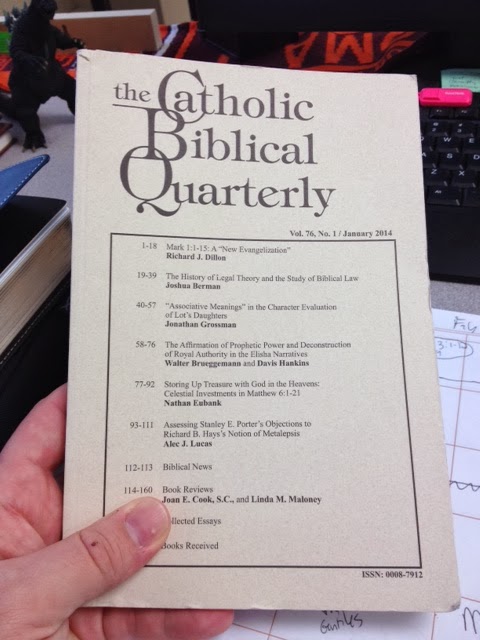
Catholic Biblical Quarterly
Vol. 76, No. 1/January 2014
Mark 1:1-15: A "New Evangelization"
Richard J. Dillon
The History of Legal Theory and the Study of Biblical Law
Joshua Berman
"Associative Meetings" in the Character
Evaluation of Lot's Daughters
Jonathan Grossman
The Affirmation of Prophetic Power and Deconstruction of
Royal Authority in the Elisha Narratives
Walter Brueggemann and Davis Hankins
Storing UP Treasure with God in the Heavens: Celestial
Investments in Matthew 6:1-21
Nathan Eubank
Assessing Stanley E. Porter's Objection to Richard B Hays's Notion of Metalepsis
Alec J. Lucas
Tuesday, October 29, 2013
Catholic Biblical Quarterly: October 2013
.JPG)
Forgiveness as Private and Public Act: A Reading of the Biblical Joseph Narrative
J. Gordon McConville
Love Is (Strong as) Death: Reading the Song of Songs through Proverbs 1-9
Kathryn Imray
Rebuke or Recall? Rethinking the Role of Peter in Mark's Gospel
Robyn Whitaker
Cloaks, Conflicts, and Mark 14:51-52
Erin Vearncombe
"Zealots for Good Works"
Benjamin J. Lappenga
Constructing Jesus and the Son of Man
Francis J. Moloney, SDB
Mary of Bethany and the Hermeneutics of Remembrance
Mary Ann Beavis
Monday, July 22, 2013
Catholic Biblical Quarterly July 2013 Articles

For July (Vol. 75, No.3):
"Who Would Not Write?" The Prophet as Yhwh's Prey in Amos 3:3-8
Sara J. Milstein
Newly Discovered Literary Devices in the Prayer of Habakkuk
Michael L. Barre, S.S.
Lord or God? Tobit and the Tetragrammaton
Daniel A. Machiela
Rachel's Cry for Her Children: Matthew's Treatment of the Infanticide by Herod
Eugene Eung-Chun Park
Deaf or Defiant? The Literary, Cultural, and Affective-Rhetorical Keys to the Naming of John (Luke 1:57-80)
Karl Allen Kuhn
The Eloquent Blood of Jesus: The Neglected Theme of the Fidelity of Jesus in Hebrews 12:24
Kevin B. McCruden
Synchrony and Diachrony in Contemporary Biblical Interpretation
Koog P. Hong
Subscribe to:
Posts (Atom)