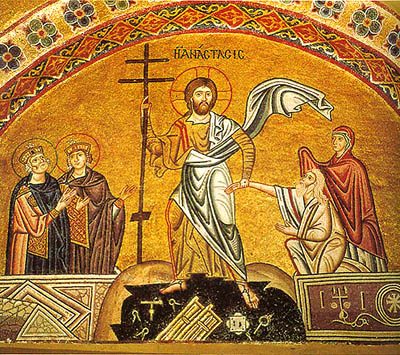
First off, a blessed Easter to you all! It is wonderful to be able to celebrate the risen Lord during this wonderful
octave of Easter, particularly as it leads up to Divine Mercy Sunday.
I have been doing a bit of thinking about study Bibles recently, including a few email discussions with some readers. I am always torn whether or not to invest in a single study Bible for everyday use. What do I mean by "invest"? While I certainly do have a number of hardcover study Bibles which I will refer to from time to time, the most recent being the
New Oxford Annotated Bible 4th Edition, I have never settled on one that would be considered my day-to-day study Bible of choice. You know, the one that I would use for Bible study and school, containing all of my own personal notes to go along side the commentary and notes supplied by the study Bible publisher. I was impressed a few years ago by someone who had their old Jerusalem Bible, which I think they received back in the 60's, that contained all of that person's personal notes and inspirations from the past 40 years. Although this Bible was written in over an almost 40 year period, it remained a constant companion for this person.
So, what to do? Well, I began thinking about what I would like in my ideal study Bible, while also seeing if any particular study Bible had everything I wanted. (English language study Bibles of course!) Of course, I knew that such a study Bible was not in print, nor probably would ever be. So here are a few of the components of a study Bible that I would like to see produced, with references to current study Bibles that fit each component. The order of each component is not necessarily in ranking order of importance in my mind.
1)
A Good Formal Equivalence Translation:
I am quite comfortable with the
NRSV, and to a lesser extend the RSV-2CE. I wonder if I will be adding the
NABRE to this list sometime next year. That would certainly make things interesting.
2)
Cross-References: Yes sir, those always important cross-references are a must for any good study Bible. While some study Bibles, mostly using the
NRSV, consign them to the commentary portion of the study Bible, I prefer them to be
separate. I think the
NJB (with all the notes and cross-references) does the best job at this. Of course this is aided by the fact that the
NJB comes in a single-column format, which is woefully represented in most study Bibles applicable to Catholic readers. I should also mention that the Oxford NAB study Bibles also have a
separate location for cross-references, as well as the Ignatius RSV-2CE study Bible.
3)
Decent Margins: While having a smaller study Bible is nice, one thing that suffers is the size of the margins, which are a must if you want to write in your Bible. The original Oxford
Catholic Study Bible had some decent sized margins, but subsequent editions reduced their size considerably. The
NJB also gives a bit of room too!
4)
Comprehensive Maps: I love Bible maps, yes I said it. When I look at study Bibles, one of the first things I look at are the maps. Many of the newly released study Bibles contain not only end maps, but also incorporate additional ones in the text itself. I think the
HarperCollins Study Bible does a fine job, as well as the new
NOAB 4th Edition. Let me just say that I have looked at the
ESV Study Bible, which I think does a really great job with maps, charts, and diagrams.
5)
Concordance: It's nice to have, but not a deal breaker for me. Most study Bibles contain one, so this is not much of an issue really. The one exception is the
New Interpreters Study Bible.
6)
Multiple Cover Editions: If I am going to get an everyday study Bible, I would prefer it to be in a genuine leather cover or perhaps the new imitation/Italian
DuoTone style. The Oxford study Bibles, whether
NRSV or NAB, typically come in paperback, hardcover, and leather. Funny enough, the most recent
HarperCollins Study Bible only comes in hardcover and softcover, but no leather option, even though the earlier edition did.
7)
Lectionary: As a Catholic, I think every Catholic Bible, even a study Bible, should contain at least the Sunday l
ectionary readings. The complete, Sunday and weekday, would be even better. The
Catholic Study Bible NAB does this, but few others include the
lectionary readings.
8)
Historical Notes/Theological In-Text Boxes: I prefer that the commentary at the bottom of the page be focused on historical data. For the most part, I think the Oxford
NRSV study Bibles do a good job with this. In additional, however, I would like to see important Catholic theological information, with references to the
Catechism of the Catholic Church, displayed at appropriate locations in the Biblical text. For example, one could see an in-text box placed at 2 Maccabees 12 discussing prayers for the dead and purgatory, with references to the entries on this topic in the
CCC.
So, these are just a few of my thoughts on the issue of study Bibles. Feel free to add or subtract some from my ideas. I may add a few more over the next few days.