
Monday, September 8, 2014
International Contest Winner
The winner, via random number generator, is John Blake from Ireland. John, please send me an email, mccorm45(at)yahoo(dot)com, with your full address. Thanks to all who entered this contest.


Sunday, September 7, 2014
Sunday's Message

One of my hopes for doing this new series is to have a lively discussion on the renderings, compared to the more formal ones we are use to reading and hearing at Mass. Is there a place for a translation like this? Could this be a good Bible to give to a Catholic "seeker" or young adult?
First Reading
Ezekiel 33:7-9
“You, son of man, are the watchman. I’ve made you a
watchman for Israel. The minute you hear a message from me, warn them. If I say
to the wicked, ‘Wicked man, wicked woman, you’re on the fast track to death!’
and you don’t speak up and warn the wicked to change their ways, the wicked
will die unwarned in their sins and I’ll hold you responsible for their
bloodshed. But if you warn the wicked to change their ways and they don’t do
it, they’ll die in their sins well-warned and at least you will have saved your
own life."
Psalm 95:1-2,
6-7b, 7c-9
Come, let’s shout praises to God,
raise the roof for the Rock who saved us!
Let’s march into his presence singing praises,
lifting the rafters with our hymns!
So come, let us worship: bow before him,
on your knees before God, who made us!
Oh yes, he’s our God,
and we’re the people he pastures, the flock he feeds.
Drop everything and listen, listen as he speaks:
“Don’t turn a deaf ear as in the Bitter Uprising,
As on the day of the Wilderness Test,
when your ancestors turned and put me to the test.
For forty years they watched me at work among them,
as over and over they tried my patience.
Second Reading
Romans 13:8-10
Don’t run up debts, except for the huge debt of love you
owe each other. When you love others, you complete what the law has been after
all along. The law code—don’t sleep with another person’s spouse, don’t take
someone’s life, don’t take what isn’t yours, don’t always be wanting what you
don’t have, and any other “don’t” you can think of—finally adds up to this:
Love other people as well as you do yourself. You can’t go wrong when you love
others. When you add up everything in the law code, the sum total is love.
Gospel
Matthew 18:15-20
Jesus said to his disciples:
“If a fellow believer hurts you, go and tell him—work it
out between the two of you. If he listens, you’ve made a friend. If he won’t
listen, take one or two others along so that the presence of witnesses will
keep things honest, and try again. If he still won’t listen, tell the church.
If he won’t listen to the church, you’ll have to start over from scratch,
confront him with the need for repentance, and offer again God’s forgiving
love.
“Take this most seriously: A yes on earth is yes in
heaven; a no on earth is no in heaven. What you say to one another is eternal.
I mean this. When two of you get together on anything at all on earth and make
a prayer of it, my Father in heaven goes into action. And when two or three of
you are together because of me, you can be sure that I’ll be there.”
Friday, September 5, 2014
Wednesday, September 3, 2014
7 Questions: William Griffin
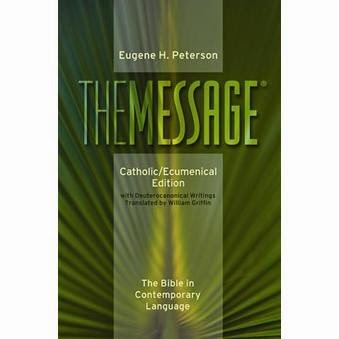
William Griffin, a well-respected Catholic writer and translator and friend of Eugene Peterson, translated the Deuterocanonical books that first appeared in the Catholic/Ecumenical Edition in September 2013 from ACTA. I would like to thank him for taking the time to answer these questions.
You can read more about The Message: Catholic/Ecumenical Edition here. In addition, last year I did an interview with ACTA publisher Greg Pierce, which you can read here.
You can read more about The Message: Catholic/Ecumenical Edition here. In addition, last year I did an interview with ACTA publisher Greg Pierce, which you can read here.
1) Eugene
Peterson describes you in the introduction as "an excellent writer and
translator who understands exactly what I have tried to do in The Message but
also a friend and colleague of many years whom I can trust to carry on my work
into this new edition." That is quite an endorsement. So as
we begin this interview, could you start by telling us a little bit about
yourself? Have you always been involved in areas of scripture and
translation? How did you get started?
Bostonian. Jesuit educated. Former Jesuit. New York: Harcourt and Macmillan editor. New Orleans and Alexandria, Louisiana: freelance writer, editor, translator. No, I haven’t always been involved in scripture or translation.
Bostonian. Jesuit educated. Former Jesuit. New York: Harcourt and Macmillan editor. New Orleans and Alexandria, Louisiana: freelance writer, editor, translator. No, I haven’t always been involved in scripture or translation.
2) Can you
talk a little about your connection to Eugene Peterson and his description of you
as one "who understands exactly what I have tried to do in The
Message."
Eugene and I have talked many times about scripture and translation, resulting in, among other things, an essay of mine, “In Praise of Paraphrase.”
Eugene and I have talked many times about scripture and translation, resulting in, among other things, an essay of mine, “In Praise of Paraphrase.”
3) How did you
come to be the translator of the Deuterocanonical books for the Message?
I auditioned for the job. When I heard that there would be a Catholic edition of The Message, I decided to send a sample. I translated the Book of Tobit. Months passed; I inquired. Yes, it got the job. It turned out that no one else had been asked for a sample. (Please note that the project took years to develop.)
I auditioned for the job. When I heard that there would be a Catholic edition of The Message, I decided to send a sample. I translated the Book of Tobit. Months passed; I inquired. Yes, it got the job. It turned out that no one else had been asked for a sample. (Please note that the project took years to develop.)
4) One of the
unique features of your translation of the Deuterocanonicals is the use of the
Nova Vulgata. This may be the first printed translation into English of
the Nova Vulgata. Why was it chosen, as opposed to the older editions of
the Vulgate or perhaps even the Septuagint? Were the any challenges in
translating from it?
When I asked Eugene what Hebrew text he used for his translation, he replied, the one he used at John Hopkins. Hence, when I came my time to pick a language for the Apocrypha / Deuterocanonicals, I could have picked Greek, but I chose Latin, Nova Vulgata (the Jerome Vulgate plus editorial tweaks to bring the text up to date). Please note. Why pick the the purest / oldest text (Septuagint)? Why not pick the latest, the Nova Vulgata? No particular challenge.
When I asked Eugene what Hebrew text he used for his translation, he replied, the one he used at John Hopkins. Hence, when I came my time to pick a language for the Apocrypha / Deuterocanonicals, I could have picked Greek, but I chose Latin, Nova Vulgata (the Jerome Vulgate plus editorial tweaks to bring the text up to date). Please note. Why pick the the purest / oldest text (Septuagint)? Why not pick the latest, the Nova Vulgata? No particular challenge.
5) One of my
favorite passages in the Deuterocanonicals is Baruch 3:9-15, 3:32-4:4, which is
one of the readings used for the Easter Vigil. In my opinion, you have
rendered it quite cleverly and in such a way that clearly brings out the
personification of Lady Wisdom. Could you talk a bit about your rendering
of this passage?
Abstract nouns in Latin and Greek are by and large feminine. From there it’s a hop, skip, and jump to personify them. Sometimes it works; sometimes it doesn’t.
Abstract nouns in Latin and Greek are by and large feminine. From there it’s a hop, skip, and jump to personify them. Sometimes it works; sometimes it doesn’t.
6) How do you
think the average Catholic could best utilize The Message:Catholic/Ecumenical
edition?
You’d have to ask Greg that. He’s the utilizer. I’m only the translator. But the average Catholic could do worse than read the book. Failing that, he could use the heavy volume for a doorstop.
You’d have to ask Greg that. He’s the utilizer. I’m only the translator. But the average Catholic could do worse than read the book. Failing that, he could use the heavy volume for a doorstop.
7) Do you
have a favorite verse or verses from the Deuterocanonical Books of The Message
that you translated ?
Verses are like children; I love them all.
Verses are like children; I love them all.
Monday, September 1, 2014
International Contest
.JPG)
1) USCCB's Pocket NAB Gospels and Acts
2) Jesus Shock by Peter Kreeft
3) Spirituality of the Psalms by Walter Brueggemann
4) Wrap Yourself in Scripture by Karen Kangas Dwyer
Rules for the contest:
1) If you have a website or blog or are active on Facebook, please announce this contest. If you don't, that is OK. You can still enter the contest.
2) Please enter your name and country in the comment section of this blog post. I will randomly draw one winner at the conclusion of the contest, which will be on Sunday September 7th 11:59 PM.
3) I will announce the winner on Monday September 8th. The winner must contact me, via email, within a week with their full name and address.
4) One entry per person.
5) This contest is open to anyone outside of North America.
Saturday, August 30, 2014
Sunday Knox: Jeremiah 20:7-9

Lord, thou hast sent me on a fool’s errand; if I played a fool’s part, a strength greater than mine overmastered me; morn to night, what a laughing-stock am I, every man’s nay-word! Long have I prophesied, and still I clamoured against men’s wickedness, and still cried ruin; day in, day out, nothing it earns me, this divine spokesmanship, but reproach and mockery. Did I essay to put the Lord out of my thoughts, and speak no more in his name, all at once it seemed as though a raging fire were locked in my bosom, pierced my whole frame, till I was worn out with it, and could bear no more.
NAB:
You duped me, O LORD, and I let myself be duped;
you were too strong for me, and you triumphed.
All the day I am an object of laughter;
everyone mocks me.
Whenever I speak, I must cry out,
violence and outrage is my message;
the word of the LORD has brought me
derision and reproach all the day.
I say to myself, I will not mention him,
I will speak in his name no more.
But then it becomes like fire burning in my heart,
imprisoned in my bones;
I grow weary holding it in, I cannot endure it.
The Message:
You pushed me into this, God, and I let you do it.
You were too much for me.
And now I’m a public joke.
They all poke fun at me.
Every time I open my mouth
I’m shouting, “Murder!” or “Rape!”
And all I get for my God-warnings
are insults and contempt.
But if I say, “Forget it!
No more God-Messages from me!”
The words are fire in my belly,
a burning in my bones.
I’m worn out trying to hold it in.
I can’t do it any longer!
Thursday, August 28, 2014
Subscribe to:
Posts (Atom)