Showing posts sorted by relevance for query Grail Psalms. Sort by date Show all posts

Saturday, January 15, 2011

Revised Grail Psalms Review


"The Lord is my shepherd:
there is nothing I shall want.
Fresh and green are the pastures
where he gives me repose.
Near restful waters he leads me;
he revives my soul.

He guides me along the right path
for the sake of his name.
Though I should walk in the valley
of the shadow of death,
no evil would I fear, for you are with me.
Your crook and your staff will give me comfort.

You have prepared a table before me
in the sight of my foes.
My head you have anointed with oil;
my cup is overflowing.

Surely goodness and mercy shall follow me
all the days of my life.
In the Lord's own house shall I dwell
for length of days unending."
- Psalm 23 (Revised Grail Psalms)

So there you have it, Psalm 23 of the Revised Grail Psalms. As many of you know, the USCCB decided to go with the Revised Grail Psalms for all future liturgical books. The Congregation for Divine Worship and the Discipline of the Sacraments gave its recognitio last March, so any future editions of liturgical books, like the Liturgy of the Hours, will contain this Psalter.

I received this lovely little paperback Revised Grail Psalms yesterday, and have spent some time looking at some of my favorite Psalms. The book comes with a copy of the recognitio from the Vatican, a short foreword by Cardinal George, and a very helpful introduction by Abbot Gregory J. Polan OSB of Conception Abbey. This 11 page introduction gives not only an informative history of the Grail Psalms going back to the 1963 edition, but also discusses why the Psalms are so important to Christian prayer. Abbot Polan rightly states: "How often in this quest do we find ourselves struggling to find words to express the manifold movements of the human heart! The Psalms provide a way into a unique chamber of the heart where one stands most free and open to God (xi)." I love the Psalms like many of you, so when I am looking at a particular translation usually the Psalms are the first place I go.

This new Psalter will read fairly close to the original 1963 edition, although there will be some noticeable differences. The Revised Grail Psalms follows the principles of the document Liturgiam Authenticam. This will become immediately noticeable when one looks at Psalm 8:5, where the more messianic "son of Man" translation is used. The primary source for the Psalter is Masoretic Text, but they do refer to the Septuagint and Vulgate when necessary.

Overall, this is a fine little book. Certainly those of you who love the Psalms and are daily readers of the Liturgy of the Hours, this book is for you. Anyone else who is interested in getting a preview of what Psalms will be sung at Mass in the future should also consider picking up a copy. Copies can be purchased online at the Printery House site in both a standard paperback edition, as well as a singing version.

Thursday, August 5, 2010

NRSV with Grail Psalms?

Perhaps one of my favorite things about running this blog are the occasional emails I get from readers who alert me to upcoming Bible releases. It is a real help to me, and so I thank all of you who have contacted me in the past with information on Catholic Bibles. I truly appreciate it! I have learned over the past year, particularly now as I am both married and expecting my first child in October, in addition to my ministry work at the high school, that I don't always have the time to spend hours searching different sites seeking the latest Catholic Bible releases. Yet, the Lord is good and always provides. So, again, I think you for your contributions, not only by emailing me, but also through our conversations on this blog.

Now on to the news at hand. Reader Kenneth emailed me this morning alerting me to a listing at Amazon.uk which suggests that Harper will be releasing an edition of the NRSV with the Grail Psalms. Interesting huh? Here is the description found on the site:

A new edition of the Bible aimed especially at Roman Catholics, including both the anglicized Catholic text of the NRSV translation, and the much loved Grail Psalms. For years, Catholics have been waiting for a Bible including both the NRSV Bible and the Grail Psalms. Now, it is here at last. The NRSV is increasingly becoming the most popular translation among Catholics, and it will be used in the new edition of the Lectionary which is coming soon. The much loved Grail Psalms are already in wide liturgical use, and will continue to be. This Bible also includes additional features such as Mass Readings and maps.

With a release date of February 3, 2011, this truly is a fascinating edition isn't it? Of course, we are all familiar with the CTS Bible, which contained the Jerusalem Bible, sans YHWH, with the Grail Psalms. The Amazon listing is for a hardcover volume with 1664 pages, but the Harper website mentions both leather and imitation leather editions. Very cool!

Some things to consider:

1) The Catholic Bishops of the UK are adapting the NRSV, much like Canada did, for liturgical use. Could there be a connection between that work and the Harper volume?

2) I wonder which version of the Grail Psalms will be included? Will it be the original, which is still in use in the Liturgy of the Hours and in the UK liturgy? Here in the USA, the Catholic Bishops, last year, approved the use of a new revised Grail Psalter to be used at Mass in the near future.

3) As I have mentioned before, I am really impressed with what Harper/HarperCollins/HarperOne has been producing, concerning it's line of NRSV Bibles. One doesn't have to be a fan of the NRSV to acknowledge this. Notice that this UK NRSV with Grail Psalms is published in the same month as the HarperOne edition of the NRSV Go-Anywhere Thinline Catholic Bible. The first true Catholic thinline Bible!

4) It is nice that publishers, and even Church leaders, in the UK, albeit Harper or CTS, are willing to develop a Bible for Catholics which generally match what they hear at Mass. Wouldn't that be nice?

I hope to have more information on this as the months go by. I would certainly be interested in hearing from some readers in the UK.

Thursday, November 13, 2008

Grail Psalms for Mass Approved by USCCB


Well, I spotted this bit of information on the Catholic News Service website. You can read the whole story here. It looks like the USCCB has decided to adopt the Revised Grail Psalms which are used at Mass in other English speaking churches, as well as in the Liturgy of the Hours, for the Mass in America. Currently, the Psalms heard at Mass here in the USA are from the original version of the New American Bible. As some of you know, this edition of the Psalms is currently unavailable, since a revised version was published back in 1991. The revised '91 NAB Psalms was not approved for liturgical use by the Vatican. As a matter of fact, the Vatican website uses the NAB as its English Bible, minus the Psalms. In my studies at seminary, I have seen very few people actually use it in class.

Probably the most important reason why I don't use the NAB is the terrible quality of the '91 Psalms. There are two main reasons for this:

1) Its use of inclusive language is too over the top in my mind. It makes the NRSV Psalms look conservative in that sense. While I don't have a huge problem with moderate horizontal inclusive language, the '91 NAB Psalms consistently uses vertical inclusive language in relation to God. See Psalm 136. Yuck!

2) The translation is just not good. For example, take a look at the much maligned NAB '91 Psalm 23:1-2: "The LORD is my shepherd; there is nothing I lack. In green pastures you let me graze; to safe waters you lead me" Graze? Really? Let's not over-use the sheep metaphor. I think I'd rather lie down. There is also the problem of the 91' Psalms working with the '86 Revised NAB NT. The revised NT I think is pretty good, but when doing cross-referencing with the '91 Psalms it is a mess. (see Psalm 8 and Hebrew 2).

What this all tells me is that the NAB is the mess I think it is. It must be embarrassing to some of the bishops. But, perhaps is there a silver lining? There has been rumours that a new edition of the NAB Old Testament is in the works. Perhaps could this recent decision to adopt the Grail Psalms be an indication that the revised OT will include another revision of the Psalms? Lets hope so! Below are some of the reasons for the switch to the Grail Psalms. Let us hope that this will inspire them to ditch the 91' NAB Psalms as well! (And please, make sure the verse numbering of the Psalms follows the standard usage of the RSV and all the other English Bible versions!)

Bishop Serratelli said "there were four reasons that his committee was recommending the Revised Grail Psalter over the Revised NAB version:

-- "It has been recommended by musicians for its musicality" and can easily be sung, chanted or recited.

-- It is faithful to the Hebrew text.

-- It is already "somewhat familiar" to those who pray the Liturgy of the Hours.

-- "While being faithful to Hebrew imagery and anthropology, it is critically aware of the Christological references."

Tuesday, March 8, 2011

Review: Collins NRSV-CE with Grail Psalms


Yesterday I received, from the UK, the recently released NRSV-CE with Grail Psalms. My order was placed through Amazon UK and took about a week to arrive. This edition is published by Collins and contains the NRSV-CE text and the original Grail Psalms. When I opened this Bible, I immediately had a feeling of familiarity as I flipped through the pages. Why? Well, the page format, type, and font is identical to the one used in the HarperCollins Catholic Gift Bible, which was released a few years back. The one major difference, however, is that there is a solid inch of space at the bottom of each page, presumably to allow for personal note taking. This edition also uses the same type of Bible paper as in the Catholic Gift Bible version, and appears to be of the same binding. The cover material is made of a very flexible leather-like material. The material is not as smooth as the one used for the Catholic Gift Bible. To be honest, I am not sure what the cover material actually is. One of the listings for this Bible said it was genuine leather, which it might very well be. If that is the case, then, I would say it is similar to the Saint Benedict Press genuine leather Bibles. The cover color is dark green.

The NRSV-CE with Grail Psalms has the standard NRSV text at the beginning, with the Grail Psalms placed at the back. Included with the Sacred Text is a concise concordance, information on the Lectionary, including the weekday and Sunday Mass readings, 6 black and white maps, and the always important Bible ribbon. But alas, the one thing that is missing, which as you all know continues to plague almost every edition of the NRSV, is, say it with me: “scriptural cross-references!” It was mentioned on a previous post that Collins plans to release a revised edition of this in the future, which would include the NRSV adaptions for the liturgy in the UK and the Revised Grail Psalms. It would be a great addition if in the future they included cross-references or at least a table of OT references in the NT, as found in the HarperCollins Study Bible.

Overall, this is a fine reading Bible. The size, while not being compact, does allow it to be fairly portable. If you love the original Psalms and the NRSV, there is no better Bible out there for you. The current price at Amazon UK is 22.50 pounds, which, with shipping, ended up costing me somewhere around 46 dollars US.

Monday, October 25, 2010

Collins NRSV with Grail Psalms

Yea, so I missed this comment at the original post on the Collins NRSV with Grail Psalms to be published in the UK. Thank you Sam for the following info.

Sam Richardson:

Hi there, I'm the editorial director at Collins, I can confirm a few points about this Bible. It will contain the current versions of the NRSV and the Grail Psalms that are used in the UK - if and when CBCEW approve revised versions for a new lectionary (as is happening in the US with the Grail Psalms and in Canada with the NRSV) then we will update this product accordingly. However, as the timings on this seem rather up in the air at the moment, we have decided to push ahead with this Bible now, as our survey data suggests catholics in the UK are now mostly buying NRSV for their personal study rather than JB. The Grail Psalms will be added at the back rather than in place of the NRSV Psalms.

Friday, March 14, 2014

More on the Death of the ESV Lectionary

For more, go here.

Here is the key section:

After 10 years of unsuccessful efforts by ICPELL, it became apparent that the whole lectionary project was in serious jeopardy. It had proved impossible to find a lectionary that suits the Holy See, the copyright holders of the scripture translations, and bishops’ conferences. Another issue was that the Revised Grail psalms, which were planned to be part of the revised lectionary, have also lost support in some quarters.
At the end of 2013 the decision was made to dismantle ICPELL and leave each conference of bishops to make its own decision regarding a lectionary for Mass. Consequently, the Australian Catholic Bishops Conference agreed to discontinue its involvement in the international lectionary project and to reprint the existing lectionary. It would contain a slightly modified version of the Jerusalem Bible currently in use and the Grail translation of the responsorial Psalms.
The general opinion is that some poor translations in the Jerusalem Bible are easily remedied and that other required changes to the text can be made fairly quickly.

So, there you have it.  Those who hoped for an ESV-CE can put that dream to rest.  So, what does that leave us with?  Well, from the article above, I would imagine that those other English speaking areas will follow suit and adapt the Jerusalem Bible.   My first question is why not spend a little more time and adapt the NJB.  It is better in almost every way compared to the original.  Also, I do find it interesting that the Revised Grail Psalms had "lost support."  I wonder if that is just in Australia or other places as well, like the UK?  So, then, it is quite possible that at some point we could have a different Psalter being used in the various English speaking territories.  That is just weird, and really I can't find another word to describe this situation.

What about that ever elusive dream of having a Bible, in hand, that actually matches what is read at Mass.  Will the Catholic Truth Society in London create a "new" CTS Bible after the UK bishops adapt the JB?  Will it include the original or revised Grail Psalms?  Is it possible, particularly after all the complaining here in the US, that the American bishops are the ones who actually pull off the unimaginable task of giving us a Bible that matches the lectionary?  It seems clear that the American Bishops are moving forward with the Revised Grail Psalms for future liturgical books, as well as the upcoming revised NABRE.  The revised NABRE NT provides the opportunity to do this.  Let's pray.

Monday, May 1, 2017

Guest Post: The NAB vs. the Lectionary (Feast of St. Mark)

Thanks again to Robert for doing this new series!


Feast of St. Mark the Evangelist

Entrance Antiphon
Mark 16:15b

Lectionary:
Go into all the world, and proclaim the Gospel to every creature, alleluia.

NAB 1970/1986
Go into the whole world and proclaim the gospel to every creature.

Nothing to see here, really.  I suppose the lectionary text is marginally more poetic.  Alleluia, of course, isn't from the bible text.  I suppose this is one of those little things that causes changing a lectionary to take a decade.

  
First Reading
1 Peter 5:5B-14

Lectionary:
Beloved:
Clothe yourselves with humility
in your dealings with one another, for:

God opposes the proud
but bestows favor on the humble.


So humble yourselves under the mighty hand of God,
that he may exalt you in due time.
Cast all your worries upon him because he cares for you.

Be sober and vigilant.
Your opponent the Devil is prowling around like a roaring lion
looking for someone to devour.
Resist him, steadfast in faith,
knowing that your brothers and sisters throughout the world
undergo the same sufferings.
The God of all grace
who called you to his eternal glory through Christ Jesus
will himself restore, confirm, strengthen, and establish you
after you have suffered a little.
To him be dominion forever. Amen.

I write you this briefly through Silvanus,
whom I consider a faithful brother,
exhorting you and testifying that this is the true grace of God.
Remain firm in it.
The chosen one at Babylon sends you greeting, as does Mark, my son.
Greet one another with a loving kiss.
Peace to all of you who are in Christ.


New American Bible 1970/1986
And all of you, clothe yourselves with humility in your dealings with one another, for:

“God apposes the proud
but bestows favor on the humble”

So humble yourselves under the mighty hand of God, that he may exalt you in due time.  Cast all your worries upon him because he cares for you.

Be sober and vigilant.  Your opponent the devil is prowling around like a roaring lion looking for someone to devour.  Resist him, steadfast in faith, knowing that your fellow believers throughout the world undergo the same sufferings.  The God of all grace who called you to his eternal glory through Christ Jesus will himself restore, confirm, strengthen, and establish you after you have suffered a little.  To him be dominion forever.  Amen.

I write you this briefly through Silvanus, whom I consider a faithful brother, exhorting you and testifying that this is is the true grace of God.  Remain firm in it.  The chosen one at Babylon sends you greeting, as does Mark, my son.  Greet one another with a loving kiss.  Peace to all of you who are in Christ.

Exactly the same except for the incipit, which provides an antecedent for the “you” in the reading as it appears in the NAB.


Responsorial Psalm
Psalm 89:2-3, 6-7, 16-17

Lectionary:
R. For ever I will sing the goodness of the Lord.
or:
R. Alleluia.

The favors of the LORD I will sing forever;
through all generations my mouth shall proclaim your faithfulness.
For you have said, "My kindness is established forever";
in heaven you have confirmed your faithfulness.


The heavens proclaim your wonders, O LORD,
and your faithfulness, in the assembly of the holy ones.
For who in the skies can rank with the LORD?
Who is like the LORD among the sons of God?


Blessed the people who know the joyful shout;
in the light of your countenance, O LORD, they walk.
At your name they rejoice all the day,
and through your justice they are exalted.


New American Bible 1970/1986:
The favors of the Lord I will sing
forever;
through all generations my mouth
shall proclaim your faithfulness.
For you have said, “My kindness is
established forever”;
in heaven you have confirmed
your faithfulness”

The heavens proclaim your wonders,
O Lord,
and your faithfulness, in the
assembly of the holy ones.
For who in the skies can rank with
the Lord?
Who is like the Lord among the
sons of God?


Happy the people who know the
joyful shout;
in the light of your countenance,
O Lord, they walk.
At your name they rejoice
all the day,
and through your justice they are exalted.


For contrast, the NABRE:

I will sing of your mercy forever, LORD
proclaim your faithfulness through all ages.
For I said, “My mercy is established forever;
my faithfulness will stand as long as the heavens.”

The heavens praise your marvels, LORD,
your loyalty in the assembly of the holy ones.
Who in the skies ranks with the LORD?
Who is like the LORD among the sons of the gods?

Blessed the people who know the war cry,
who walk in the radiance of your face, LORD.
In your name they sing joyfully all the day;
they rejoice in your righteousness.

And the Revised Grail Psalms:

I will sing forever of your mercies, O LORD;
through all ages my mouth will proclaim your fidelity.
I have declared your mercy is established forever;
your fidelity stands firm as the heavens.

The heavens praise your wonders, O LORD,
your fidelity in the assembly of your holy ones.
For who in the skies can compare with the LORD,
or who is like the LORD among the heavenly powers?

How blessed the people who know your praise,
who walk, O LORD, in the light of your face,
who find their joy every day in your name,
who make your justice their joyful acclaim.


The response is an adaptation of the 2nd verse of the psalm, which matches neither the lectionary text as the reader or cantor presents, nor the NAB.  The lectionary shows its allergy to the use of the word “happy” when “blessed” is an option.  I tend to agree with that decision.  Many translations seemed to opt for “happy” in the heady days of the mid 20th century, but I suppose the word simply seems banal and overused now. 

Here, the NABRE shows how one must take the sour with the sweet when it comes to formal equivalence translations.  “I will sing of your mercy forever, Lord” is magnificent in its simplicity and its beauty.  Other parts (“skies”, “sons of the gods”, “war cry”) remind us that the original context of the psalms was one much different from ours.  The world of the psalter is an untamed one, and to ignore that is frankly to ignore the psalter.  Notice the difference in Verse 3 between the NABRE and the original 1970 translation. 

As you may know, the Revised Grail Psalms are another choice for the liturgy.  Rumor was that it would become the norm for the Liturgy of the Hours and the Mass, but that may not end up occurring.  I am unsure if that would be because the Bishops' Conference is nervous about the official Psalter of the American Church being so tightly controlled by GIA or their not wanting to see the NABRE psalms orphaned after years of effort.  Perhaps someone with much more knowledge can add something to the conversation.

My first instinct while reading the responsorial psalms back to back to back is that the Revised Grail version is head and shoulders above the others, but I wonder what an expert in Hebrew poetry would think of this.  Like the Grail Psalms themselves, this revised version seems to be sandpapered of any rough edges and obscure bits.  In the NABRE, some of the psalms sound like dirges, some sound like war songs, and some sound like prayers.  In the Grail Psalms, by contrast, they all sound like prayers.  I'm not sure if that is a bad thing or a great thing.  The vocabulary of the Grail Psalms seems to have been preserved in this Revised Version—perhaps this joyous familiarity is simply that it sounds a lot like the Liturgy of the Hours. 

Alleluia Verse
1 Corinthians 1:23A, 24B

Lectionary:
We proclaim Christ crucified:
he is the power of God and the wisdom of God.

New American Bible 1970/1986:
But we proclaim Christ crucified, Christ the power of God and the wisdom of God.

Note that the NAB text would make more sense with I:23B included.  So far in this study, the lectionary seems to use the most freedom in the antiphons and alleliuia verse.  Here, the lectionary has mercifully added a verb to the final clause.  Perhaps some Greek expert will tell us if the NAB's odd syntax there is faithful to the Greek or simply a snatch of English which is odd to these ears.

Gospel
MK 16:15-20

Lectionary:

Jesus appeared to the Eleven and said to them:
"Go into the whole world
and proclaim the Gospel to every creature.
Whoever believes and is baptized will be saved;
whoever does not believe will be condemned.
These signs will accompany those who believe:
in my name they will drive out demons,
they will speak new languages.
They will pick up serpents with their hands,
and if they drink any deadly thing, it will not harm them.
They will lay hands on the sick, and they will recover."

Then the Lord Jesus, after he spoke to them,
was taken up into heaven
and took his seat at the right hand of God.
But they went forth and preached everywhere,
while the Lord worked with them
and confirmed the word through accompanying signs.

New American Bible 1970/1986

He said to them:
"Go into the whole world
and proclaim the Gospel to every creature.
Whoever believes and is baptized will be saved;
whoever does not believe will be condemned.
These signs will accompany those who believe:
in my name they will drive out demons,
they will speak new languages.
They will pick up serpents with their hands,
and if they drink any deadly thing, it will not harm them.
They will lay hands on the sick, and they will recover."

So then the Lord Jesus, after he spoke to them,
was taken up into heaven
and took his seat at the right hand of God.
But they went forth and preached everywhere,
while the Lord worked with them
and confirmed the word through accompanying signs.

These two texts are exactly the same except for the incipit and the deletion of the word “so” in the lectionary. 

Communion Antiphon
Matthew 28:20

Lectionary:
Behold, I am with you always, even to the end of the age, says the Lord, alleluia.

New American Bible 1970/1986:
And behold, I am with you always, until the end of the age.

The “and” which make this last verse of Matthew so pleasing to the ear is unnecessary when shorn of its context as an antiphon. 

Final observation:
The NAB 1970/1986 proves to be all but identical to the lectionary.

The first comparison with the NABRE reveals the limits of a formal equivalence approach to the Old Testament, as well as some of that translation's underrated beauty.

Monday, April 2, 2012

New Series: Mondays with the New Psalms

With the conclusion of the Mondays with Verbum Domini series a few weeks back, I wanted to initiate a new series of posts each Monday morning to fill the void. So, I have decided to begin a weekly post comparing the two most recent Catholic translations of the Psalms, the Revised Grail Psalms and the NABRE Psalms. Each Monday, I will post a particular Psalm in both translations, with limited comments, in hopes of initiating a discussion on them. Having returned to using the Little Office of the Blessed Virgin Mary on a daily basis, which relies heavily on Psalms 120-134, I am going to begin with the Psalms of Ascent (or Gradual Psalms).

Psalm 120

1 A song of ascents.
The LORD answered me
when I called in my distress:
2 LORD, deliver my soul from lying lips,
from a treacherous tongue.

3 What will he inflict on you,
O treacherous tongue,
and what more besides?
4 A warrior’s arrows
sharpened with coals of brush wood!

5 Alas, I am a foreigner in Meshech,
I live among the tents of Kedar!
6 Too long do I live
among those who hate peace.
7 When I speak of peace,
they are for war.

--NABRE


1 A Song of Ascents.
To the LORD in the hour of my distress
I call—and he answers me.
2 “O Lord, save my soul from lying lips,
from the tongue of the deceitful.”

3 What should he give you, what repay you,
O deceitful tongue?
4 The warrior’s arrows sharpened,
with red-hot coals from the broom tree!

5 Alas, that I live in Meschech,
dwell among the tents of Kedar!
6 I have had enough of dwelling
with those who hate peace.
7 I am for peace, but when I speak,
they are for war.

--Revised Grail Psalms

Wednesday, December 10, 2008

Update on Revised Grail Psalter

GIA Music, which produces hymnals used by many Catholic parishes has provided some additional information about the upcoming Revised Grail Psalter that was recently approved for Mass in the US. You can read all about it here. Earlier in November, during the USCCB meeting, I posted about the USCCB's decision to adopted the new Revised Grail Psalms. It appears like it will be a completely new translation, under the guidelines of Liturgiam Authenticam. Liturgiam Authenticam is an important Vatican document that was released in 2001 to deal with future liturgical translations, in light of the commission of the Second Vatican Council. If you are not up to reading the whole document, the Vatican published a short press release that gives a good overview of the document.

Whenever the new Revised Grail Psalms are released, it will be interesting to see how they conform to Litugiam Authenticam, along with comparing them to the original Grail Psalms and the NAB '91 Psalms, which was rejected.

Thursday, February 8, 2018

RNJB on February 15th?

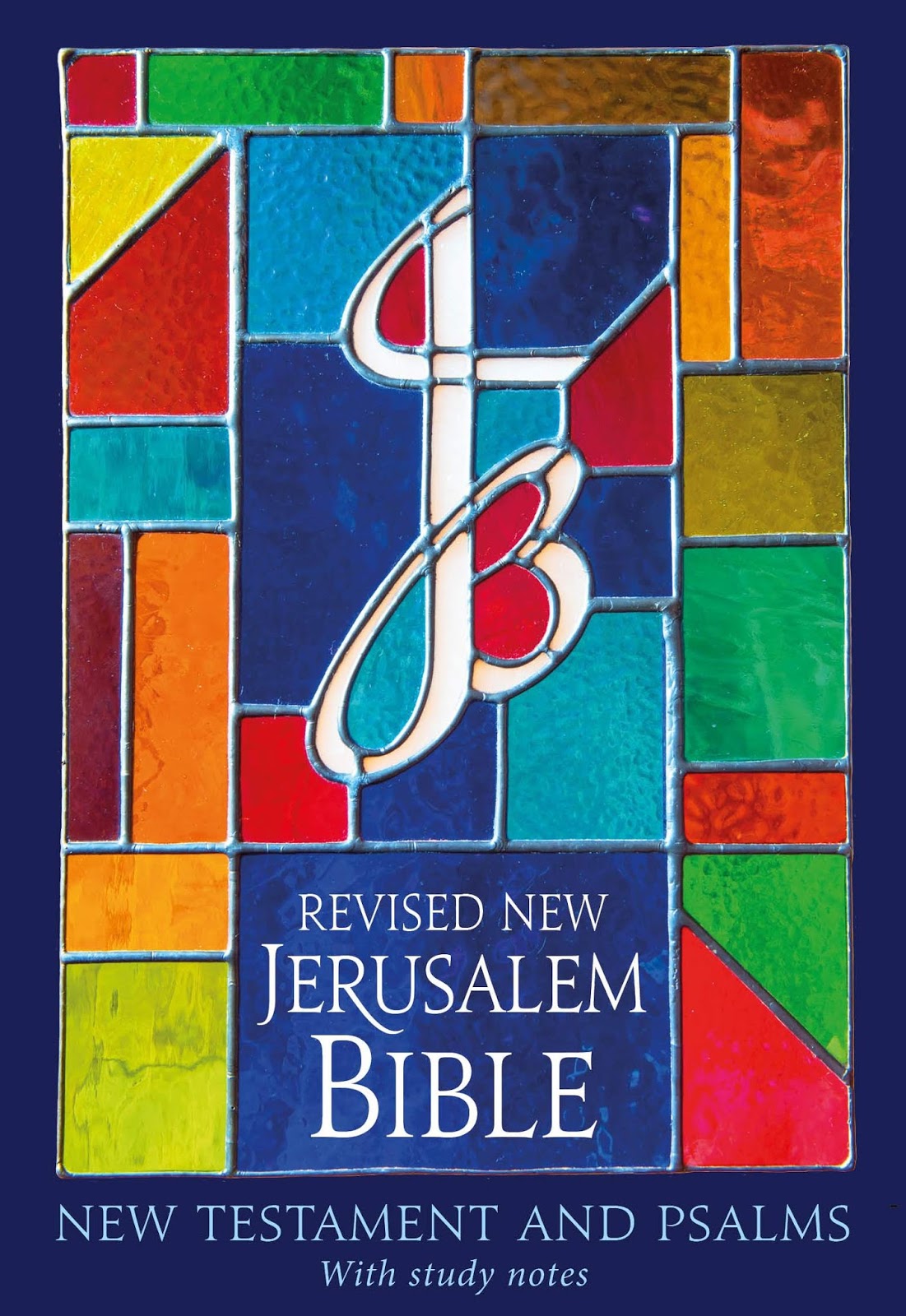
According to the Amazon listing, the Revised New Jerusalem Bible (NT and Psalms) will be published on February 15th.  The price is quite good, coming in under $10.  It will be interesting to see if this is the actual date of publication this time around.  A reminder that the Psalms appear to be the 2010 Revised Grail Psalms.  I have it pre-ordered and will let you know if I get a shipping notice.

Once again, here is the description:
A Bible for study and proclamation. The Revised New Jerusalem Bible presents anew the scholarship, character and clarity of the 1966 Jerusalem Bible (the first modern English version) and the 1985 New Jerusalem Bible. It is a Bible that prioritises accuracy of translation and richness of tone, written that `the message might be fully proclaimed' (2 Ti 4:17). This volume presents the full New Testament and the Psalms, and a comprehensive set of study notes, cross-references and book introductions. `Clear read' style. The biblical scriptures were written to be proclaimed, so the RNJB uses linguistic style and speech patterns best suited for being read out loud. Formal equivalence. The language, concepts and imagery of the original scriptures are presented more accurately by the RNJB than the colloquial approach of many other modern translations. Gender inclusion. The message of the Bible is for all people, so care has been taken to avoid traditional male bias of the English language, while remaining faithful to the meaning of the original scriptures. Revised Grail Psalter. The book of Psalms is based on the text of the 2010 translation of The Revised Grail Psalms. Modern measurements. Ancient systems of measuring and timing have been replaced by modern, metric equivalents. Comprehensive study notes. The notes, cross-references and book introductions of the JB and NJB are replaced in the RNJB by new materials which reflect the fruit of the most up-to-date and ecumenical scholarship. The Revised New Jerusalem Bible has been prepared and edited by The Revd Henry Wansbrough OSB, who was previously General Editor of the New Jerusalem Bible.

Wednesday, March 4, 2015

Helpful Article on the Revised Grail Psalms

Follow this link, via the blog PrayTell, for an interesting article on the Revised Grail Psalms.  You can read the Revised Grail Psalms here.

Tuesday, January 23, 2018

Update on the RNJB

Shout out to Jeff for supplying me with the info on this and for regularly checking out the RNJB publisher's website.

This info comes from the DLT website which is now being updated.  Information includes the use of the Revised Grail Psalms as well as a February publication date.  I have also been hearing that this edition is not directly affiliated with the Ecole Biblique, but a product of the publisher in union with Fr. Wansbrough.  Read on:

A Bible for study and proclamation.
The Revised New Jerusalem Bible presents anew the scholarship, character and clarity of the 1966 Jerusalem Bible (the first modern English version) and the 1985 New Jerusalem Bible. It is a Bible that prioritises accuracy of translation and richness of tone, written that ‘the message might be fully proclaimed’ (2 Ti 4:17).
This volume presents the full New Testament and the Psalms, and a comprehensive set of study notes, cross-references and book introductions.
‘Clear read’ style. The biblical scriptures were written to be proclaimed, so the RNJB uses linguistic style and speech patterns best suited for being read out loud.
Formal equivalence. The language, concepts and imagery of the original scriptures are presented more accurately by the RNJB than the colloquial approach of many other modern translations.
Gender inclusion. The message of the Bible is for all people, so care has been taken to avoid traditional male bias of the English language, while remaining faithful to the meaning of the original scriptures.
Revised Grail Psalter. The book of Psalms is based on the text of the 2010 translation of The Revised Grail Psalms.
Modern measurements. Ancient systems of measuring and timing have been replaced by modern, metric equivalents.
Comprehensive study notes. The notes, cross-references and book introductions of the JB and NJB are replaced in the RNJB by new materials which reflect the fruit of the most up-to-date and ecumenical scholarship.
The Revised New Jerusalem Bible has been prepared and edited by The Revd Henry Wansbrough OSB, who was previously General Editor of the New Jerusalem Bible.

Wednesday, June 20, 2012

Some Reflections on the NABRE Revision News

As we await official word from the USCCB about the sure-to-be lengthy revision process of the NABRE, I wonder where this leaves us for the next ten years?  It is strange that within a week of my posting the poll about what will be the most popular Catholic Bible in 2012, we get this news about the NABRE which will likely take ten years to complete.  Many of you have brought up some good discussion points in the previous post, most notably Biblical Catholic, who reminds us of all the different "hoops" that the translators will have to go through, via the USCCB and Rome, before an approved text, for both Mass and study, can be published.  But hasn't that been the case for the NAB all along? 

When we think back to the origins of the NAB, with the Confraternity edition, it was a long process to get to the final publication of the original NAB in the early 70's.  At that point, parts of the Old Testament portion had been previously translated almost twenty years prior.  Once published, it became clear that the NT needed an overhaul, thus prompting the 1986 Revised NAB NT.  Soon after, there was a push for a revised Psalter, with extensive inclusive language.  The result was that in 1991, with the publication of the '91 Revised Psalms, the NAB was a mishmash of translation philosophies and textual foundations.  (It should be noted that the Confraternity Bible suffered from this as well.)

Now comes 2011 and the publication of the New American Bible Revised Edition, almost twenty years after the process of revising the OT began.  In many ways, this revision remains a marked improvement over the prior edition.  The '91 Revised Psalms were properly re-revised and the OT was made more formal/literal in the same way as the revised NAB NT.  Simply put, the 2011 edition of the NAB was/is the best edition of this translation.  I have spent considerable time over the past year reading through large portions of the NABRE, and with only a few exception, most notably in Genesis, I have come away being very impressed by it.

Now, fast forward barely a year later, and we hear that there will be another revision, the fourth since 1970, which will take "a long time" to complete.  I applaud the Cardinal's desire to have a unified text which will: “provide us one source of language when we speak the Word of God.”  Many people, including myself, have been advocating this very thing. 

Logistically, I wonder how this is actually going to happen.  For instance, what about the Revised Grail Psalms, which were approved for liturgical use only a few years ago?  Is this going to be a NAB w/ Revised Grail Psalms?  Wouldn't it need to be in order to meet the Cardinal's criteria of having one text?  Also, what part will Liturgiam authenticam play in this new translation?  Neo-Vulgate?  Then, of course, is the waiting.  I freely admit that I am a man of Generation X, which makes me very impatient, so waiting "a long time" is not very appealing to me personally. Add to my impatience is seeing Bibles like the ESV, NLT, or NIV updated every couple of years. 

So where does that leave us?  Again, if we look at the current landscape of English language Catholic Bibles, there is quite a bit of movement, although very little certainly as to what is going to get published and when.  The ESV will be the basis for the lectionary in Australia and the UK at some point in the near future.  Will there be an ESV-CE published along side of it?  No clear answer.  The RSV-2CE will remain the lectionary of the Ordinariates, the Antilles, and some parts of Africa.  Ignatius Press continues to minimally promote this translation, even with the ICSB will being completed by 2015, in either one or two volumes.  But where does that leave the future prospect for the RSV-2CE?  Is is possible, particularly with all the lectionary news going around, that the RSV-2CE will remain a fringe translation?  What about the NRSV?  Will it continue to be the basis for the lectionary in Canada?  What role is the NCCUSA playing in all this revision/lectionary news?  It appears that they have begun to protect their product more so than in past years.  Will the NRSV be revised in the coming years? 

So many questions, with very few answers at this point.  Who knows if this blog will even be around when the new NAB is completed. 

Tuesday, October 6, 2009

The CTS Bible: A Second Look


In a previous post back in November of 2008, I gave some of the details of the CTS New Catholic Bible. At the time, I had received the small travel edition which was even smaller than I had anticipated. For me, it was a little tough to read, and last time I checked I had 20/20 vision. Therefore, I sort of pushed it aside and never gave it a proper review. Well, during my honeymoon in Roma, I stopped in a Catholic bookstore and spotted the larger, presentation edition of the CTS Bible on the shelf. I figured that it would be a shame if I didn't buy at least one Catholic Bible while in Rome, so I made the purchase. I am very glad I did!

The standard size is very similar to the size of a typical Liturgy of the Hours or Christian Prayer volume. This means it isn't too small to be considered compact, yet is not as large as a standard medium sized Bible either. Overall, the size is very portable, yet big enough to be used as an everyday/every occasion Bible. The page format is also well designed, much like most editions of the Jerusalem or New Jerusalem Bibles. It is single column, with cross-references on the sides, paragraph headings, and commentary at the bottom. In many ways, I think this is the best page layout that I have seen in any recently published Catholic Bible. The page layout truly invites the person to read and stay with the text.

The main text of the CTS Bible is the Jerusalem Bible, with two exceptions. First off, the Psalms are not from the Jerusalem Bible, but are rather the Grail Psalms. Most of you in the United States who pray the Liturgy of the Hours will be familiar with them. Secondly, by request of the Pope, all references to "YHWH", which was one of the unique features of the Jerusalem Bible, have been changed back to "the LORD". What does all this mean? Well, basically this Bible is exactly the what one would hear at Mass in the English speaking world outside of North America, where the NAB and NRSV are used. Nice concept huh?

The CTS Bible also comes with multiple study helps, including four Bible maps, full book introductions, including when a book is read during the liturgical year and why it is important in Christian liturgy, and verse commentary/notes. The book introductions and commentary were newly produced by NJB editor Henry Wansbrough OSB, member of the Pontifical Biblical Commission. The commentary notes often highlight historical-critical issues and they are not as plentiful as in the standard edition of the NJB. There is also a very helpful appendix with information on historical framework of the Bible, weights and measures, Sunday and Weekday Mass readings, and Psalms/Canticles for 4 week Breviary cycle with Office of Readings. Also, they added the nice touch of including not one, but three ribbon markers. Thank you very much! Overall, the CTS Bible has within it plenty of information, both scholarly and liturgically, to keep you satisfied.

The CTS Bible is a fine Catholic Bible. Although the translations used are over forty years old, the presentation and tools included within its covers are very up-to-date and most welcome. If you are looking for an all-purpose Bible, this is definitely a top contender. If you live in the UK, then it is a necessity, since you can feel comfortable bringing this Bible to both Mass and Bible study. If you are living in the USA or Canada and want a new edition of the Jerusalem Bible or if you really like the Grail Psalms, then this Bible is for you. In my opinion, I think it would be a very good thing to see publishers of the NRSV, RSV, or NAB learn from what the CTS has done for future publications.

Friday, June 5, 2009

NAB Revised OT News


I decided to do a little search for information about the NAB OT revision. Like most things associated with the NAB, information is scarce. However, I was able to find a page on the Catholic Biblical Association site, which chronicles the history of the NAB OT revision. Below is the chronology which they provide, the last section being the most pertinent:

August 1990: at the Business Session of the 1990 meeting of the CBA, the membership passed a resolution urging the leadership to take steps toward initiating the revision of the New American Bible Old Testament (except the Psalter, which had already being revised) (see minutes of the meeting CBQ 52 [1990] 703).

July 1993: Based on the resolution passed in 1990, the CBA Executive Secretary requested that the CBA’s NAB Board of Control take the necessary steps to initiate this revision process.

April 1994: With the agreement of the Administrative Board of the National Council of Catholic Bishops to proceed with the revision, a new Steering Committee/Editorial Board (whose members were suggested by the Board of Control) was established. It eventually consisted of Deirdre A. Dempsey, Robert A. Di Vito, Joseph Jensen, O.S.B. (chair), Dale Launderville, Roland E. Murphy, O.Carm., Kathleen Nash, Irene Nowell, O.S.B., and James P. Walsh, S.J. This first meeting was to establish guidelines for the revision and to arrange for thirty-eight CBA members, chosen for their specialization in the Old Testament books they would revise, to begin work.

Late 1994 through May 2002: Revised texts began to be received before the end of 1994, and the committee began meeting one whole weekend every month going over the texts received to improve and complete the revision process.

May 2002: The completed revision of the Old Testament text was sent to the CCD office of the USCCB. This was then transmitted to the Bishops Ad Hoc Committee for Scripture Translations Proposed for the Liturgy, chaired by Bishop Arthur Serratelli. This committee sent the texts to individual "censors," whose job it was to assure that the revision would be suitable as a Catholic translation. They returned their findings to the Ad Hoc Committee. The Ad Hoc Committee reviewed the work of the censors and then sent the texts back to the revision committee with any suggestions from the censors for changes.

June 2005 through September 2008: These texts began to be received from the Ad Hoc Committee. These were then reviewed by the revision committee and responses to suggestions returned to the Ad Hoc Committee.

September 2008: The last book (Jeremiah) was received from the Ad Hoc Committee, which the revision committee (necessarily) dealt with very promptly (in view of CCD plans to present the completed revision to the USCCB for approval at their November meeting).

Concomitantly, the CBA was attempting a revision of the NAB Psalter of 1991 to a form that would be acceptable for the liturgy; this meant conforming it to the requirements of Liturgiam authenticam. In June 2003 a revision of the NAB Psalter, revised in this manner, was sent to Bishop Serratelli's Ad Hoc Committee with the hope it would be used in the liturgy. In March 2006 Bishop Donald Trautman, then Chair of the Bishops Committee on the Liturgy, invited a presentation of this revised Psalter, which presentation would be to demonstrate its conformity to Liturgiam authenticam and its "singability" (the latter demonstrated with the help of a CD which included pieces by St. Anselm's Abbey schola, the Benedictine Sisters of Sacred Heart Monastery, Cullman, AL, Jean Olexy, Normand Gouin, and the Oregon Catholic Press Singers). Bishop Trautman sent letters of thanks to all those involved individually in its production, but the Ad Hoc Committee had not reported on the vetting process so no action was taken.
May 2008: The Ad Hoc Committee finished the vetting process and sent suggestions for the re-revised Psalter.
June 2008: The CBA was again invited to make a presentation similar to that of June 2006 of the re-revised Psalter, now before the Bishops Committee on Divine Worship (a reconstitution of the Bishops Committee on the Liturgy), now under Bishop Serratelli as Chair, during the USCCB meeting in Orlando. A few days later the CBA was informed that that committee had chosen instead a revised version of the Grail Psalter for use in the liturgy.

November 2008: The completed revised NAB OT was presented to the USCCB at their
November 2008 meeting, at which time it was approved. However, at the same meeting it was decided that this newly revised NAB would not be published using the 1991 Psalter. Since the re-revised Psalter was not available for use, the revised NAB will be published when a new revision of the Psalter is finished.

So, what does this all mean.

1) The revised NAB OT is complete and it has also been approved for eventual publication with the revised NAB NT. Good!

2) There will be a re-revised NAB Psalms! Even though the USCCB decided to go with the revised Grail Psalms for Mass, the CBA will only publish the revised OT once the re-revised NAB Psalms are finished. Anyone who has read this blog knows how I really dislike the revised '91 NAB Psalms. I love reading the Psalms, so my use of the NAB has been very limited due to the poor translation, most notably the use of vertical inclusive language. Wow! I am actually excited! This revision certainly can't be worse than the '91 Psalms. There is a God! :) Very good!

3) All revisions are in "conformity" with the Vatican document Liturgiam Authenticam. Of course, this could be interpreted in many ways, and we will just have to see the results whenever the fully revised NAB is published. Hopefully good!

Ultimately, if the revised NAB OT and re-revised Psalms follows the translation philosophy of the revised NAB NT, in reasonable conformity with Liturgiam Authenticam, then I would seriously consider using the NAB full-time. I have never really had a problem with the revised NAB NT, which I think does some things quite well. And while there will always be those who dislike the NAB, for various reasons, I think it would be a wonderful gift to the many Catholic Americans who deserve and desperately need a solid Church sponsored modern translation of the Bible.

St. Jerome Pray for us!

Friday, December 10, 2010

Revised Grail Psalms Pre-Order


Yes, you can now pre-order the Revised Grail Psalms. These will be the new Psalms used in the Mass in the United States, and conceivably in the future revision of the Liturgy of the Hours. I pre-ordered mine last night and look forward to sharing my thoughts about it with you sometime in January. Thank you to reader Sharon for the link!

Thursday, December 1, 2011

NRSV w/ Grail Psalms on Sale


Amazon UK has slashed its prices for the Collins NRSV w/ Grail Psalms. You can now purchase it for £12.90. For a brief review I did on this Bible, you can go here.

I wonder if this means that the adapted NRSV w/ Revised Grail Psalter, which is being prepared for the UK lectionary, will be coming out in 2012?

Thanks to reader Llanbedr for alerting me to this.

Tuesday, November 25, 2008

CTS New Catholic Bible


Well, here is something that recently was published in England. It is the CTS New Catholic Bible. For those of you in the English speaking Catholic world, outside the USA, this may be the Bible for you. It contains the original edition of the Jerusalem Bible, with the Grail Psalms inserted in place of the JB ones. Also, this new edition alters the divine name, YHWH, and has replaced it with the standard English use of LORD, in conjunction with Pope Benedict's recommendations. I commend the Catholic Truth Society for publishing this edition; it would be nice to see what the USCCB does in the future, since it adopted the Grail Psalms for the liturgy. Why not have a Bible that Catholics in American could use at Mass on Sunday and for private study and devotions? Seems like a no-brainer! It also comes in four different editions.
Below are some of the other features of the CTS New Catholic Bible:

-New specially commissioned introductions, one for each book, giving the biblical and historical context
-New specially commissioned liturgical introductions placing each book of the Bible in the Church’s liturgical year
-New footnotes following the latest scholarship
-New marginal references helping you get the most out of each passage.
-New layout – using clear and modern fonts in easy-to-read single-column format
-New text alterations, replacing the word ‘Yahweh’ with ‘the LORD’ as requested by Benedict XVI for all new Bibles
-New directories of references for readings used in the Mass and the Liturgy of the Hours, including the fuller two-year cycle for the Breviary.

Monday, April 2, 2018

Is the RNJB a Viable Option for the New Lectionary?

I would like to thank Fr. Neil Xavier O’Donoghue for providing this essay on the RNJB and the Roman Lectionary.  Fr. Neil will be a regular guest contributor, focusing on issues related to the lectionary and other translation issues.  Please welcome him to the Catholic Bibles Blog.  A full bio is below.

Lectionary translation is a tricky business. Initially after Vatican II a number of English lectionaries were prepared and in many areas parishes were free to pick the translation that best suited them.  In the United States three translations were approved: The Jerusalem Bible, The Revised Standard Version and the New American Bible. Of these the New American Bible was the most widely used.

In 2001 the Congregation of Divine Worship in Rome published an instruction called Liturgiam Authenticam that regulates liturgical translation in Catholic liturgy.  Liturgiam Authenticam 36 deals with the use of scripture in the liturgy:

In order that the faithful may be able to commit to memory at least the more important texts of the Sacred Scriptures and be formed by them even in their private prayer, it is of the greatest importance that the translation of the Sacred Scriptures intended for liturgical use be characterized by a certain uniformity and stability, such that in every territory there should exist only one approved translation, which will be employed in all parts of the various liturgical books. This stability is especially to be desired in the translation of the Sacred Books of more frequent use, such as the Psalter, which is the fundamental prayer book of the Christian people. The Conferences of Bishops are strongly encouraged to provide for the commissioning and publication in their territories of an integral translation of the Sacred Scriptures intended for the private study and reading of the faithful, which corresponds in every part to the text that is used in the Sacred Liturgy.

This preference for a single translation of Scripture was implemented in the United States and (even before Liturgiam Authenticam) when the current Lectionary edition was adopted permission to use the three earlier translations was withdrawn. Although it is worth noting that the current US Lectionary is not actually from any published edition of the New American Bible. John Allen, the veteran Vatican reporter, analyzed the process used to produce the current US Lectionary in a 1998 article.

Canada also has a fairly new edition of the Lectionary using an adapted edition of the New Revised Standard Version.  Ignatius Press prepared a new edition of the Lectionary using their own Second Catholic Edition of the Revised Standard Version that was approved for use in the Antilles. Some had hoped that US parishes might adopt this as an alternative to the New American Bible, but this was not possible due to the restrictions of Liturgiam Authenticam and this edition of the Lectionary was eventually adopted by the Ordinariates for their liturgy. Surprisingly an edition of this Lectionary was also adopted by English Africa (with the Revised Grail Psalms), even though this seems to be in contravention of Liturigam Authenticam as they had recently published a new edition of the Liturgy of the Hours uses the New American Bible (also with the Revised Grail Psalms). 

However, in many English speaking countries the Jerusalem Bible Lectionary has remained in use as basically the only Lectionary version, and these regions are still using the initial edition of the Lectionary prepared in the aftermath of the Council (with minor revisions made in 1981). This is the case in Ireland, England and Wales, Scotland, Australia and New Zealand.  

Today this Lectionary is clearly in need of revision.  Over the years there have been attempts by the bishops of these regions to prepare a new Lectionary using the New Revised Standard Version, the English Standard Version, and, most lately, the Revised Standard Version.  For one reason or another (usually to do with copyright) all of these projects have failed to produce a new Lectionary and some have suggested that there is now a certain fatigue on the part of the bishops regarding the prospect of starting another process to produce a new Lectioanry.

The Jerusalem Bible has served the Church well and is now over 50 years old. In 1985 a new edition (the New Jerusalem Bible) was prepared by the Benedictine Dom Henry Wansbrough. This was based on the newer French edition and contains updated scholarship and has corrected some of the translation inaccuracies of the original English translation.  However, to my knowledge, this newer edition was never used in any approve liturgical book.

Readers of this blog will be aware that Darton, Longman and Todd Ltd have recently published the New Testament of the Revised New Jerusalem Bible. This edition was also prepared by Benedictine Henry Wansbrough and is a thoroughly reworked translation that is more faithful to the original text, has been prepared with an eye to proclamation and has a moderate use of inclusive language.

The New Testament has been published before the full Bible to allow the public to have an appreciation of the full project while the final touches are being put to the Old Testament which will be published before the end of this year (and is in the process of receiving an imprimatur).

Personally I have been impressed by the quality of the translation and have been wondering if it could provide a relatively painless solution to the Lectionary problem in those countries that use the Jerusalem Bible Lectionary. In particular, given that it is the direct successor of the original Jerusalem Bible, the translation already sounds familiar to Catholics in these countries. I believe that there is a great value in continuity in translation. Also given that there are new translation guidelines governing the process of liturgical translation, it should now be easier to officially prepare a new Lectionary edition.

During the Easter season a peculiarity of the Lectionary is that it uses only New Testament readings. Therefore I propose that the readers of this blog help me to compare the current Jerusalem Bible version of the Sunday Lectionary readings with the same passages in the Revised New Jerusalem Bible.  

Each week I will post a comparative table of the two translations of the selection of readings for that Sunday’s Mass accompanied with a short analysis of any differences that I note. I invite readers to chime in with their comments. The goal of this exercise is to help answer the question if it would be wise to propose this new translation of the Bible as the basis for a new Lectionary in those regions that already use the Jerusalem Bible in their Lectionary.

This week we are posting the first comparative version for the Mass of the Day of Easter Sunday. Due to the length of this introduction I have not prepared any comments on the translations, but I invite the readers to do so in the comments section.


Neil Xavier O'Donoghue is a priest of the Archdiocese of Newark, New Jersey. He currently ministers in the Archdiocese of Armagh, Ireland, where he serves as vice rector at Redemptoris Mater Seminary. He has studied at Seton Hall University, the University of Notre Dame, and St Vladimir’s Orthodox Theological Seminary. He holds a Doctorate in Theology from St Patrick’s College, Maynooth.