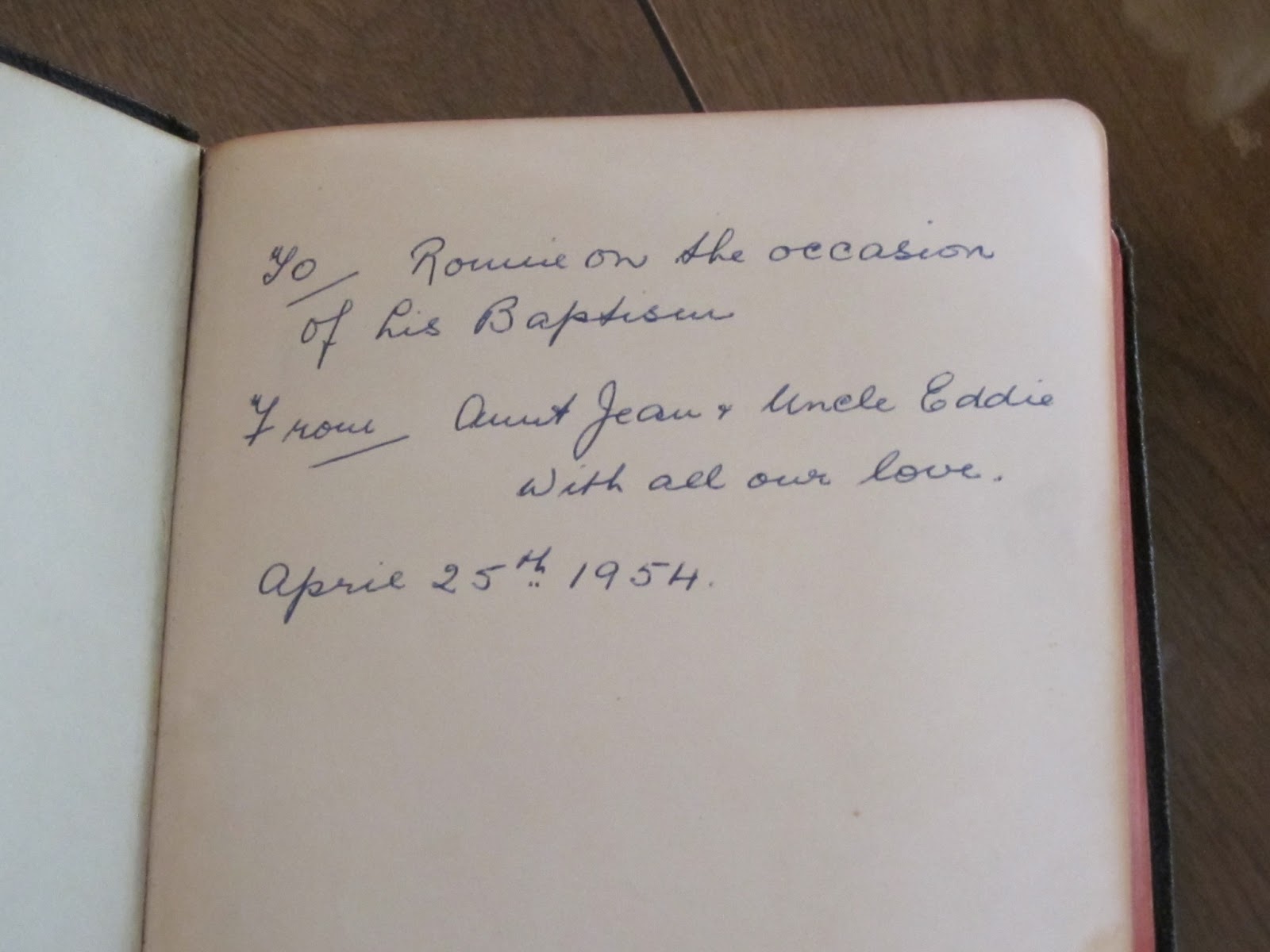
I wrote a post for this blog a while back about the
Douay-Rheims Bible, and how it was instrumental to my conversion to the
Catholic Church. I will always have a
deep affection and appreciation for the Douay-Rheims Bible, and it continues to
be one of the few translations I read on a regular basis. However, after I became Catholic, I began to
be active in various ministries throughout my parish, and found I needed a more
modern translation to communicate the Scriptures more effectively. This post is not only features the Bible I
use for ministry, but is also the story of how I came to use that particular
edition.
The first modern English Catholic Bible I bought was a 1991
NAB. I was excited about this because as
a Protestant I had general distrust in modern translations, but I felt like I
could trust the NAB because it had official Catholic approval. I turned out that I really didn’t care for
the translation after being spoiled on the D-R and more literal non-Catholic
translations. Then one day, in a parish
gift shop, I spotted the Revised Standard Version, Catholic Edition. It was the blue-covered, Ignatius Press
reprint of the original 1966 edition. As
I thumbed through and read here and there, I saw that this Bible had more
formal language, and the font and page layout were more traditional looking as
well. When I saw the self-pronouncing
text I was sold for sure, despite the Bible’s overall humble appearance.
I have really enjoyed reading out of this edition, and
definitely got my money’s worth, but I was a little disappointed as the glossy
blue cover began flaking away. I then
began looking for another edition that was a little nicer. I think I got one of every edition of the
RSV-CE available, but there seemed to be some serious defect with each of them:
cheap leather, no cross-references, glued binding, manifold typos (that edition
is no longer available), or any combination of the above. I also searched web and bookstore for any and
all Catholic translations and available editions, and collected what I
considered the best specimen of each. In
the end of this search, I was left even more frustrated than what I was in the
beginning!
For it was during this time of intense Bible collecting I
increased in responsibility with the various ministries in my parish. As I interacted with an increasing number of
Priests, Deacons, and lay people of all ages, I came to realize there are four
points that need to be true of a Bible I use for ministry:

a)
Must
be translated from the original languages
b) Must
have an imprimatur
c) Must
not use excessive inclusive language
d) Must
say “Hail, full of grace” in Luke 1:28
I know that list might seem like a bit superficial, but my
experience has been that those are the four points that are recurring obstacles
to using a Bible to interact amongst Catholics.
Long story short, the RSV-CE has proven, in my experience, to be the
most universally accepted translation for use in ministry.
So now back to the story of “My Bible.” Given the information above, I found it meet
to give Ignatius RSV-CEs as gifts to some of my Catholic friends. This was a couple of years after I had
purchased mine with the flakey cover, and I noticed on the new ones I bought
that the deep blue color was replaced by a brighter blue cover of the same
design. I wondered if the new one was
better, so I ordered one for myself. I
found that my old one was published by Thomas Nelson for Ignatius Press in the
U.S., while the new one was printed in Colombia, apparently with Ignatius
applying the covers themselves. The new cover
was of better quality, and didn’t peel, but the book was not bound together
well. I decided to grin and bear the
imperfection. A year of so later, I gave
the newer copy away to a friend and ordered another new copy for myself. This one was slightly better, but still not
acceptable for a plain hardcover reprint of a book published in 1966 that costs
over 30 dollars! I finally called
Ignatius Press and told them of the trouble I had with that particular book,
and they sent me a very nice copy with an even, tight binding. This is the
Bible I have used as my basic, primary Bible for all things officially
connected to my parish ministries ever since.
A few more details about the Ignatius RSV-CE are in
order. As I mentioned before, this is a
self-pronouncing edition, meaning that most of the proper names have the
phonetic markings printed on the first occurrence of each name per
paragraph. This is also the only edition
of the RSV-CE that has the original RSV-CE cross references. There are a lot in the NT, less in the OT,
and none in Deuterocanonical books. Yet
it has more than any other edition of the RSV-CE, which have none at all. It is actually an exact reprint, page for
page, of the original 1966 edition. I
know that because I know someone who owns the 1966 Thomas Nelson edition. It has the burgundy hardcover with gold
lettering just like the original Thomas Nelson Protestant RSVs did. Like the original, it is also sadly lacking a
map section. I carry my copy in a Bible
cover loaded with glossy inserts available from Rose Publishing. One of the inserts is a booklet entitled
“Then and Now Bible Maps Insert,” which has proven to be more useful than the
map sections in other Bibles I own. So
that’s it. No fancy leather or ribbons,
just the basic stuff I need to get the job done. I hope you are as surprised as I was!
Thank you Jonny! The plan is to make this a monthly series. So, if you are interested in participating, just send me an email, mccorm45(at)yahoo(dot)com, and we'll talk.


 You might be asking
yourself: Is there a need for the GNB when we have other versions such as the
NABRE or NIV? I say yes and here’s why. It’s easy to understand. (I'm not
saying it’s the easiest to understand. That title would go to the International
Children's Bible. This is a Protestant translation written at a 3rd grade
reading level.) This understandability helps clarify passages that can be
difficult at times. On the down side, this isn’t a version suited for
liturgical use or study. The second reason I like the GNB is the illustrations
by Swiss artist Annie Vallotton. They are engrossing, drawing you into the
text. For example, I’m reading through Ecclesiastes. At Ecclesiastes 1:14 there
is a drawing that shows Solomon showing regret. This helps me to better
understand what’s being said. The last reason I like the GNB is that it’s a
version for everyone. It is available with the Protestant canon and in a
Catholic edition. If you desire to get a copy, I would look for the 1979
edition. A 1992 revision added gender-inclusive language.