Showing posts with label William Griffin. Show all posts

Thursday, July 13, 2017

In Praise of Paraphrase

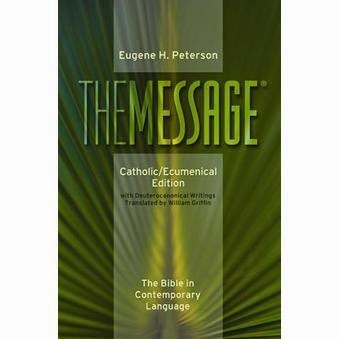
A quote from William Griffin, translator of the deuterocanonical books in The Message:Catholic/Ecumenical Edition, while translating some of the Latin classics into English, as found in Eugene Peterson's Eat This Book:

"I fully intended to do the literal translation, of course, and yes, better than any of my predecessors had done, but I soon found myself faltering.  Fidelity seemed its only virtue.  Felicity was nowhere to be seen.  But Fidelity without Felicity in translation can be a very mean virtue indeed.... As many before me, I'd always thought Paraphrase was bonkers.  Why?  Because my intellectual betters had told me so, and I had no occasion to say them nay.  But what they never told me in so many words was that all translation was all too errant.  Soon thereafter I concluded that if err I must, then I'd prefer to err on the side of Paraphrase rather than Literalese (172)."

And of course, there is this classic quote from Msgr. Ronald Knox:

"The translator, let me suggest in passing, must never be frightened of the word 'paraphrase'; it is a bogey of the half-educated.  As I have already tried to point out, it is almost impossible to translate a sentence without paraphrasing; it is a paraphrase when you translate 'Comment vous portez-vous?' by 'How are you?'  But often enough it will be a single word that calls for paraphrase.  When St. Paul describes people as "wise according to the flesh', the translator is under an obligation to paraphrase.  In English speech, you might be called fat according to the flesh, or thin according to the flesh, but not wise or foolish.  The flesh here means natural, human standards of judging, and the translator has got to say so.  'Wise according to the flesh' is Hebrew in English dress; it is not English (Englishing the Bible 8-9)."

Thursday, April 23, 2015

In Praise of Paraphrase by William Griffin

This article dates back to 2002, before Griffin was given the task to translate the Deuterocanonical books from the Nova Vugata for The Message: Catholic/Ecumenical Edition. Thanks to Russ for the link.


Among his mail one foggy Oxford morning, C. S. Lewis found a letter-cum-manuscript from J. B. Phillips, vicar of the Church of the Good Shepherd in London. He didn't know the man, but the vicar had said some nice things about his books and broadcasts.

As for the enclosed manuscript, well, with bombs falling and sirens wailing and buildings collapsing all around, London wasn't so unlike first-century Rome, at least from the Christians' point of view. Paul's epistles seemed right to the point.

Trouble was, the young people in Phillips' parish couldn't understand the Authorized Version. What they needed was something just a little easier to read. Hence, his own attempt at Colossians. What did Lewis think?
Immediately he put the translation to the test.

"Beware lest any man spoil you through philosophy and vain deceit, after the tradition of men, after the rudiments of the world, and not after Christ," read the eighth verse of the second chapter in the Authorized Version.

"Be careful that nobody spoils your faith through intellectualism or high-sounding nonsense," read Phillips' rendition of the same passage. "Such stuff is at best founded on men's idea of the nature of the world, and disregards Christ!"

Lewis thought he knew Colossians pretty well, but this Paraphrase, for that's what it was, seemed to hit the nail right on the head. He then read the Phillips version from beginning to end. "It was like seeing a familiar picture after it's been cleaned," he wrote to the good vicar.

Wednesday, September 3, 2014

7 Questions: William Griffin

William Griffin, a well-respected Catholic writer and translator and friend of Eugene Peterson, translated the Deuterocanonical books that first appeared in the Catholic/Ecumenical Edition in September 2013 from ACTA.  I would like to thank him for taking the time to answer these questions.  

You can read more about The Message: Catholic/Ecumenical Edition here.  In addition, last year I did an interview with ACTA publisher Greg Pierce, which you can read here.

 1) Eugene Peterson describes you in the introduction as "an excellent writer and translator who understands exactly what I have tried to do in The Message but also a friend and colleague of many years whom I can trust to carry on my work into this new edition."  That is quite an endorsement.   So as we begin this interview, could you start by telling us a little bit about yourself?  Have you always been involved in areas of scripture and translation?  How did you get started?
Bostonian. Jesuit educated. Former Jesuit. New York: Harcourt and Macmillan editor. New Orleans and Alexandria, Louisiana: freelance writer, editor, translator. No, I haven’t always been involved in scripture or translation.

 2) Can you talk a little about your connection to Eugene Peterson and his description of you as one "who understands exactly what I have tried to do in The Message."
Eugene and I have talked many times about scripture and translation, resulting in, among other things, an essay of mine, “In Praise of Paraphrase.”

3) How did you come to be the translator of the Deuterocanonical books for the Message?
I auditioned for the job. When I heard that there would be a Catholic edition of The Message, I decided to send a sample. I translated the Book of Tobit. Months passed; I inquired. Yes, it got the job. It turned out that no one else had been asked for a sample. (Please note that the project took years to develop.)

4) One of the unique features of your translation of the Deuterocanonicals is the use of the Nova Vulgata.  This may be the first printed translation into English of the Nova Vulgata.   Why was it chosen, as opposed to the older editions of the Vulgate or perhaps even the Septuagint?  Were the any challenges in translating from it?
When I asked Eugene what Hebrew text he used for his translation, he replied, the one he used at John Hopkins. Hence, when I came my time to pick a language for the Apocrypha / Deuterocanonicals, I could have picked Greek, but I chose Latin, Nova Vulgata (the Jerome Vulgate plus editorial tweaks to bring the text up to date). Please note. Why pick the the purest / oldest text (Septuagint)? Why not pick the latest, the Nova Vulgata? No particular challenge.

 5) One of my favorite passages in the Deuterocanonicals is Baruch 3:9-15, 3:32-4:4, which is one of the readings used for the Easter Vigil.  In my opinion, you have rendered it quite cleverly and in such a way that clearly brings out the personification of Lady Wisdom.  Could you talk a bit about your rendering of this passage?
Abstract nouns in Latin and Greek are by and large feminine. From there it’s a hop, skip, and jump to personify them. Sometimes it works; sometimes it doesn’t.

6) How do you think the average Catholic could best utilize The Message:Catholic/Ecumenical edition?
You’d have to ask Greg that. He’s the utilizer. I’m only the translator. But the average Catholic could do worse than read the book. Failing that, he could use the heavy volume for a doorstop.

 7) Do you have a favorite verse or verses from the Deuterocanonical Books of The Message that you translated ?
Verses are like children; I love them all.