I have mentioned
before on this blog that one of my favorite devotions is
The Little Office of the Blessed Virgin Mary. There are a number of things that have attracted me to this liturgy of the Church over the years. First, the history of this office goes back many centuries, some say even back to the 8th century. Even though the Little Office has certainly changed over the years, I love the fact that there is this connection to the medieval Church. Secondly, it is an office in honor of Our Lady. Devotional to the Blessed Virgin has been an important part of my spiritual life since I started to take my faith seriously. With my wife and I praying a family rosary every Sunday night, I have found that this office is a great aid during the rest of the week. Those who have a strong devotion to Our Lady will find the Little Office to be quite powerful. Third, I love praying the Psalms, in particular the gradual Psalms (or Psalms of Ascent). The daytime Psalms for the Little Office are centered around those Psalms, which I always find a great comfort when I read them in the middle of the day. Fourth, this office is simple and compact. It fits easily in my bag for work or even into my pocket if necessary. Because there isn't much in the way of variation each day, unlike the older full Breviary or even more so in the newer Liturgy of the Hours, many, including myself, enjoy the comfort of hearing the same prayers and Psalms each day. I have prayed both of the full and shorter breviaries in the past, but I find myself attracted to the Little Office. Perhaps that has to do with my state in life, married with two (soon to be three) children, as well as two teaching jobs. Finally, I love having the Latin and the English side by side. It is great to be able to pray in both languages.
 Baronius Press
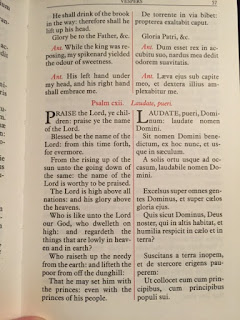
, back in 2007, were the first to re-publish the Little Office. Since then, it has gone through four different printings. As usual, the quality of the edition is top-notch, with a blue leather "flexible" (with boards) cover and a sewn binding. Two ribbons are added to make flipping through this small office quite easy. It looks and feels great, and it will certainly last a lifetime. Baronius recently sent me a review copy (4th printing), which thankfully will replace my older copy. My original edition was used lovingly and often to the point that I had it outside while it was raining, which ended up marking up the gold gilding. Yet, it remains quite readable and sturdy, with no issues with the binding or the leather cover. (Although you can see some finger-print marks at the bottom of each page.) This newer edition comes with a 2011 nihil obstat/imprimatur and is in conformity with Pope Emeritus Benedict's Motu Proprio
Summorum Pontificum. There is a short introduction along with an over 50 page appendix with articles explaining the Little Office. The appendix also includes the older liturgical calendar, various Marian prayers, and a short article on indulgences related to this prayer. There are also commemorations of St. Joseph and the Saints, which can be added to Lauds and Vespers for additional variety on these feast days and solemnities. Content is the same between the four editions, although the earlier editions had some typos that have been fixed in subsequent editions. The Baronius Little Office has the English and Latin on the same page, which makes it easy to pray using both languages. In addition, this Little Office contains the complete Gregorian Chant for praying all the hours.
 Angelus Press
recently published their own edition of the Little Office. Like the Baronius edition, it comes in a very compact 4" x 5" size. Unlike Baronius, it is a soft paperback cover, with glued binding. Both editions are completely re-typeset, which means they are not facsimiles. This edition, instead of having both the English and Latin on the same page, places the English and Latin on facing pages. This may be more beneficial to those who need a larger print or prefer that type of format. The great advantage to getting this edition is that it includes the Matins, Lauds, and Vespers for the Office of the Dead. I prayed this a couple days back for All Souls and appreciated the different antiphons, Psalms, and collects which are absent in the Baronius edition, since it only has the Little Office. Each office has the various seasonal antiphon options before and after their respective Psalm or the Benedictus/Magnificat/Nunc Dimittis, thus there is no need for ribbons or flipping through to a different section of the book. (The Baronius has the different seasonal antiphons in collected together after the "ordinary time" office.) I noticed that while the translation of the antiphons are similar between the two editions, the Psalms are slightly different. They both come from a translation of the Vulgate, but there are some minor differences. (Perhaps one was done from the New Latin Psalter?)
I really like both of these editions. I have used the Baronius one for at least four years, so I am much more familiar with it. The Angelus Press version, I think, would be a good option for those who are not sure if they want to commit to this devotion, but are more interested in trying it out. I would also say that if you have bad vision, the Angelus Press one would be much easier to read. One of its other great strengths is that it contains the Office for the Dead. On the other hand, if you want a much fuller edition of the
Little Office of the Blessed Virgin Mary and you plan on using it daily, the Baronius edition is probably the one you want to go with. It has the look and feel of a book that will be your constant prayer companion for years to come. It also has more information about the Little Office, itself, along with the added section of Gregorian Chant. I will continue to use the Baronius Press Little Office on a daily basis, supplemented by the Angelus Press one on days I wish to pray the Office of the Dead. Both editions are affordable, with the Angelus Press one listed for $19.95 and the one from Baronius Press for $29.95.
I would like to thank both Baronius Press and Angelus Press for each providing a review copy of their edition of the Little Office. Please make sure to support both publishers.


 The Prayer of Christians


