
Showing posts with label B16. Show all posts
Showing posts with label B16. Show all posts
Thursday, March 6, 2014


Thursday, February 28, 2013
The Final Tweet of B16
"Thank you for your love and support. May you always experience the joy that comes from putting Christ at the center of your lives."
B16 Week: Pope Benedict on Sacred Scripture

(March 29, 2006)
May God continue to bless Pope Benedict XVI during his retirement!
Wednesday, February 27, 2013
B16 Week: Benedict on the YOUCAT
(Foreword of the YOUCAT)
Tuesday, February 26, 2013
B16 Week: Pope Benedict on Marriage
(May 11, 2006)
Monday, February 25, 2013
B16 Week: Cardinal Ratzinger on Biblical Exegesis
The time seems to have arrived for a new and thorough reflection on exegetical method. Scientific exegesis must recognize the philosophic element present in a great number of its ground rules, and it must then reconsider the results which are based on these rules.
Exegesis can no longer be studied in a unilinear, synchronic fashion, as is the case with scientific findings which do not depend upon their history, but only upon the precision of their data. Exegesis must recognize itself as an historical discipline. Its history belongs to itself. In a critical arrangement of its respective positions within the totality of its own history, it will be able, on one hand, to recognize the relativity of its own judgments (where, for example, errors may have crept in). On the other hand, it will be in a better position to achieve an insight into our real, if always imperfect, comprehension of the biblical word.
Philological and scientific literary methods are and will remain critically important for a proper exegesis. But for their actual application to the work of criticism — just as for an examination of their claims — an understanding of the philosophic implications of the interpretative process is required. The self-critical study of its own history must also imply an examination of the essential philosophic alternatives for human thought. Thus, it is not sufficient to scan simply the last one hundred and fifty years. The great outlines of patristic and medieval thought must also be brought into the discussion. It is equally indispensable to reflect on the fundamental judgments made by the Reformers and the critical importance they have had in the history of exegesis.
d) What we need now are not new hypotheses on the Sitz im Leben, on possible sources or on the subsequent process of handing down the material. What we do need is a critical look at the exegetical landscape we now have, so that we may return to the text and distinguish between those hypotheses which are helpful and those which are not. Only under these conditions can a new and fruitful collaboration between exegesis and systematic theology begin. And only in this way will exegesis be of real help in understanding the Bible.
Finally, the exegete must realize that he, does not stand in some neutral area, above or outside history and the Church. Such a presumed immediacy regarding the purely historical can only lead to dead ends. The first presupposition of all exegesis is that it accepts the Bible as a book. In so doing, it has already chosen a place for itself which does not simply follow from the study of literature. It has identified this particular literature as the product of a coherent history, and this history as the proper space for coming to understanding. If it wishes to be theology, it must take a further step. It must recognize that the faith of the Church is that form of "sympathia" without which the Bible remains a closed book. It must come to acknowledge this faith as a hermeneutic, the space for understanding, which does not do dogmatic violence to the Bible, but precisely allows the solitary possibility for the Bible to be itself.
Sunday, February 24, 2013
B16 Week: Pope Benedict on Faith
"Faith is a living reality that must constantly be discovered and deepened so that it may grow."
(Vatican City, February 15, 2013)
Wednesday, February 20, 2013

Friday, February 15, 2013
An Amazing Moment
From Mass on Ash Wednesday.
This long ovation was only ended by our Holy Father, himself, who wanted the faithful gathered at St. Peter's to return back to a spirit of prayer. In many ways this encapsulates the entire career of Benedict XVI. For him, as it should be for all of us, it is all about the Lord Jesus! Pope Benedict knows this with every fiber of his being, and has been trying to communicate this fundamental truth to us, both in his writings and actions. He will be missed! May our Heavenly Father richly bless Pope Benedict XVI!
This long ovation was only ended by our Holy Father, himself, who wanted the faithful gathered at St. Peter's to return back to a spirit of prayer. In many ways this encapsulates the entire career of Benedict XVI. For him, as it should be for all of us, it is all about the Lord Jesus! Pope Benedict knows this with every fiber of his being, and has been trying to communicate this fundamental truth to us, both in his writings and actions. He will be missed! May our Heavenly Father richly bless Pope Benedict XVI!
Wednesday, February 13, 2013
B16 Contest

Contest Rules:
1) If you have a blog, please advertise this contest on it. (If you do not have a blog, then don't worry about it.)
2) This contest is open to everyone, not just those in North America.
3) Answer the following question in fifty words or less, in the comments: "What will you miss most about Pope Benedict when he abdicates on February 28th?"
4) Include at least your first name and country at the end of the entry. No anonymous entries will be considered. Only one entry per person.
5) Contest ends on Saturday, February 16th at 11:59PM.
Monday, February 11, 2013
Thursday, December 20, 2012
Pope Benedict's Op-Ed in Financial Times

A time for Christians to engage with the world
“Render unto Caesar what belongs to Caesar and to God what belongs to God,” was the response of Jesus when asked about paying taxes. His questioners, of course, were laying a trap for him. They wanted to force him to take sides in the highly-charged political debate about Roman rule in the land of Israel. Yet there was more at stake here: if Jesus really was the long-awaited Messiah, then surely he would oppose the Roman overlords. So the question was calculated to expose him either as a threat to the regime, or a fraud. Jesus’ answer deftly moves the argument to a higher plane, gently cautioning against both the politicization of religion and the deification of temporal power, along with the relentless pursuit of wealth. His audience needed to be reminded that the Messiah was not Caesar, and Caesar was not God. The kingdom that Jesus came to establish was of an altogether higher order. As he told Pontius Pilate, “My kingship is not of this world.”
The Christmas stories in the New Testament are intended to convey a similar message. Jesus was born during a “census of the whole world” taken by Caesar Augustus, the Emperor renowned for bringing the Pax Romana to all the lands under Roman rule. Yet this infant, born in an obscure and far-flung corner of the Empire, was to offer the world a far greater peace, truly universal in scope and transcending all limitations of space and time.
Jesus is presented to us as King David’s heir, but the liberation he brought to his people was not about holding hostile armies at bay; it was about conquering sin and death forever. The birth of Christ challenges us to reassess our priorities, our values, our very way of life. While Christmas is undoubtedly a time of great joy, it is also an occasion for deep reflection, even an examination of conscience. At the end of a year that has meant economic hardship for many, what can we learn from the humility, the poverty, the simplicity of the crib scene? Christmas can be the time in which we learn to read the Gospel, to get to know Jesus not only as the Child in the manger, but as the one in whom we recognize God made Man.
It is in the Gospel that Christians find inspiration for their daily lives and their involvement in worldly affairs – be it in the Houses of Parliament or the Stock Exchange. Christians shouldn’t shun the world; they should engage with it. But their involvement in politics and economics should transcend every form of ideology. Christians fight poverty out of a recognition of the supreme dignity of every human being, created in God’s image and destined for eternal life. Christians work for more equitable sharing of the earth’s resources out of a belief that, as stewards of God’s creation, we have a duty to care for the weakest and most vulnerable. Christians oppose greed and exploitation out of a conviction that generosity and selfless love, as taught and lived by Jesus of Nazareth, are the way that leads to fullness of life. Christian belief in the transcendent destiny of every human being gives urgency to the task of promoting peace and justice for all.
Because these goals are shared by so many, much fruitful cooperation is possible between Christians and others. Yet Christians render to Caesar only what belongs to Caesar, not what belongs to God. Christians have at times throughout history been unable to comply with demands made by Caesar. From the Emperor cult of ancient Rome to the totalitarian regimes of the last century, Caesar has tried to take the place of God. When Christians refuse to bow down before the false gods proposed today, it is not because of an antiquated world-view. Rather, it is because they are free from the constraints of ideology and inspired by such a noble vision of human destiny that they cannot collude with anything that undermines it.
In Italy, many crib scenes feature the ruins of ancient Roman buildings in the background. This shows that the birth of the child Jesus marks the end of the old order, the pagan world, in which Caesar’s claims went virtually unchallenged. Now there is a new king, who relies not on the force of arms, but on the power of love. He brings hope to all those who, like himself, live on the margins of society. He brings hope to all who are vulnerable to the changing fortunes of a precarious world. From the manger, Christ calls us to live as citizens of his heavenly kingdom, a kingdom that all people of good will can help to build here on earth.
Thursday, December 6, 2012
Tuesday, November 27, 2012
The Pope Hates Christmas

Pope Benedict's newest book Jesus of Nazareth: the Infancy Narrative is a wonderful, though short, treatment on Matthew 1-2 and Luke 1-2. I picked up a copy this past Friday and read it over the weekend. I hope to provide some of my thoughts in the coming days. However, take the time to get this book yourself, either in hardcover or via E-book. It really is a perfect book for Advent.
Wednesday, November 14, 2012
Release Date for Jesus of Nazareth III Update

Description from Amazon.com:
The momentous third and final volume in the Pope’s international bestselling Jesus of Nazareth series, detailing how the stories of Jesus’ infancy and childhood are as relevant today as they were two thousand years ago.
In 2007, Joseph Ratzinger published his first book as Pope Benedict XVI in order “to make known the figure and message of Jesus.” Now, the Pope focuses exclusively on the Gospel accounts of Jesus’ life as a child. The root of these stories is the experience of hope found in the birth of Jesus and the affirmations of surrender and service embodied in his parents, Joseph and Mary. This is a story of longing and seeking, as demonstrated by the Magi searching for the redemption offered by the birth of a new king. It is a story of sacrifice and trusting completely in the wisdom of God as seen in the faith of Simeon, the just and devout man of Jerusalem, when he is in the presence of the Christ child. Ultimately, Jesus’ life and message is a story for today, one that speaks to the restlessness of the human heart searching for the sole truth which alone leads to profound joy.
Thursday, October 18, 2012
Jesus of Nazareth III due in December

From Ignatius:
The momentous third and final volume in the Pope's international bestselling Jesus of Nazareth series, detailing the stories of Jesus' infancy and boyhood. This third part of the trilogy dedicated to Jesus of Nazareth begins with the Gospels and concludes with the contemporary man.
As the Pope wrote in volume two of this series, he attempts to "develop a way of observing and listening to the Jesus of the Gospels that can indeed lead to the personal encounter and that, through collective listening with Jesus' disciples across the ages, can indeed attain sure knowledge of the real historical figure of Jesus."
"I can at last consign to the reader the long promised little book on the narratives of Jesus' childhood . . . Here I have sought to interpret, in dialogue with exegetes of the past and of the present, what Matthew and Luke recount at the beginning of their Gospels about the infancy of Jesus." - Pope Benedict XVI
Thursday, October 11, 2012
The "Year of Faith" Begins!

"The “door of faith” (Acts 14:27) is always open for us, ushering us into the life of communion with God and offering entry into his Church. It is possible to cross that threshold when the word of God is proclaimed and the heart allows itself to be shaped by transforming grace. To enter through that door is to set out on a journey that lasts a lifetime. It begins with baptism (cf. Rom 6:4), through which we can address God as Father, and it ends with the passage through death to eternal life, fruit of the resurrection of the Lord Jesus, whose will it was, by the gift of the Holy Spirit, to draw those who believe in him into his own glory (cf. Jn 17:22). To profess faith in the Trinity – Father, Son and Holy Spirit – is to believe in one God who is Love (cf. 1 Jn 4:8): the Father, who in the fullness of time sent his Son for our salvation; Jesus Christ, who in the mystery of his death and resurrection redeemed the world; the Holy Spirit, who leads the Church across the centuries as we await the Lord’s glorious return.
Ever since the start of my ministry as Successor of Peter, I have spoken of the need to rediscover the journey of faith so as to shed ever clearer light on the joy and renewed enthusiasm of the encounter with Christ. During the homily at the Mass marking the inauguration of my pontificate I said: “The Church as a whole and all her Pastors, like Christ, must set out to lead people out of the desert, towards the place of life, towards friendship with the Son of God, towards the One who gives us life, and life in abundance.”[1] It often happens that Christians are more concerned for the social, cultural and political consequences of their commitment, continuing to think of the faith as a self-evident presupposition for life in society. In reality, not only can this presupposition no longer be taken for granted, but it is often openly denied.[2] Whereas in the past it was possible to recognize a unitary cultural matrix, broadly accepted in its appeal to the content of the faith and the values inspired by it, today this no longer seems to be the case in large swathes of society, because of a profound crisis of faith that has affected many people.
We cannot accept that salt should become tasteless or the light be kept hidden (cf. Mt 5:13-16). The people of today can still experience the need to go to the well, like the Samaritan woman, in order to hear Jesus, who invites us to believe in him and to draw upon the source of living water welling up within him (cf. Jn 4:14). We must rediscover a taste for feeding ourselves on the word of God, faithfully handed down by the Church, and on the bread of life, offered as sustenance for his disciples (cf. Jn 6:51). Indeed, the teaching of Jesus still resounds in our day with the same power: “Do not labour for the food which perishes, but for the food which endures to eternal life” (Jn 6:27). The question posed by his listeners is the same that we ask today: “What must we do, to be doing the works of God?” (Jn 6:28). We know Jesus’ reply: “This is the work of God, that you believe in him whom he has sent” (Jn 6:29). Belief in Jesus Christ, then, is the way to arrive definitively at salvation.
In the light of all this, I have decided to announce a Year of Faith. It will begin on 11 October 2012, the fiftieth anniversary of the opening of the Second Vatican Council, and it will end on the Solemnity of Our Lord Jesus Christ, Universal King, on 24 November 2013. The starting date of 11 October 2012 also marks the twentieth anniversary of the publication of the Catechism of the Catholic Church, a text promulgated by my Predecessor, Blessed John Paul II,[3] with a view to illustrating for all the faithful the power and beauty of the faith. This document, an authentic fruit of the Second Vatican Council, was requested by the Extraordinary Synod of Bishops in 1985 as an instrument at the service of catechesis[4] and it was produced in collaboration with all the bishops of the Catholic Church. Moreover, the theme of the General Assembly of the Synod of Bishops that I have convoked for October 2012 is “The New Evangelization for the Transmission of the Christian Faith”. This will be a good opportunity to usher the whole Church into a time of particular reflection and rediscovery of the faith. It is not the first time that the Church has been called to celebrate a Year of Faith. My venerable Predecessor the Servant of God Paul VI announced one in 1967, to commemorate the martyrdom of Saints Peter and Paul on the 19th centenary of their supreme act of witness. He thought of it as a solemn moment for the whole Church to make “an authentic and sincere profession of the same faith”; moreover, he wanted this to be confirmed in a way that was “individual and collective, free and conscious, inward and outward, humble and frank”.[5] He thought that in this way the whole Church could reappropriate “exact knowledge of the faith, so as to reinvigorate it, purify it, confirm it, and confess it”.[6] The great upheavals of that year made even more evident the need for a celebration of this kind. It concluded with the Credo of the People of God,[7] intended to show how much the essential content that for centuries has formed the heritage of all believers needs to be confirmed, understood and explored ever anew, so as to bear consistent witness in historical circumstances very different from those of the past."
--
PORTA FIDEI (1-4)
OF THE SUPREME PONTIFF
BENEDICT XVI
BENEDICT XVI
FOR THE INDICTION OF THE YEAR OF
FAITH
Monday, September 3, 2012
Back to School Sale at Logos

Use coupon code B2SBXVI to save on the Joseph Ratzinger/Pope Benedict XVI Collection (14 vols.). One of our time’s most revered Catholic scholars, theologians, teachers, and authors, Benedict XVI will have you pulling all-nighters even though there won’t be an exam tomorrow.
The Hans Urs von Balthasar Collection (16 vols.) is a similar treasure trove of Catholic theology, sure to bring you insight, whether you’re wanting to discover new theological ideas or seeking a deeper understanding of Christology, eschatology, Mariology, soteriology, and ontology. And with coupon code B2SHANS, you can get this thought-provoking collection on a student’s budget.
Wednesday, August 29, 2012
B16 on the Beheading of John the Baptist

Dear Brothers and Sisters,
on the last Wednesday of August, we celebrate the liturgical memorial of the martyrdom of St. John the Baptist, the forerunner of Jesus. In the Roman Calendar, he is the only saint whose birth, June 24, and death through martyrdom are celebrated on the same day. Today’s memorial dates back to the dedication of a crypt of Sebaste in Samaria, where, by the middle of the fourth century, his head was venerated. The cult spread to Jerusalem, in the Churches of the East and Rome, with the title of the Beheading of St. John the Baptist. In the Roman Martyrology, reference is made to a second finding of the precious relic, transported, for the occasion, to the church of St. Sylvester in Campo Marzio, Rome.
on the last Wednesday of August, we celebrate the liturgical memorial of the martyrdom of St. John the Baptist, the forerunner of Jesus. In the Roman Calendar, he is the only saint whose birth, June 24, and death through martyrdom are celebrated on the same day. Today’s memorial dates back to the dedication of a crypt of Sebaste in Samaria, where, by the middle of the fourth century, his head was venerated. The cult spread to Jerusalem, in the Churches of the East and Rome, with the title of the Beheading of St. John the Baptist. In the Roman Martyrology, reference is made to a second finding of the precious relic, transported, for the occasion, to the church of St. Sylvester in Campo Marzio, Rome.
These small historical references help us to understand how ancient and profound devotion to the John the Baptist is. In the Gospels his role in relation to Jesus stands out very well. In particular, St Luke tells his birth, his life in the wilderness, his preaching, and St. Mark tells us about his tragic death in today’s Gospel. John the Baptist began his preaching under the emperor Tiberius, in AD 27-28, and his clear invitation addressed to the people who flocked to hear him, is to prepare the way to welcome the Lord, to straighten the crooked streets of life through a radical change of heart (cf. Lk 3, 4). But the Baptist did not limit himself to preaching repentance, conversion, he also recognized Jesus as the "Lamb of God" who comes to take away the sin of the world (Jn 1, 29), he has the deep humility to reveal in Jesus the true Messenger of God, stepping aside so that Christ can grow, be listened to and followed. As a final note, the Baptist bears witness to his fidelity to the commandments of God with his blood, without ever giving in or turning back, carrying out his mission to the very end. In his Homilies the IXth century monk, St. Bede writes: "For [Christ] he gave his life, although he was not ordered to deny Jesus Christ, he was ordered not to silence the truth. However, he died for Christ "(Hom. 23: CCL 122, 354). For the love of truth, he did not stoop to compromises with the powerful and was not afraid to use strong words with those who had lost the path of God.
Now we look at this great figure, this strength in passion, in resistance to the powerful. Where does this life of rectitude and coherency, this interior strength, completely spent for God and to prepare the way for Jesus, come from? The answer is simple: from his relationship with God, from prayer, which is the main theme of his whole existence. John is the Divine gift that had been long invoked by his parents, Zechariah and Elizabeth (cf. Lk 1:13), a great gift, humanly beyond hope, because both were advanced in years and Elizabeth was barren (cf. Lk 1:7), but nothing is impossible for God (cf. Luke 1:36). The announcement of the birth takes place in a place of prayer, the temple of Jerusalem, indeed it takes place when it is Zechariah’ turn to have the great privilege of entering the holiest place of the temple to burn incense to the Lord (cf. Lk 1: 8-20). The birth of John the Baptist was marked by prayer: the song of joy, praise and thanksgiving that Zechariah raises to the Lord and which we recite every morning at Lauds, the "Benedictus", enhances the action of God in history and prophetically indicates the mission of his son John, who precedes the Son of God made flesh in order to prepare the way for Him (cf. Lk 1.67 to 79). The whole existence of the Forerunner of Jesus is powered by his relationship with God, especially in the time he spent in the wilderness (cf. Lk 1.80), the desert is a place of temptation, but also the place where the man feels his poverty most because he is deprived of material support and safety, and he understands that the only solid reference point is God Himself. John the Baptist, however, is not only a man of prayer, of constant contact with God, but also a guide in our relationship with God. The Evangelist Luke notes that when introducing the prayer that Jesus taught his disciples the "Our Father", the request is formulated with these words: "Lord teach us to pray, as John also taught his disciples "(cf. Lk 11:1).
Dear brothers and sisters, the martyrdom of St. John the Baptist reminds us, Christians of our time, that we can not stoop to compromises with the love of Christ, his Word, the Truth. The Truth is the Truth and there is no compromise. Christian life requires, so to speak, the daily "martyrdom" of fidelity to the Gospel, that is the courage to let Christ grow in us and direct our thinking and our actions. But this can only happen in our lives if there is a solid relationship with God. Prayer is not a waste of time, it does not rob much space from our activities, not even apostolic activities, it does the exact opposite: only if we are able to have a life of faithful, constant, confident prayer will God Himself give us the strength and capacity to live in a happy and peaceful way, to overcome difficulties and to bear witness with courage. St. John the Baptist intercede for us, so that we always maintain the primacy of God in our lives.
I offer a warm welcome to all the English-speaking pilgrims and visitors, especially those from England, Indonesia, Japan and Malta. Today, the Church celebrates the Martyrdom of Saint John the Baptist. John, whose birth we celebrate on the twenty-fourth of June, gave himself totally to Christ, by preparing the way for him through the preaching of repentance, by leading others to him once he arrived, and by giving the ultimate sacrifice. Dear friends, may we follow John’s example by allowing Christ to penetrate every part of our lives so that we may boldly proclaim him to the world. May God bless all of you!
(Wednesday Audience from Castel Gandolfo via news.va article)
Tuesday, August 14, 2012
Year of Faith Bible Study
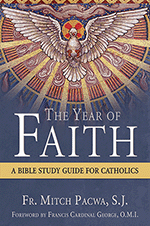
According to the OSV site:
Our society is struggling with what Pope Benedict has called "profound crisis of faith that has affected many people."
In response, the Holy Father has called us all to a Year of Faith from October 2012 to November 2013.
We see the signs all around us: the demand for science to prove everything before we can believe it, the role of media and celebrities who deny the existence of God and denounce the role of the Church, and the ease in which we can all isolate God and faith into only one part of our life.
In a follow-up to his best selling St. Paul Bible Study for Catholics during the year of St. Paul, Fr. Mitch Pacwa once again leads Catholics to a deeper understanding of Pope Benedict's call to action for the year.
Perfect for individual or group study, this book is a wonderful guide to experiencing a conversion, growing in faith, and following Jesus Christ more closely. It shows us how to integrate every component of our life – relationships, morality, work, recreation, and all – into a meaningful whole.
Make the most of Pope Benedict's Year of Faith, walking hand in hand with Fr. Pacwa as he guides you through the beauty and insights of Scripture in relationship to your everyday life.
Subscribe to:
Posts (Atom)